NSW RCD requirements: submit CCEWs via eCert by July 1, 2026
In New South Wales, RCDs (safety switches) must protect specified circuits under AS/NZS 3000, and workplaces must ensure regular testing with proper records kept on file. Homeowners and landlords face similar obligations wherever socket outlets and lighting circuits are involved. From 1 July 2026, electricians must submit Certificates of Compliance for Electrical Work through the BCNSW eCert portal. The safest move is straightforward: book a licensed electrician for an inspection and keep your CCEW on file.
TL;DR:
- RCDs are required in NSW for all new or upgraded circuits feeding outlets or light fittings, including in social housing and workplaces with damp or vibrating environments.
- Testing should be conducted every six months in high-risk settings, with more extended intervals acceptable for lower-risk locations, and a monthly test button check is recommended.
- Since May 2023, only Type A and Type B RCDs are allowed in new installations, replacing the now-banned Type AC devices to better detect pulsating DC faults.
- From July 2026, all electrical work must have CCEWs submitted through the BCNSW eCert portal within seven days, making proper recordkeeping essential for legal, insurance, and property transactions.
- Upgrading old switchboards with fuse wiring, missing test buttons, or signs of damage is vital, and should include issuing a CCEW and confirming work complies with current standards.
Table of Contents
- When RCDs are required in NSW: residential, rental and workplace rules
- RCD testing: who must test, how often, and what a competent test involves
- Standards and the Type AC ban: what changed and what it means for installations
- Recordkeeping and compliance: CCEWs, eCert submission and penalties
- When to upgrade your switchboard or add RCD protection
- Author’s practical note on NSW compliance
- What actually matters in NSW RCD compliance
- How High Demand Electrical helps you stay compliant
- Sources
When RCDs are required in NSW: residential, rental and workplace rules
RCD requirements in NSW hinge on a simple principle: if a circuit feeds a socket outlet or a light fitting, it almost certainly needs RCD protection. AS/NZS 3000 (the Wiring Rules) sets this out for every new or upgraded residential installation, and it’s the baseline every licensed electrician works from.
The rules shift slightly depending on who owns the property and who lives in it:
- New builds and any upgraded switchboard must have RCDs fitted to final subcircuits supplying socket outlets and lighting.
- Social housing under Homes NSW policy mandates RCD installation, and existing dwellings with multiple final subcircuits typically carry a minimum of two RCDs.
- Rental properties don’t have a blanket retrofit mandate, but landlords carry a general duty of care, and most agents now request an electrical safety inspection before a new tenancy starts.
- Workplaces must provide RCDs wherever plug‑in electrical equipment runs through socket outlets, particularly in environments with damp, dust or heavy vibration, according to SafeWork NSW.
Older homes are the grey area. If your switchboard hasn’t been touched since the 1980s, there’s a good chance it predates RCD protection entirely, and that’s worth acting on rather than assuming it’s “grandfathered” indefinitely.
RCD testing: who must test, how often, and what a competent test involves
Testing responsibility sits differently depending on where you are. In a workplace, SafeWork NSW requires a competent person to carry out testing and confirm the RCD is still doing its job, not just that the test button clicks. In a private home, there’s no equivalent legislated testing schedule, but Homes NSW dwellings and workplaces both treat testing as an ongoing obligation, not a one‑off box to tick.
There’s no single NSW‑wide mandatory interval for residential RCDs, but industry practice gives a useful benchmark: high‑risk workplaces commonly test safety switches every six months, while lower‑risk commercial and residential settings often stretch that out further. Treat six‑monthly as the safe default if your site involves damp conditions, portable equipment, or public foot traffic.
A competent test covers more than the trip button. It generally includes:
- Trip time and trip current at a defined threshold within a short time.
- Insulation resistance across the circuit.
- Continuity of protective earthing.
- Earth fault loop impedance.
- Polarity checks at outlets and switchboard terminals.
Pro Tip: Push the test button yourself once a month between professional checks. If it doesn’t trip cleanly, don’t wait for the next scheduled visit, call an electrician straight away.
Standards and the Type AC ban: what changed and what it means for installations
Since 1 May 2023, Type AC RCDs are no longer permitted in new installations anywhere in Australia, a change confirmed in the NSW Government’s advisory on RCD compliance. The reasoning is technical but important: modern electronics and switch‑mode power supplies often produce pulsating DC fault currents that a Type AC device simply can’t detect.
Two replacement types now dominate the market:
- Type A RCDs detect both standard AC faults and pulsating DC faults, and they’re the standard fit for most homes and general commercial circuits.
- Type B RCDs go further, covering smooth DC leakage as well, and they’re required on circuits with higher DC leakage risk, such as EV chargers and solar inverters.
Ask your electrician to specify the device type on the quote before work starts. It’s a one‑line question that avoids a non‑compliant installation.
Recordkeeping and compliance: CCEWs, eCert submission and penalties
A Certificate of Compliance for Electrical Work is the paper trail that proves the job was done to standard. It matters for insurance claims, for warranty disputes, and for property sales, where a buyer’s solicitor will often ask for it directly.
From 1 July 2026, electricians must submit CCEWs through the BCNSW eCert portal rather than handing over a paper or PDF copy. Key points to know:
- Submission should happen as soon as practical, and no later than seven days after testing is completed where that timeframe applies.
- A handwritten CCEW accepted after that date is not compliant, and you’re entitled to query it.
- Penalties apply for failing to submit, and for carrying out electrical work without the required certification at all.
Digital submission also cuts down on lost paperwork, which has historically been a headache for property owners chasing warranty claims years after the work was done.
When to upgrade your switchboard or add RCD protection
Some switchboards announce their problems loudly. Others fail quietly until something trips, or worse, doesn’t trip when it should.
Watch for these warning signs:
- Rewirable fuses (the ceramic kind with fuse wire) instead of modern circuit breakers.
- No visible test button anywhere on the board.
- Burning smells, discolouration, or a buzzing sound near the switchboard.
- Frequent nuisance trips that reset themselves without explanation.
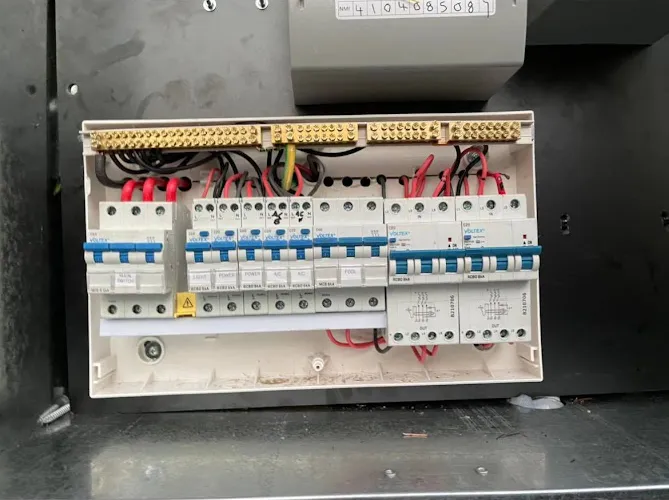
A typical switchboard upgrade replaces old fuse boards with DIN‑rail panels, adds RCDs or combined RCBOs, labels every circuit clearly, and often includes surge protection. Timeframes and costs vary by property size and existing wiring condition, so treat any online figure as a rough guide rather than a quote.
Pro Tip: Before booking, ask for the electrician’s licence number and confirm they’ll issue a CCEW via eCert. Keep a digital copy in your own files, not just theirs.
Author’s practical note on NSW compliance
Christopher works alongside High Demand Electrical’s Level 2 team, and the pattern across hundreds of NSW jobs is consistent: most non‑compliance isn’t deliberate corner‑cutting, it’s old work that was compliant when installed and simply hasn’t been revisited.
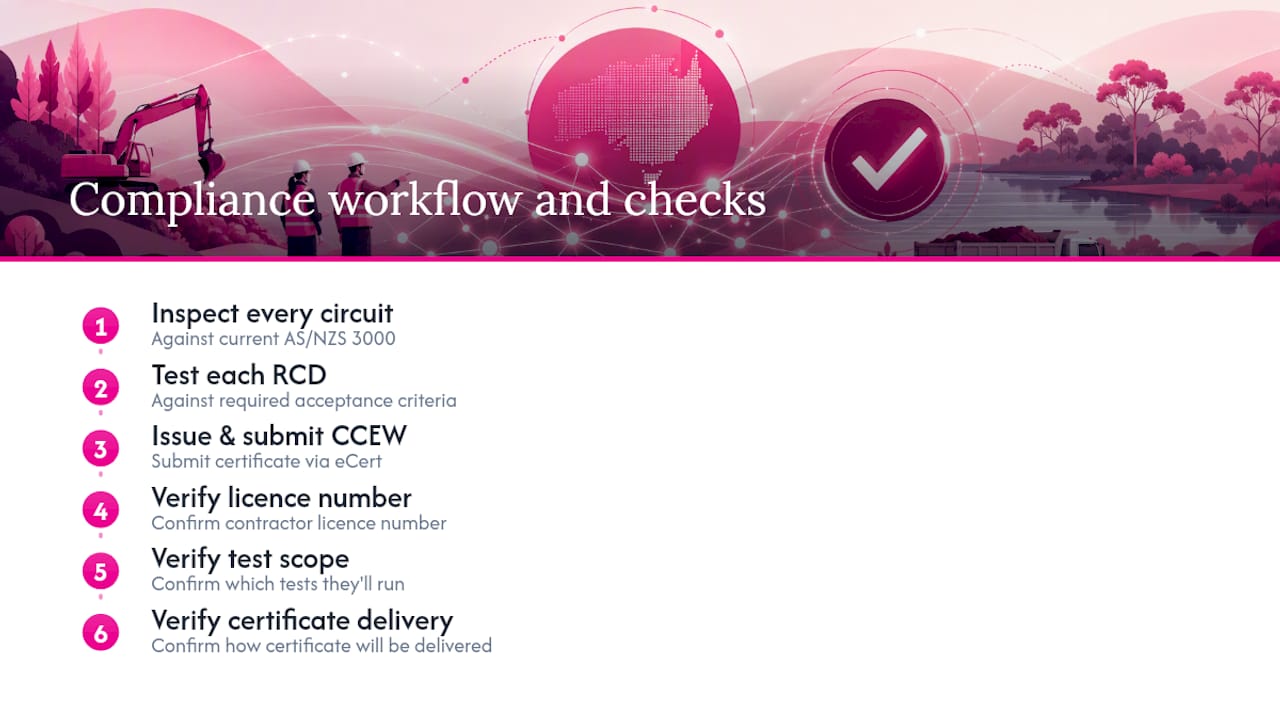
A proper inspection checks every circuit against current AS/NZS 3000 requirements, tests each RCD against the criteria above, and finishes with a CCEW submitted through eCert. Before booking anyone, confirm three things: their licence number, the specific tests they’ll run, and how they’ll deliver your certificate.
What actually matters in NSW RCD compliance
The conventional advice on RCDs treats testing as a formality, something you do once when the electrician leaves and never think about again. That’s backwards. An RCD that worked perfectly at installation can fail silently five years later, and nobody finds out until it doesn’t trip during an actual fault.
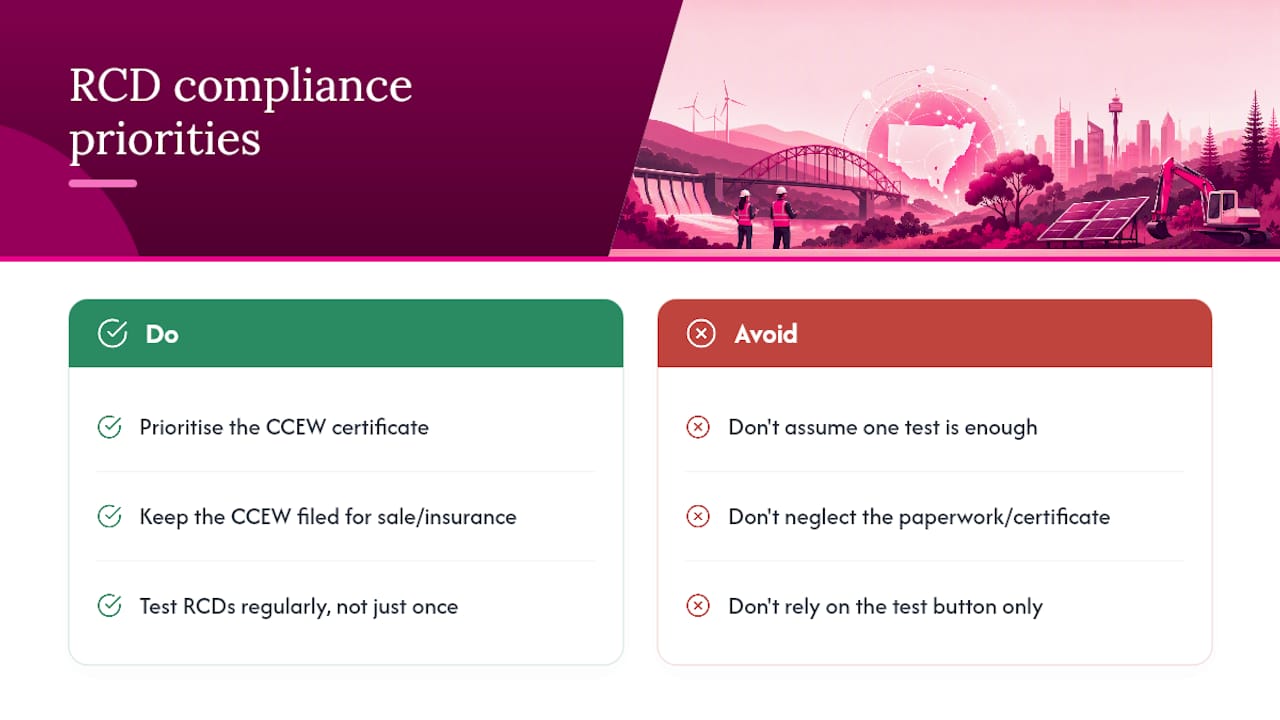
What gets underestimated is the paperwork side. Readers fixate on device types and testing intervals, reasonably, but the CCEW is what actually protects you legally and financially. Without it, you’ve got no proof the work happened to standard, and that becomes a real problem the moment you sell a property or lodge an insurance claim.
If you take one thing from this article, prioritise the certificate as much as the circuit. A compliant RCD with no CCEW on file leaves you exposed in ways a test button never will.
— Christopher
How High Demand Electrical helps you stay compliant
High Demand Electrical gets you a compliant switchboard without the guesswork of piecing together AS/NZS standards yourself. Our Level 2 electricians handle safety switch installation, switchboard upgrades, and full electrical safety inspections across Sydney, and every Level 2 job starts with a free site inspection so you know exactly what needs fixing before any work begins.

On the first visit, we check your existing RCD coverage against current standards, run the full test sequence, and confirm your licence and CCEW documentation on the spot. We handle the eCert submission ourselves, so you’re not left chasing paperwork after the job’s done. If your switchboard’s showing any of the warning signs above, or your last inspection predates the Type AC ban, book a Level 2 electrician today and get it sorted before it becomes a bigger problem. For urgent faults, our emergency electrician team is on call around the clock.
Sources
For legally binding detail, go straight to SafeWork NSW, the NSW Government’s RCD compliance advisory, Homes NSW policy, and BCNSW eCert requirements.
- Residual current devices | SafeWork NSW
- RCD Testing: How to Test and Requirements in Australia by State | RS Components
- Residual current devices policy | Homes NSW
Recommended
Related Services
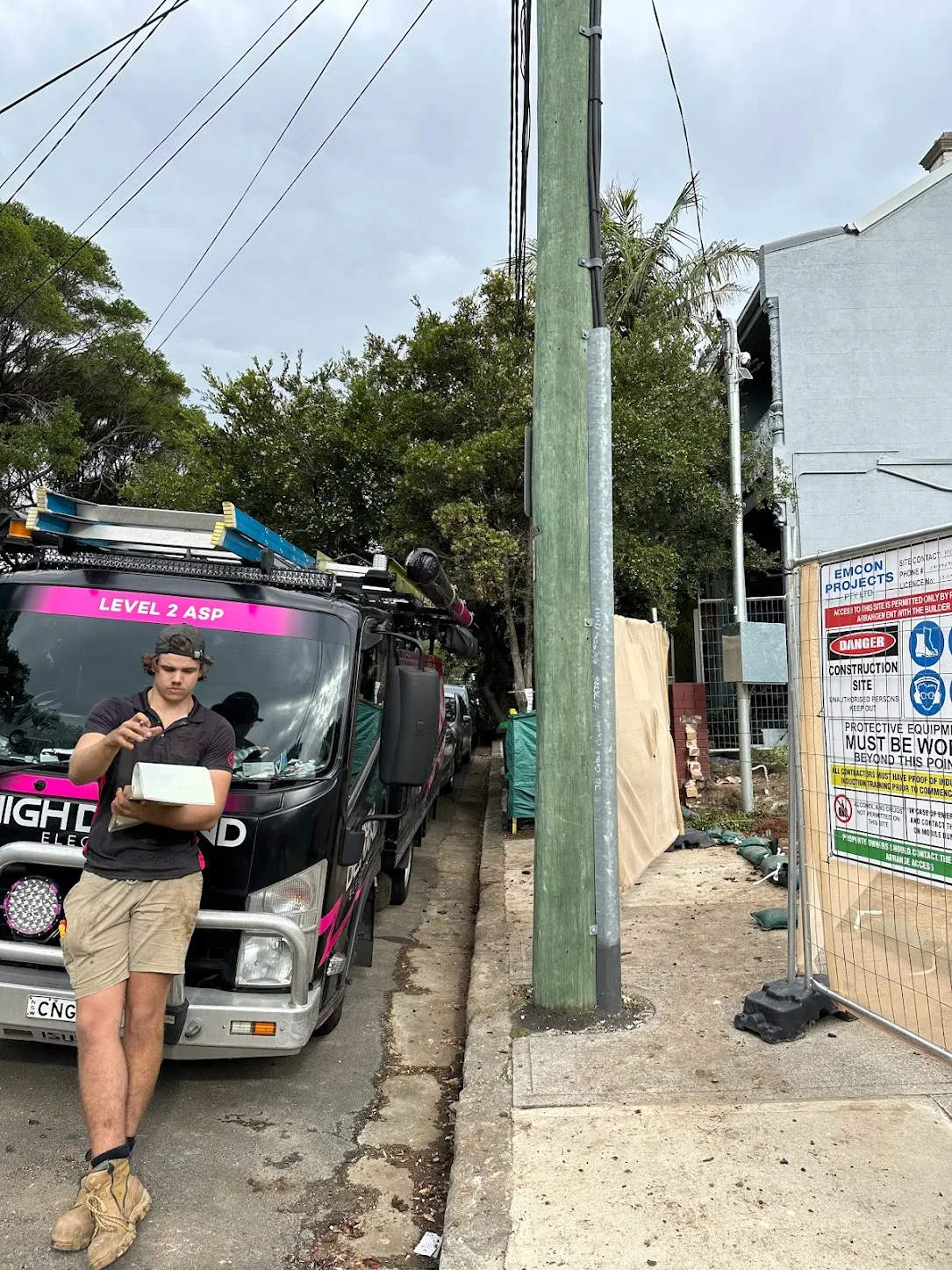
Powering Your Needs with Expertise
If you’re looking for a reliable, experienced, and prompt electrician, look no further than High Demand Electrical. We cater to all your electrical needs, from routine maintenance to emergency repairs and complete system installations. Our skilled team is committed to providing professional service that ensures your electrical systems run smoothly. Whether it's a small task or a large project, give us a call today. Let us meet all your electrical demands with the quality and reliability you deserve.