
Professional vs DIY EV Charger Installation: What Sydney Homeowners Need to Know
A fixed EV charger is not a weekend DIY wiring project. For Sydney homeowners weighing professional vs DIY EV charger installation, the key distinction is straightforward: you can prepare for the job, but electrical installation work must be carried out by a licensed electrician in NSW.
It’s understandable to wonder whether a charger can be mounted near the parking spot and connected to an existing outlet. Portable plug-in charging equipment is different from a fixed unit, which may need a dedicated circuit and an assessment of your switchboard, electrical supply and cable route. You can note where the car usually parks and where the switchboard is located, but leave wiring and electrical work to a licensed professional. Completed electrical work is documented with a Certificate of Compliance for Electrical Work (CCEW).
This guide compares safe homeowner preparation with work that requires a professional. You’ll see how single-phase and three-phase supplies, switchboard condition, property layout and network connections can affect an installation, and why some homes or small businesses may need additional electrical work. By the end, you’ll have a clearer next step for planning EV charger installation in Sydney.
Key Takeaways
• Understand the difference between portable plug-in charging equipment and a fixed EV charger, and why preparing the site is not the same as electrical installation work.
• Compare professional vs DIY EV charger installation by considering the work involved, site assessment, switchboard and electrical supply.
• Record the charger details and planned parking location. Note known switchboard or supply concerns without opening equipment or testing circuits.
• Learn how a single-phase or three-phase supply, property layout and network connection requirements can shape an installation plan.
• See how professional installation and a switchboard upgrade, if needed, can help move your Sydney home or small business towards a suitable charging setup.
Professional vs DIY EV charger installation: what is actually being compared?
The practical difference is between preparing the site and carrying out electrical installation work. A fixed EV charger is mounted in place and connected to the property’s electrical installation. Portable plug-in charging equipment, by contrast, connects to a suitable existing outlet. Although a fixed charger may look simple, installing it involves electrical work, not just attaching a unit to a wall.
For a general overview of charger formats and components, see EV charging station types and components. Here, professional vs DIY EV charger installation means comparing safe homeowner preparation with a professional’s assessment and electrical work. It is not a guide to DIY wiring, circuit changes or switchboard work. Nor can a general guide determine what a specific property needs.
| Area | Homeowner preparation | Professional installation |
|---|---|---|
| Scope | Gather details and prepare access. | Assess and complete the electrical installation. |
| Safety | Avoid opening equipment or testing circuits. | Carry out electrical work using appropriate professional processes. |
| Assessment | Share known property information. | Consider the electrical setup and project requirements. |
| Electrical work | None. | Completed by a licensed electrician. |
What can a homeowner safely prepare before installation?
Useful preparation helps make the installation discussion more focused. Record the charger make and model, note where the vehicle is usually parked, and identify the switchboard’s location. If you know of concerns with the switchboard or electricity supply, write them down. Don’t remove covers, inspect wiring or test circuits yourself.
Clear access to the parking area and identify your preferred mounting location. Consider whether the spot works for everyday use and how the cable would reach the vehicle. These are planning tasks, not electrical work. The final installation approach depends on the property assessment.
What does professional EV charger installation cover?
High Demand Electrical installs EV chargers for both single-phase and three-phase supplies. The right approach depends on the property’s electrical setup and the project requirements. A preferred charger location alone cannot establish what installation work is needed. If the existing switchboard needs attention, HDE also provides switchboard upgrades.
For Sydney properties where service line, metering or connection work is relevant, HDE is a Level 2 Accredited Service Provider (ASP), authorised to carry out service line, metering and connection work for Ausgrid, Endeavour Energy and Essential Energy. Find out about Level 2 electrical services in Sydney. To discuss EV charger installation, call 0402 559 777 or email chris@highdemandelectrical.com.au.
Why fixed EV charger electrical work is not a DIY shortcut
A fixed charger becomes part of the property’s electrical installation. Connecting one involves more than mounting hardware: the electrical supply, existing installation and proposed charger need to be considered together. A convenient-looking location does not show whether the electrical setup is suitable or what work may be required.
Homeowners can prepare the site, but electrical installation work belongs with a licensed electrician. That distinction is central to the professional vs DIY EV charger installation decision. Don’t open the switchboard, alter circuits or attempt wiring. Your role is to share useful property information and leave electrical assessment and installation to a professional.
In Australia, AS/NZS 3000, known as the Wiring Rules, and the NSW Service and Installation Rules (SIRNSW) are relevant frameworks for electrical installations and supply arrangements. Requirements depend on the work and the property, so this overview cannot replace an assessment of a specific installation. The US EPA also outlines general home EV charging considerations for homeowners, including electrical capacity and professional assistance. Its guidance is not a guide to NSW requirements.
How the switchboard and supply can affect the job
The switchboard and electrical supply matter because adding a charger adds electrical demand to the property. The existing arrangement may affect which installation approach is suitable, so an assessment needs to consider the charger alongside the property’s electrical setup. Homeowners shouldn’t try to judge capacity by inspecting equipment or testing circuits themselves.
If the project requires work on the existing switchboard, an upgrade may form part of the installation. The appropriate scope depends on the property, rather than a one-size-fits-all assumption. A switchboard upgrade guide for EV chargers can provide more context on how these considerations relate.
When network-side work may require a Level 2 ASP
Installing a charger at a property and working on the connection between that property and the electricity network are related but distinct tasks. Some projects may involve service line, metering or connection work. That does not mean every EV charger installation requires network-side work or a Level 2 ASP.
High Demand Electrical is a Level 2 Accredited Service Provider (ASP), authorised to carry out service line, metering and connection work for Ausgrid, Endeavour Energy and Essential Energy. This accreditation applies to that network work, not to every charger installation. For a Sydney property where the supply or connection is part of the project, an assessment helps establish the scope. Contact High Demand Electrical about EV charger installation.
DIY vs professional EV charger installation: compare the real trade-offs
The practical comparison is not between two ways to wire a charger. It is between homeowner preparation and professional electrical installation. Even a compact, straightforward-looking unit needs to suit the property’s electrical setup. Appearance alone cannot show whether the switchboard, supply or proposed location is suitable.
Use this comparison to decide what you can organise and what belongs in a professional assessment. It is not a wiring guide.
| Consideration | DIY preparation | Professional installation |
|---|---|---|
| Scope | Record charger details, parking location and known property information. | Assess the job and complete the electrical installation. |
| Site assessment | Identify preferred mounting locations and clear access. | Consider the location alongside the property’s electrical setup and project requirements. |
| Switchboard | Note known concerns without opening equipment. | Assess whether the existing arrangement needs attention. |
| Standards | Don’t attempt to judge or apply electrical requirements yourself. | Consider relevant installation requirements, including applicable frameworks. |
| Accountability | Provide accurate information about the site and charger. | Take responsibility for the electrical work within the installation scope. |
What a DIY approach can and cannot reasonably cover
Useful preparation is straightforward: gather the charger make and model, note where the car is usually parked, and identify your preferred charger location. You can clear access and share known information about the property, including any switchboard or supply concerns. These details help make a conversation about the installation more specific.
Keep the boundary clear. Wiring, circuit changes and switchboard work are not part of DIY preparation. Don’t remove covers, test circuits or try to determine electrical capacity. A mounting spot that seems convenient is a starting point, not proof that the installation is suitable.
What professional installation adds to the decision
A professional assessment connects the site details with the property’s electrical setup and the relevant requirements for the work. Preparation helps you explain your preferences; assessment helps establish what the project involves. The scope can differ between properties, even when the chargers look similar.
If the existing switchboard needs attention as part of the project, High Demand Electrical also provides switchboard upgrade services. This does not mean every home needs an upgrade. It recognises that the switchboard may be relevant to the overall installation plan.
For a Sydney home or small business, gather the charger and site information, then discuss the installation instead of attempting electrical work. You can discuss an EV charger installation with High Demand Electrical.
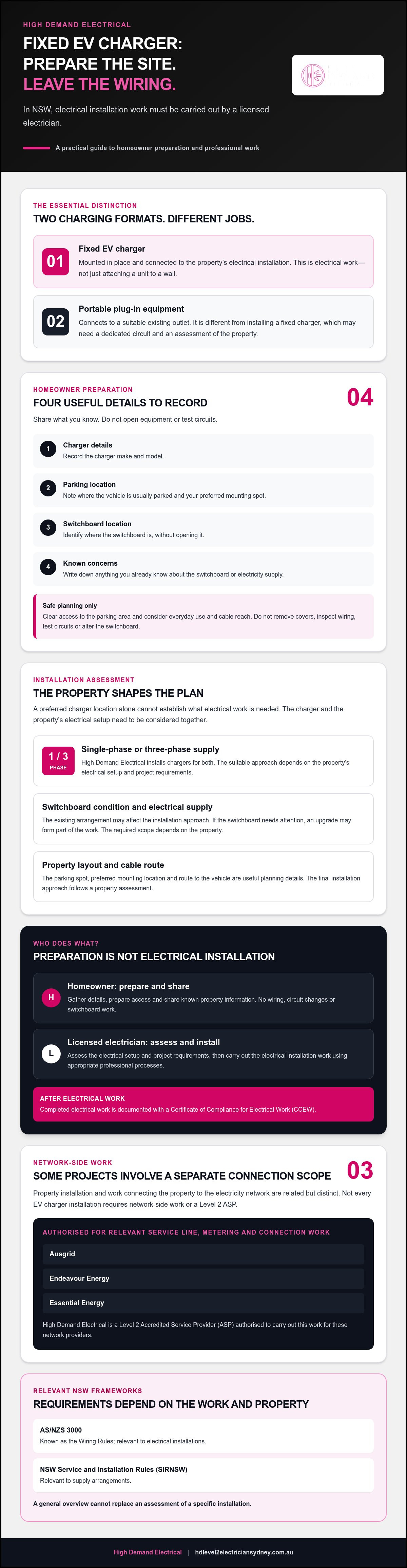
How to prepare for professional EV charger installation in Sydney
A little preparation can make an installation discussion more focused, but it cannot establish the work required. In the professional vs DIY EV charger installation decision, your role is to organise information about the charger and property. Leave the inspection of electrical equipment and all electrical work to a professional.
Charger details, parking location, property type and known supply concerns give an installer a useful starting point. Keep these notes together and describe concerns in plain language. There is no need to diagnose a problem or inspect electrical equipment yourself.
Information to have ready for an installation discussion
Gather the charger make and model, if selected, and note whether the property is a house, townhouse or small business premises. Identify where the vehicle is usually parked and the preferred mounting area. If the parking position varies, mention that too. These details explain how the charger will be used and where you would like it located.
• Charger make and model details, if available.
• Property type and the usual parking position.
• Preferred mounting area and any access considerations.
• Known changes to the electrical setup or concerns about the switchboard or supply.
For electrical history, plain descriptions are enough. You might mention that the switchboard has previously been upgraded or that you've been told the property has a supply concern. Don't remove covers, test circuits or try to confirm the details yourself. This information supports an assessment, but it does not determine the scope, quote or installation outcome.
When the installation involves broader electrical work
A charger installation may involve work beyond the charger itself if the property's switchboard or power supply needs attention. An assessment establishes whether related work, such as a switchboard upgrade, is relevant. It is not a given for every home. HDE installs EV chargers for single-phase and three-phase supplies and provides switchboard upgrades where required by the project.
Some projects may also involve work on the connection between the property and the electricity network. This is distinct from installing the charger and is not automatically required. High Demand Electrical is a Level 2 Accredited Service Provider (ASP), authorised to carry out service line, metering and connection work for Ausgrid, Endeavour Energy and Essential Energy. Where network-side work is relevant, its Sydney Level 2 electrician service applies to that scope, rather than ordinary charger installation alone.
HDE serves Sydney's Inner West, Sydney's West, South West and the Sutherland Shire. To discuss your property and plan a professional EV charger installation, contact High Demand Electrical. You can also call 0402 559 777 or email chris@highdemandelectrical.com.au.
Professional EV charger installation with High Demand Electrical
Once you’ve separated homeowner preparation from electrical installation work, plan around your property rather than guessing what it needs. High Demand Electrical (HDE) installs EV chargers for single-phase and three-phase supplies and provides switchboard upgrades when related work is needed. For Sydney homeowners and small businesses, this offers a practical way to move from considering a charger to discussing the electrical requirements of the site.
HDE’s credentials and Sydney service area
HDE is Engnet Pty Ltd trading as High Demand Electrical. Its electrical contractor licence is EC Licence 397193C, and its certifications are ISO 9001, ISO 45001, and ISO 14001. The business ABN is 87 051 836 527. These identifiers give specific information about the business and its credentials.
For network-side work, HDE is a Level 2 Accredited Service Provider (ASP), authorised to carry out service line, metering and connection work for Ausgrid, Endeavour Energy and Essential Energy. This accreditation relates to the specified network work; it does not mean every EV charger installation requires a Level 2 ASP. The charger installation and any associated work are considered in relation to the property and project.
HDE serves Sydney, including the Inner West, Sydney’s West, South West and the Sutherland Shire. Whether you plan to install a charger in a home garage, driveway or small-business parking area, the location and electrical setup help inform the installation scope.
Next steps for a home or small-business installation
To start a useful discussion, bring together a few details about the proposed installation. You don’t need to inspect electrical equipment or work out the technical requirements yourself. Share what you know and leave assessment of the electrical setup to the professional carrying out the work.
• The charger make and model, if you’ve selected one.
• The property location and the area where the vehicle is usually parked.
• Your preferred charger mounting area and any access considerations.
• Known switchboard or power supply concerns, described in plain language.
These details help explain the project, but they do not determine a fixed installation scope or outcome. Each site has its own electrical arrangements, and the work required depends on the property and its requirements.
For a practical next step, Contact High Demand Electrical to discuss EV charger installation for your Sydney home or small business. You can also call 0402 559 777 or email chris@highdemandelectrical.com.au. The installation scope depends on the property and its electrical requirements.
Take the next step towards home charging
Your next move does not need to be a technical decision. Start with how you expect to use the charger, where the vehicle is usually parked and what you want the setup to make easier. That gives the installation discussion a clear purpose, while an assessment can establish what electrical work is involved.
That’s the practical takeaway from professional vs DIY EV charger installation: focus on planning and leave electrical work to a professional. A considered starting point can make the project easier to discuss, whether you’re planning for a home or a small business.
Share your plans with High Demand Electrical and take the next step towards a charging setup suited to your property. Discuss your EV charger installation with High Demand Electrical.
With the right preparation and a professional assessment, you can move forward with a clearer understanding of the project.
Frequently Asked Questions
Can I install an EV charger myself in Sydney?
No. Fixed EV charger wiring must be carried out by a licensed electrician in NSW. You can help by organising the charger information, choosing a preferred parking and mounting location, and clearing access to the work area. These steps help explain what you want from the setup, but they do not include connecting, wiring or altering electrical equipment. That’s the key boundary in professional vs DIY EV charger installation.
Does every EV charger installation need a Level 2 ASP?
No. A Level 2 ASP is relevant if a project involves specified network-side work, such as service line, metering or connection work. It is not automatically needed for every charger installation within a property. A home installation with no network connection work may have a different scope from a project that includes changes to the property’s network connection. The proposed work and supply arrangements determine whether Level 2 ASP work is relevant.
Can High Demand Electrical install single-phase and three-phase EV chargers?
Yes. High Demand Electrical installs EV chargers for both single-phase and three-phase supplies. Which arrangement applies to your property is determined as part of the installation assessment, rather than inferred from the charger’s appearance or parking location. To discuss an EV charger project, call 0402 559 777 or email chris@highdemandelectrical.com.au. Sharing the charger details and property location can help frame the initial discussion.
Will my switchboard need an upgrade for an EV charger?
Not necessarily. Whether an upgrade is needed depends on the property’s existing electrical setup and the proposed installation requirements. A switchboard upgrade may be relevant if the assessment identifies work is needed, but it should not be assumed before the property is considered. You can mention any known switchboard history or concerns, such as a previous upgrade, without opening the switchboard or testing circuits yourself.
What does a Level 2 Accredited Service Provider do for an EV charger project?
A Level 2 ASP can carry out specified work on the service line, metering and connection between a property and the electricity network. High Demand Electrical is a Level 2 Accredited Service Provider (ASP), authorised to carry out service line, metering and connection work for Ausgrid, Endeavour Energy and Essential Energy. This accreditation applies to that network work; it does not mean every EV charger project needs a Level 2 ASP.
Which Sydney areas does High Demand Electrical service for EV charger installation?
High Demand Electrical services Sydney, including the Inner West, Sydney’s West, South West and the Sutherland Shire. If you’re planning an installation for a home or small business, have the property location, charger details and any known electrical concerns ready to discuss. The installation requirements depend on the property. For enquiries, call 0402 559 777 or email chris@highdemandelectrical.com.au.
Powering Your Needs with Expertise
If you’re looking for a reliable, experienced, and prompt electrician, look no further than High Demand Electrical. We cater to all your electrical needs, from routine maintenance to emergency repairs and complete system installations. Our skilled team is committed to providing professional service that ensures your electrical systems run smoothly. Whether it's a small task or a large project, give us a call today. Let us meet all your electrical demands with the quality and reliability you deserve.

