Private Power Pole Maintenance Requirements NSW: The Homeowner’s Safety Checklist
Your private power pole is more than just a utility fixture; it is a significant legal liability that remains your sole responsibility from the day it is installed. Many homeowners across Sydney and regional NSW mistakenly believe their network provider manages these assets, but failing to meet private power pole maintenance requirements NSW can result in a forced power disconnection or, in extreme cases, a catastrophic bushfire. Under the Electricity Supply (Safety and Network Management) Regulation 2014, the burden of safety and compliance rests entirely on your shoulders.
We understand the anxiety that comes with receiving a defect notice or worrying about the structural integrity of an ageing pole. It's frustrating to navigate complex ownership boundaries while facing a strict 30-day deadline to respond to network providers like Ausgrid or Endeavour Energy. This article provides the professional clarity you need to take control of your electrical infrastructure. You'll learn exactly what your legal obligations are, how to conduct a thorough self-inspection using our practical checklist, and when the law requires you to call in a Level 2 ASP electrician to rectify dangerous defects and secure your property's energy supply.
Key Takeaways
• Identify the 'Connection Point' to clearly understand where the network provider's liability ends and your legal maintenance responsibility begins.
• Learn the critical private power pole maintenance requirements NSW to spot early warning signs of structural failure, such as ground-line rot, rust, or excessive leaning.
• Navigate the complexities of the NSW Service and Installation Rules to ensure your overhead assets remain compliant with current safety and bushfire mitigation standards.
• Discover the mandatory steps for responding to Ausgrid or Endeavour Energy defect notices to prevent the risk of forced power disconnection.
• Understand why high-risk repairs on private poles must legally be performed by an accredited Level 2 ASP to maintain property safety and insurance validity.
What is a Private Power Pole and Who is Responsible?
A private power pole is any utility pole situated within your property boundary that supports the electrical lines connecting your premises to the street network. While it might look identical to the poles on the nature strip, its legal status is entirely different. In the eyes of the law, this pole is a private asset, much like your roof or your driveway. Understanding the private power pole maintenance requirements NSW begins with acknowledging that you, the property owner, are responsible for the structural integrity and electrical safety of this infrastructure.
The "Connection Point" rule defines the boundary of ownership. For most residential properties, the network provider, such as Ausgrid or Endeavour Energy, is responsible for the network up to the point where their service line meets your property. Beyond this physical junction, the responsibility shifts. This private asset includes not only the pole itself but also the overhead conductors, the crossarms that hold them in place, and all associated insulators and brackets. Neglecting these components can lead to catastrophic failure, yet many owners remain unaware of their liability until a defect notice arrives.
Identifying Your Connection Point
Locating your Point of Attachment (POA) is the first step in determining your maintenance scope. In established Sydney suburbs, this is often a bracket on the fascia of your house or a dedicated private pole near the front boundary. In semi-rural NSW areas, your connection point might be several poles deep into your property. You can often confirm your status by checking your electricity bill. If you see charges or notations regarding private assets or metering at the pole, you likely have significant ownership responsibilities.
The Legal Risks of Neglect
The NSW Electricity Supply Act mandates that homeowners maintain their electrical installations in a safe condition. If a neglected pole falls and causes a bushfire or property damage, you could be held personally liable for the resulting costs. Insurance companies frequently deny claims if they determine the cause was a failure to adhere to private power pole maintenance requirements NSW. To mitigate these risks, engaging an ASP Level 2 electrician is essential. These specialists are authorised to work on the network side of your meter, ensuring your private infrastructure meets the rigorous standards required to keep your power on and your liability low.
The Essential Private Power Pole Maintenance Checklist
Adhering to private power pole maintenance requirements NSW involves more than a cursory glance from your driveway. Because these assets are exposed to extreme weather, regular and methodical self-inspections are your first line of defence against defect notices and power failures. You should conduct a visual audit at least twice a year, ideally before the summer bushfire season and after significant storm events. If you notice any of these warning signs, it is critical to secure a professional assessment from a qualified technician immediately.
The Visual Lean Test
Stand back and view the pole from multiple angles. A pole that tilts more than five degrees or appears to move during high winds indicates compromised foundation stability.
Ground-Line Integrity
This is the most common point of failure. Look for signs of decay, rust, or soil erosion where the pole meets the earth.
Hardware and Fittings
Use binoculars to inspect the top of the pole. Look for cracked ceramic insulators, loose crossarms, or wires that appear frayed or scorched.
Vegetation Clearance
NSW safety standards mandate a minimum 2-metre clearance zone around all live overhead conductors. If branches are within this zone, they pose a high risk of arcing or fire.
Timber Pole Specific Hazards
Hardwood poles are susceptible to biological degradation that is often invisible from the surface. Look for fungal growth or "pole rot" at the soil level, which feels soft or spongy when poked with a screwdriver. Termite tracks, appearing as mud tunnels on the exterior, are a major red flag. You can also perform a "tap test" using a hammer; a healthy pole produces a solid ring, while a hollow or dull thud suggests internal structural decay. Bird damage, particularly from cockatoos or woodpeckers, can also create entry points for moisture that accelerates internal rot.
Steel Pole Maintenance Requirements
While galvanised steel poles are often more durable, they face unique challenges in Sydney's coastal environment. High salt content in the air can lead to "pitting" or deep corrosion, especially at the base where moisture gets trapped against the metal. Check that the protective galvanised coating remains intact and free from bubbling. It is also vital to ensure the pole cap is securely fitted. A missing or damaged cap allows rainwater to collect inside the hollow pole, causing internal corrosion that can lead to a sudden, catastrophic collapse without any external warning signs.
NSW Regulatory Standards for Private Assets
The regulatory landscape for electrical infrastructure in New South Wales is governed primarily by the NSW Service and Installation Rules. The April 2026 edition of this document serves as the mandatory standard for any asset connecting to the state's power grid. These rules aren't merely suggestions; they are enforceable requirements that dictate the height, strength, and placement of your private pole. While your pole may have been compliant when it was first installed, standards evolve. Newer private power pole maintenance requirements NSW often require older assets to be upgraded to meet modern safety benchmarks, particularly regarding structural load and insulation integrity.
In addition to state rules, all private overhead installations must adhere to AS/NZS 3000, commonly known as the Wiring Rules. This standard ensures that the conductors, crossarms, and insulators can withstand environmental stressors without posing a risk to the public. For properties located in designated bushfire-prone areas, the stakes are significantly higher. The Electricity Supply (Safety and Network Management) Regulation 2014, updated as of March 27, 2026, mandates stricter oversight in these zones. Only an accredited Level 2 ASP possesses the legal authority and technical equipment to certify that your private assets meet these high-voltage safety standards.
Mandatory Inspection Frequencies
While homeowners should perform basic visual checks every season, a professional inspection by an ASP Level 2 is recommended every five years for most residential properties. This interval ensures that internal decay or hidden electrical faults are identified before they trigger a defect notice. It's vital to keep a detailed log of these inspections and any subsequent repairs. In the event of a fire or structural failure, your insurance provider will likely demand evidence that you've adhered to all private power pole maintenance requirements NSW to process your claim.
Compliance with Local Network Providers
Compliance isn't a one-size-fits-all matter in the Sydney basin. Ausgrid and Endeavour Energy maintain slightly different technical requirements for assets on their respective networks. For instance, if you're undertaking renovations or scaffolding work near your lines, you must install 'Tiger Tails'—highly visible yellow and black pipes—to provide temporary mechanical protection and visual warning. Furthermore, if your pole is decades old, you may need to upgrade your consumer mains to a higher current-carrying capacity to safely support modern appliances and EV chargers without overheating the overhead lines.

Dealing with NSW Defect Notices (Ausgrid & Endeavour)
A 'Notice to Rectify' or 'Defect Notice' is an official legal document issued by your network distributor, such as Ausgrid or Endeavour Energy. This notice signifies that your infrastructure has failed to meet the mandatory private power pole maintenance requirements NSW. Common triggers for these notices include vegetation overgrowth within safety zones, dangerously low-hanging wires, or advanced structural decay at the pole's base. While the arrival of such a notice is a serious matter, it serves as a vital alert to prevent hazardous electrical incidents on your property.
Typically, for non-emergency repairs, homeowners are granted a 21-day window to rectify the issues listed. If the work isn't completed within this timeframe, the network provider has the legal authority to disconnect your power supply to maintain grid safety. In extreme cases where a pole poses an immediate 'danger to life', such as a snapped pole or exposed live conductors, emergency disconnections occur instantly. If you have received a notice, you must contact a Level 2 ASP immediately to arrange a site assessment and prevent a loss of service.
The Step-by-Step Rectification Process
Your first priority is to act quickly to avoid a forced disconnection. Once you receive the notice, you must engage an accredited Level 2 ASP who is authorised to work on the specific network in your area. Standard household electricians cannot legally perform these high-risk repairs. After the rectification work is finished, your electrician will submit a Certificate of Compliance (CCEW) to the network provider. This document officially confirms that the defect has been cleared and that your asset now complies with the private power pole maintenance requirements NSW.
Shared Easements and Neighbour Disputes
Complexities often arise when a private pole is located on your land but supports service lines for multiple neighbouring properties. Under current NSW regulations, the primary responsibility for the pole's structural integrity usually remains with the property owner where the pole is physically installed. This can lead to tension regarding shared maintenance costs. It's important to note that Ausgrid and Endeavour Energy do not mediate these neighbourly disputes. They require the asset to be safe regardless of who pays, so checking your property's title deeds for easement agreements is a necessary step before beginning repairs.
Why Professional Maintenance is the Only Safe Option
Attempting to manage private power pole maintenance requirements NSW through DIY methods or unlicensed contractors is a dangerous gamble with your life and property. High-voltage overhead lines carry enough current to cause fatal injuries without even making direct contact; electricity can arc across a significant distance in humid or stormy conditions. Standard electricians lack the specific accreditation to work on the network side of your meter, meaning they cannot legally isolate the power or replace the pole. Only an Authorised Service Provider (ASP) Level 2 has the legal standing and safety training to handle these high-risk assets.
A professional structural report offers a level of certainty that a visual check simply cannot provide. Technicians use specialised testing methods, such as ultrasonic assessments and bore-hole inspections, to determine the internal health of timber poles. This data allows for planned preventative replacement, which is invariably more cost-effective than an emergency call-out. If a pole collapses during a storm, you face the immediate costs of emergency repairs, potential property damage, and the stress of a prolonged power outage. Proactive maintenance ensures you stay in control of the timeline and the budget.
The Level 2 ASP Advantage
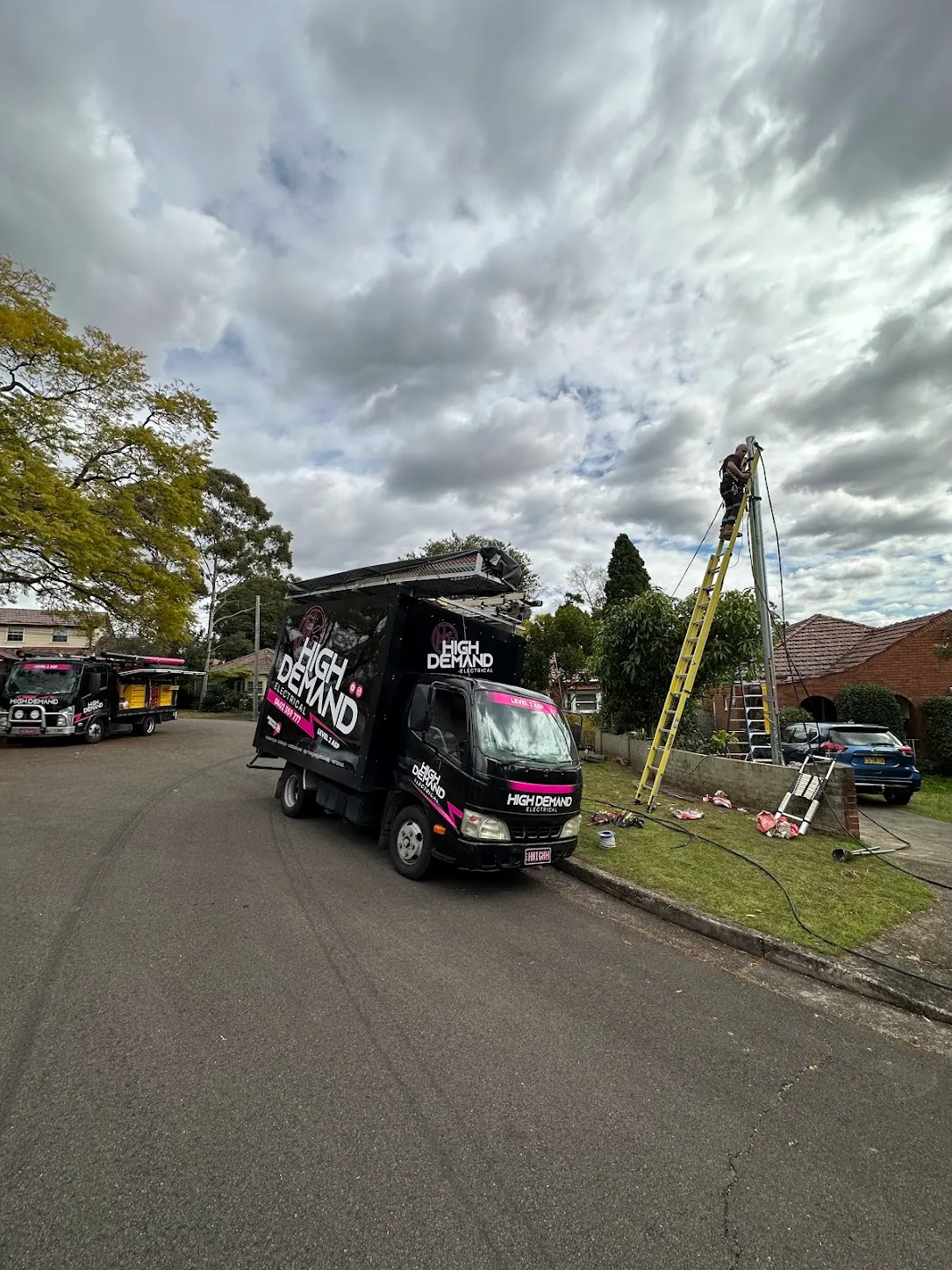
Our team utilises heavy-duty equipment that is essential for compliance, including insulated bucket trucks for safe height access and high-torque augers for deep-set installations. We are authorised to "break the seal" on network assets, allowing us to safely disconnect your property from the grid while we perform critical repairs. We also understand Sydney's unique geography. Whether your property sits on reactive clay or solid sandstone, we ensure your pole's foundation meets the exact depth and stability standards required by local network distributors.
Beyond ground-based equipment, aerial technology is increasingly used to assess insulators and crossarms without the need for immediate physical climbing. For insights into the safety standards and airspace regulations that govern these advanced inspection methods, Caswell Aviation Ltd provides an expert overview of drone operations in controlled airspace.
Next Steps for Sydney Homeowners
Don't wait for a defect notice or a summer storm to reveal a hidden fault in your electrical system. Booking a professional safety audit before the peak storm season is the most effective way to protect your home and ensure you meet all private power pole maintenance requirements NSW. High Demand Electrical manages the entire rectification process, from the initial assessment to the final submission of compliance paperwork to Ausgrid or Endeavour Energy. Secure your property's safety by contacting us today for a private power pole inspection. We provide the technical expertise and rapid response needed to keep your lights on and your family safe.
Secure Your Power Supply and Legal Compliance
Managing your electrical infrastructure doesn't have to be a source of constant anxiety. By identifying your connection point and performing regular visual checks, you've already taken the first steps toward securing your home. Adhering to private power pole maintenance requirements NSW is a continuous legal obligation that protects you from liability and ensures your property remains connected to the grid. Don't let a minor defect escalate into an emergency disconnection or a safety hazard during the next storm season.
If you've received a notice from Ausgrid or Endeavour Energy, or if you're concerned about the age of your pole, expert help is available. Our accredited Level 2 ASP specialists provide a fast response for defect notice rectifications across all of Greater Sydney, ensuring your repairs meet every regulatory benchmark. Get your private power pole inspected by a Sydney Level 2 ASP expert today to ensure your assets are fully compliant and structurally sound. Professional oversight is the most reliable way to maintain your peace of mind and your power supply.
Frequently Asked Questions
How do I know if a power pole on my property is private or belongs to the network?
Ownership is determined by the "Connection Point" where the network provider's service line meets your property infrastructure. If a pole is located within your property boundary and exclusively supports the lines feeding your premises, it is almost certainly a private asset. You can often confirm this by reviewing your electricity bill for "private asset" notations or by checking if the pole is positioned after the first junction from the street network.
What are the most common defects found on private power poles in NSW?
The most frequent issues identified during inspections include inadequate vegetation clearance, ground-line rot in timber poles, and significant corrosion in steel assets. Network providers often issue notices for "low conductors" where wires have sagged below mandatory height clearances or for cracked insulators that pose a fire risk. Failure to address these issues promptly means you aren't meeting the private power pole maintenance requirements NSW, which can lead to immediate supply intervention.
Can I trim trees near my private powerlines myself?
No, you should never attempt to trim vegetation near live overhead powerlines yourself. NSW safety regulations require a minimum two-metre clearance zone, and working within this space carries an extreme risk of electrocution or arcing. Only qualified arborists or Level 2 ASP electricians with the correct high-voltage training and insulated equipment should manage trees near electrical infrastructure to ensure the work is performed safely and legally.
How much does it typically cost to replace a private power pole in Sydney?
The total investment for a replacement varies significantly based on the pole material, site accessibility, and the complexity of the electrical reconnection. Galvanised steel poles generally offer a different price point compared to hardwood timber, and costs will fluctuate depending on whether you require new consumer mains or crossarm upgrades. While we don't provide fixed quotes without a site audit, a planned replacement is always more cost-effective than an emergency call-out following a structural collapse.
What happens if I ignore a defect notice from Ausgrid or Endeavour Energy?
Ignoring a defect notice will inevitably lead to the disconnection of your electricity supply. Network providers typically allow 21 to 60 days for rectifications, depending on the severity of the fault, but they have the legal authority to cut power immediately if they deem the asset a "danger to life." Beyond the loss of power, you also face massive legal liability and potential insurance rejection if an unmaintained pole causes a fire or injury.
Are steel power poles better than timber poles for NSW properties?
Steel poles are often preferred for modern installations because they are immune to termite damage and do not suffer from internal rot like timber. While timber is a traditional choice, it requires more frequent "tap tests" and ground-line inspections to ensure structural integrity. However, in coastal Sydney suburbs, galvanised steel must be monitored for salt-air corrosion to ensure the protective coating remains intact and prevents pitting at the base.
How often should a private power pole be professionally inspected?
You should arrange a professional inspection by an ASP Level 2 electrician at least every five years. This technical audit goes far beyond a simple visual check, using specialised tools to identify hidden decay or electrical faults. In addition to these professional reviews, homeowners should perform their own visual inspections twice a year, specifically before the summer bushfire season and after any major East Coast Low storm events.
Does insurance cover the cost of replacing a fallen private power pole?
Most home insurance policies will not cover the replacement of a pole that has failed due to wear and tear or lack of maintenance. Insurance is designed for sudden, accidental events, not for assets that have collapsed because the owner failed to meet private power pole maintenance requirements NSW. If an investigation proves the pole was rotten or termite-infested prior to falling, your claim for both the pole and any resulting property damage may be denied.
Powering Your Needs with Expertise
If you’re looking for a reliable, experienced, and prompt electrician, look no further than High Demand Electrical. We cater to all your electrical needs, from routine maintenance to emergency repairs and complete system installations. Our skilled team is committed to providing professional service that ensures your electrical systems run smoothly. Whether it's a small task or a large project, give us a call today. Let us meet all your electrical demands with the quality and reliability you deserve.