
Neutral Link Overheating: Switch Off, Then Call an Electrician
An overheating neutral link means a high-resistance connection or excessive current at a termination point, and the correct response is to switch off the affected circuit and call a licensed electrician straight away. We assess these faults against AS/NZS 3000 wiring rules and relevant safety office guidance, and when the issue involves metering or the service neutral, the job needs a Level 2 electrician like our team at High Demand Electrical.
TL;DR:
- Loose or corroded terminations are common, but shared neutrals, undersized conductors, unbalanced loads, and solar or LED harmonics can also raise neutral current.
- Flickering lights, burning odors, discolored covers, or tingling appliance casings can signal a fault, and breakers and RCDs may not detect neutral resistance heating.
- Isolate the circuit if safe, switch off the main if the board is hot, and call an electrician; do not touch warm components.
- Thermal imaging, impedance testing, and load logging can reveal faults that a visual check or single current reading misses, especially where solar equipment creates harmonics.
- Work on the meter, consumer mains, or service neutral falls under Level 2 scope, so a standard electrical license is not sufficient.
Table of Contents
- Common causes of neutral link overheating
- Why an overheated neutral is dangerous
- Immediate warning signs and first actions
- How electricians diagnose an overheating neutral
- Prevention and maintenance: how to stop neutral links overheating
- How a licensed Level 2 electrician resolves an overheated neutral
- Why early inspection beats emergency repairs
- Book an inspection or emergency callout with High Demand Electrical
- FAQ
- Sources
Common causes of neutral link overheating
A hot neutral link rarely has one simple explanation. Most cases we see trace back to a handful of recurring mechanical and electrical faults, often working together.
Loose or corroded terminations are the most frequent culprit. A termination that was torqued correctly on installation day can loosen over years of thermal cycling: the conductor expands when hot and contracts when it cools, and that constant movement breaks down the gas-tight seal between metal surfaces. Once that seal degrades, resistance climbs and the joint starts generating heat under completely normal loads.
Excessive neutral current is the second major cause. Shared neutrals across multiple circuits, overloaded circuits, or unbalanced loads across the phases of a single-phase supply can all push more current through a neutral than it was ever sized to carry.
Undersized neutral conductors compound the problem in older installations. A business case filed with the Australian Energy Regulator identifies a substantial length of undersized neutral conductors across a distribution network and recommends targeted replacement in high-risk areas to cut safety and reliability risks. Where a network operator has flagged a street or feeder for this kind of work, a hot neutral at a nearby property may reflect a supply-side issue rather than a fault inside the home.
Harmonics are an increasingly common driver in modern installations. Non-linear loads such as solar inverters, switch-mode power supplies and LED drivers generate triplen harmonics that do not cancel out in a three-phase four-wire system the way normal balanced currents do. Standards Australia’s wiring rules project notes that these harmonics can add together in the neutral conductor, sometimes pushing neutral current higher than the current on any individual phase.
Environmental damage and poor workmanship round out the list of usual suspects:
- Moisture ingress and corrosion at switchboard terminals, particularly in older or poorly sealed enclosures.
- Incorrect terminal arrangement, where a neutral bar lacks separate terminals for each final sub-circuit.
- Poor labelling that leaves neutrals mismatched against their actives, making faults harder to isolate and diagnose.
Energy Safe Victoria’s guidance on switchboard defects lists exactly these terminal arrangement and marking issues as defects regulators repeatedly find during inspections.
Why an overheated neutral is dangerous
A hot neutral is not a cosmetic nuisance. It sits at the centre of several safety risks that compound quickly if the fault is left alone.
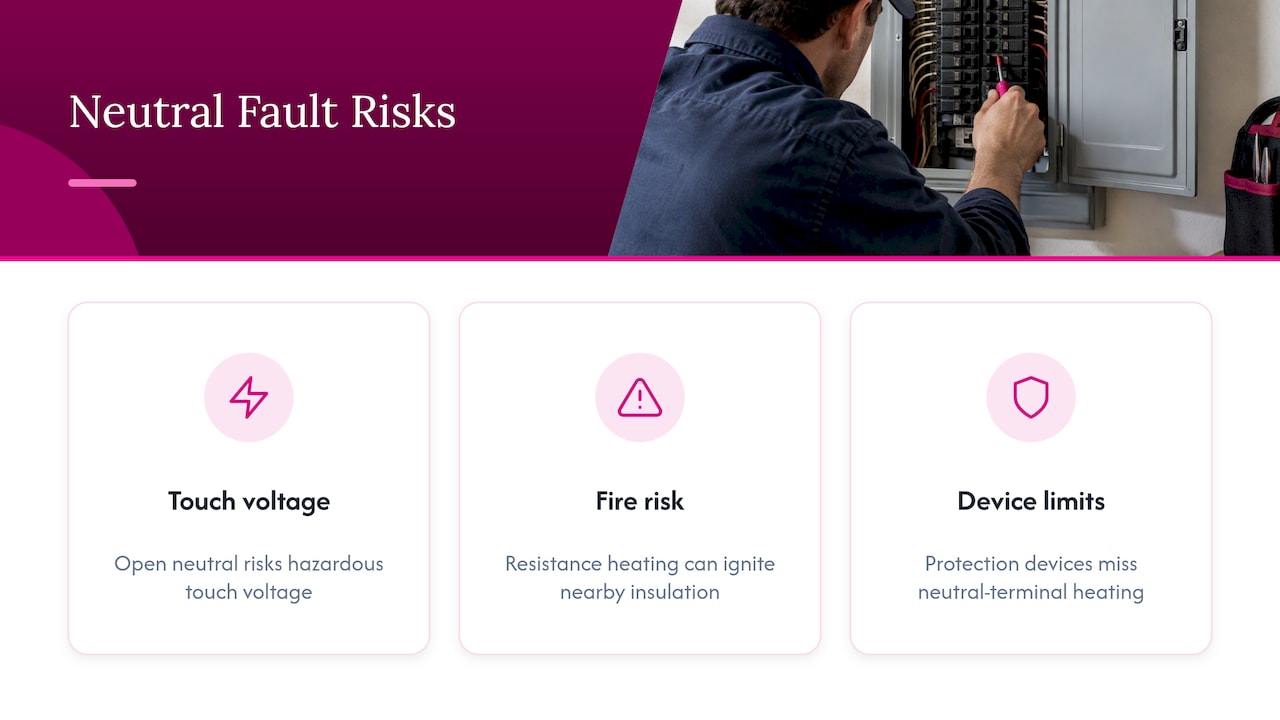
The most serious is hazardous touch voltage. If a neutral becomes high-impedance or opens completely on a shared or multi-phase circuit, appliances on the lighter-loaded leg can see voltage rise well above their rated supply, while others see it drop. That imbalance can destroy sensitive electronics in seconds and, in the wrong circumstances, puts a dangerous voltage onto exposed metalwork that a person could touch.
Fire risk follows closely behind. A high-resistance joint generates heat exactly where insulation, dust and switchboard components are packed closest together. Melted insulation, scorched terminals and, in the worst cases, a switchboard fire are the end point of a fault that started as nothing more than a slightly loose screw.
It helps to understand why standard protective devices do not catch this early. Circuit breakers and fuses respond to overcurrent on active conductors, and RCDs respond to current leaking to earth. Neither device is designed to detect resistance heating at a neutral terminal, as Safe Work Australia’s guidance on managing electrical risks makes clear: these devices reduce shock risk from earth faults, but they do nothing to stop a neutral joint from quietly heating until it fails.
In three-phase settings the consequences spread further. A failing neutral can cause voltage imbalance across all three phases, visible as persistent flicker, and that imbalance can shorten the life of motors, compressors and other connected equipment well before anyone notices the switchboard is hot.
Immediate warning signs and first actions
Catching a neutral fault early almost always comes down to recognising a small number of physical symptoms.
Watch for these signs around a switchboard or power point:
- A burning or hot plastic odour near the switchboard or a specific power outlet.
- Visible discolouration, browning or warping of a switchboard cover, socket or plug.
- Lights that flicker, dim or brighten without an obvious cause, especially across multiple circuits.
- A tingling or mild shock sensation when touching an appliance casing or switch plate.
If you notice any of these, work through the following steps in order:
- Isolate the affected circuit at the switchboard if you can do so without touching any warm or discoloured components.
- Switch off the main switch if the smell, heat or discolouration is at the switchboard itself rather than a single circuit.
- Unplug portable appliances on the affected circuit to remove load while you wait for help.
- Call a licensed electrician immediately, noting what you observed and when it started.
Never touch a warm switchboard component, attempt to re-tighten a terminal while it is live, or reset a breaker that has tripped repeatedly without explanation. Work on the meter or the service neutral specifically requires a Level 2 electrician, because that section of the installation belongs to the network rather than the household wiring.
Pro Tip: Photograph any discolouration or damage before you isolate the circuit. It gives your electrician a clearer starting point and a record for insurance purposes.
How electricians diagnose an overheating neutral
A proper diagnosis goes well beyond a visual check, because the terminal that looks fine to the eye is often the one running hottest under load.
Our technicians typically work through several layers of testing:
- Thermal imaging finds hot terminals and conductors without touching live parts, letting us prioritise exactly which joints need attention first.
- Torque and terminal inspection confirms whether a screw that looks tight is actually delivering a gas-tight connection, since thermal cycling and microscopic oxidation can raise resistance at a joint that passes a visual check.
- Continuity and impedance testing of the neutral path, along with earth/neutral integrity checks, rules out a partial break further along the circuit.
- Load logging and harmonic analysis record how current behaves over hours or days, picking up triplen harmonics from solar inverters and other non-linear loads that a single snapshot reading would miss.
Standards Australia treats a hot neutral as a signal worth investigating systemically rather than assuming it is always a single loose screw, particularly in homes with solar export or a high density of switch-mode devices.
Where the fault sits at the meter, the consumer mains, or anywhere between the switchboard and the point of supply, the work falls under Level 2 scope and requires accreditation that goes beyond a standard electrical licence. Our Level 2 electrician service covers exactly this boundary, and NT WorkSafe’s guidance on switchboard and meter box work sets out why due diligence on neutral and earthing integrity matters whenever that boundary is crossed.
Prevention and maintenance: how to stop neutral links overheating
Most neutral faults we attend could have been caught months earlier with a routine check using properly maintained insulated tools for electricians to ensure safe and accurate work. A handful of straightforward habits make the difference.
- Schedule periodic safety inspections and torque checks on switchboard terminals, since thermal cycling loosens connections gradually and invisibly.
- Mark neutrals to correspond with their actives and ensure each final sub-circuit has its own terminal, addressing the defect pattern regulators flag most often.
- Upgrade undersized neutrals or consumer mains where a load assessment or distributor advice recommends it, rather than waiting for a failure.
- Plan for harmonic mitigation and phase balancing before adding solar, an EV charger or other large switch-mode loads, since these are exactly the additions that push triplen harmonics higher.
- Keep the switchboard dry and clearly labelled, and test RCDs and breakers on schedule while understanding that these devices protect against earth leakage and overcurrent, not neutral terminal resistance.
- Keep records of every inspection and remedial job, which matters for both ongoing safety tracking and insurance purposes.
Pro Tip: If your home has solar panels, an EV charger and several large appliances on switch-mode power supplies, ask for a load and harmonic check at your next inspection rather than waiting for warning signs to appear.
A switchboard upgrade is often the most efficient way to address several of these issues at once, particularly in older boards where terminal arrangement, labelling and conductor sizing all fall short of current expectations.
How a licensed Level 2 electrician resolves an overheated neutral
When we attend a hot neutral callout, the process follows a consistent sequence designed to isolate the fault safely before any repair begins.
A typical job looks like this:
- Arrival and immediate safety isolation of the affected circuit or main, confirmed before any physical inspection begins.
- A thermal scan of the switchboard and relevant terminals to confirm exactly where the heat is concentrated.
- Continuity, impedance and load testing to establish whether the fault is a loose termination, an undersized conductor or a harmonic-driven overload.
- Re-termination, terminal replacement, or conductor upgrade depending on what the testing shows.
- Verification testing once the repair is complete, followed by a written safety report.
Work on the meter, consumer mains or service neutral sits squarely within Level 2 scope, and that is where our accreditation as a Level 2 ASP contractor applies. We offer site inspections for Level 2 work, which give you a clear picture of what the job involves and a quote before anything is scheduled. Our team operates 24/7, so a hot neutral discovered at any time receives prompt attention. Our electrical repairs service covers the re-termination and conductor replacement work that most neutral faults ultimately need.
Why early inspection beats emergency repairs
In my own experience walking through switchboards across Sydney, the same defects turn up again and again: neutrals sharing a terminal that should have been split years ago, screws that were never re-torqued after the original install, a board that has quietly absorbed a solar inverter and an EV charger without anyone checking what that does to the neutral current. None of these are dramatic faults. They are slow ones, and that is exactly why a periodic inspection catches them cheaply while an emergency callout catches them expensively, often after something has already melted. If you notice a warning sign, do not wait for a second one. Call an accredited electrician the first time.
— Christopher
Book an inspection or emergency callout with High Demand Electrical
A hot neutral link is not a fault to monitor and hope improves. If you have switched off the affected circuit and are waiting on next steps, we can take it from there.

We cover the full pathway from first symptom to signed-off repair: an electrical safety inspection to find the fault, an emergency electrician callout if the switchboard is already showing heat or odour right now, and switchboard upgrades or Level 2 work where the meter or consumer mains need attention.
- Site inspection for Level 2 work, so you know the scope before committing to a quote.
- Emergency availability.
- Accredited Level 2 electricians for metering and service mains work.
Get in touch through our Level 2 electrician page to book an inspection or arrange an emergency callout today.
FAQ
Why would a neutral wire overheat?
A neutral wire overheats when a termination develops high resistance, usually from a loose or corroded connection, or when it carries more current than it was sized for. Shared neutrals, unbalanced loads and harmonics from solar inverters or switch-mode devices are common contributing factors.
What does it mean if your neutral wire is hot?
A hot neutral wire usually means a high-resistance joint is generating heat under normal load, which can progress to insulation damage or fire if left unaddressed. It can also point to excessive current from an undersized or shared neutral conductor, so isolating the circuit and calling an electrician is the safest immediate step.
How to prevent neutral conductors from overheating?
Regular torque checks and safety inspections catch loosening terminations before they generate heat, and correct neutral labelling and separate terminals for each sub-circuit prevent the installation defects regulators flag most often. Planning for harmonic mitigation when adding solar or EV charging also reduces the risk in modern homes.
How to fix a hot neutral wire?
Fixing a hot neutral typically involves thermal imaging to locate the fault, testing to confirm whether it is a loose termination or an undersized conductor, then re-terminating or replacing the affected conductor followed by verification testing. Work on the meter or service neutral requires a Level 2 electrician rather than a standard electrical licence.
Sources
Powering Your Needs with Expertise
If you’re looking for a reliable, experienced, and prompt electrician, look no further than High Demand Electrical. We cater to all your electrical needs, from routine maintenance to emergency repairs and complete system installations. Our skilled team is committed to providing professional service that ensures your electrical systems run smoothly. Whether it's a small task or a large project, give us a call today. Let us meet all your electrical demands with the quality and reliability you deserve.

