Load management for EV chargers: a guide for property managers
Load management lets you add and run multiple EV chargers safely on the same electrical service by splitting or dynamically allocating available power, often avoiding an immediate mains upgrade. There are two flavours: static, which locks in fixed limits per charger, and dynamic, which measures real load and reallocates capacity in real time. For most sites with two or more chargers planned, dynamic load management is the better starting point.
The verdict: don’t jump straight to a service upgrade before you’ve had a proper load calculation done.
Book a site audit with a licensed Level 2 electrician before committing to hardware. It’s the cheapest step in the whole process and the one most people skip.
Key Takeaways
Dynamic load management measures real-time site load and reallocates power to chargers within seconds, letting most sites add multiple EV chargers without an immediate mains upgrade.
PointDetailsStatic vs dynamicStatic sets fixed limits per charger; dynamic measures live load and reallocates capacity in real time.Response speed mattersDynamic systems typically react to changing load in under 20 to 30 seconds, protecting the main fuse.Upgrades are sometimes unavoidableFleets, high baseline loads, or old 60 to 100 amp services often still need a panel or service upgrade.Protocol choice affects flexibilityOCPP 1.6 is widely supported; OCPP 2.0.1 and 2.1 add smart charging and DER control for future proofing.Start with a proper auditHigh Demand Electrical offers free site inspections and an EV Charger Load Calculator before any hardware spend.
Table of Contents
How does load management ev charger technology actually work?
Static load management is the blunt instrument. An electrician calculates how much spare capacity the switchboard has, divides it by the number of chargers, and sets a fixed amperage cap on each one. No sensors, no software, no real-time adjustment. It’s cheap, reliable, and appropriate for a duplex or a small strata block with two bays, but it wastes capacity because it assumes every charger is drawing maximum current at once, which rarely happens.
Dynamic load management is closer to a nervous system than a fuse box. A current transformer (CT clamp) or a site meter continuously measures total building load. A controller compares that reading against the main fuse rating, works out the spare “pool” of capacity, and pushes updated limits to every connected charger. Enphase’s documentation on dynamic balancing notes that these systems typically react to changing household load in under 20 to 30 seconds, which is fast enough to stop a kettle and an EV charger from tripping the main breaker together.
Three-phase sites add a layer of complexity. Loads rarely balance evenly across all three phases, so a good controller does phase mapping, allocating chargers to whichever phase has the most headroom, and some systems can phase switch a charger mid-session to chase spare capacity.
Pro Tip: Ask your installer what the fallback behaviour is if the meter or gateway drops out. A properly configured system should default to a low, safe amperage, not full power, until communication is restored.
Why choose load management over a power upgrade?
The single biggest reason to choose load management is cost avoidance. A mains or switchboard upgrade can mean trenching, new supply agreements with the network operator, and weeks of lead time. Load management sidesteps that by keeping total draw under the existing main fuse rating, throttling chargers rather than upgrading the service.
It also scales better than most people expect. Because EVs rarely charge at full draw simultaneously, dynamic systems can host far more chargers on the same supply than a static split would allow, sometimes dozens of ports on a single fuse where static allocation would only support a handful.
The trade-off is speed. Under heavy concurrent demand, sessions slow down; a car that would normally finish charging overnight might need a longer window. Set that expectation with residents or fleet drivers up front.
If you’ve got a home battery, ask your electrician to wire the system so the battery can’t discharge into the car. It sounds efficient in theory, but it burns through battery cycles for no real benefit when grid power is cheaper or the sun is already doing the work.
When do you still need a service or panel upgrade?
Load management is a bridge, not a permanent fix for every site. Some buildings genuinely need more capacity, no amount of clever software changes that.
If your measured baseline consumption is already within a small margin of your main fuse capacity, load management buys you very little room to move. A power supply upgrade becomes the honest answer, and it’s worth budgeting for lead times with your network operator rather than discovering the constraint mid-installation.
What hardware and protocols should you specify?
Getting the components right up front saves you from a costly retrofit later. Three pieces do the heavy lifting: a CT clamp or site meter for measurement, a controller that calculates available capacity, and charger firmware that can actually receive and act on updated limits.
OCPP 1.6 remains the most widely supported version, but OCPP 2.0.1 and 2.1 add smart charging profiles and distributed energy resource control, worth asking about if you want to future-proof against solar and battery integration down the track. Also ask about phase mapping and phase switching, and confirm the fail-safe limit; some systems drop to as low as 8 amps if the gateway loses connection, which is a sensible default rather than a fault.
What should an installer check before retrofitting?
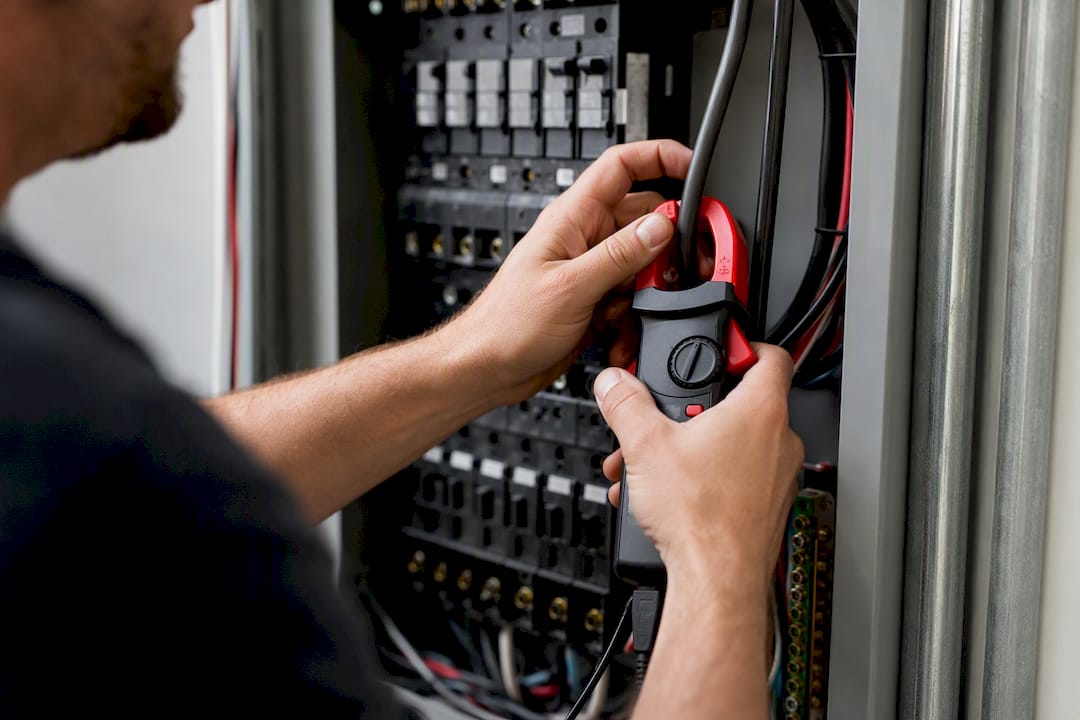
A proper retrofit starts with measurement, not guesswork. Any competent Level 2 electrician will want to see your main fuse rating, a measured load curve over a representative period (not just a single reading), and confirmation of how many phases feed the site.
For strata buildings, loop in the owners corporation early. Coordinating access, agreeing on cost allocation between lots, and sometimes notifying the network operator all take longer than the physical installation itself. Our apartment and strata EV charger installation guidance covers the coordination side in more detail.
Pro Tip: Get your baseline load measured across a full week, including a weekend, before any quote is finalised. A single weekday reading can hide the exact peak that determines whether load management alone will cut it.
How can a Level 2 electrician help with your load management project?
A certified Level 2 electrician is the right person to size this correctly, because miscalculating available capacity is a safety issue, not just an inconvenience. High Demand Electrical offers free site inspections for Level 2 work, giving you an accurate read on your switchboard, phase configuration and baseline load before you spend a dollar on hardware.
Before your appointment, have your meter details, a rough daily charging schedule, and your parking layout ready. Run the EV Charger Load Calculator beforehand if you want a head start on the numbers.
The verdict on load management ev charger — guide for owners
Most guides treat load management as a purely technical decision: pick dynamic over static, add OCPP, done. That misses the actual failure point, which is almost always the site audit. I’ve seen more projects stall from an inaccurate baseline load measurement than from any hardware limitation. A controller can only allocate capacity it actually knows about, and a single weekday snapshot rarely captures the real peak.
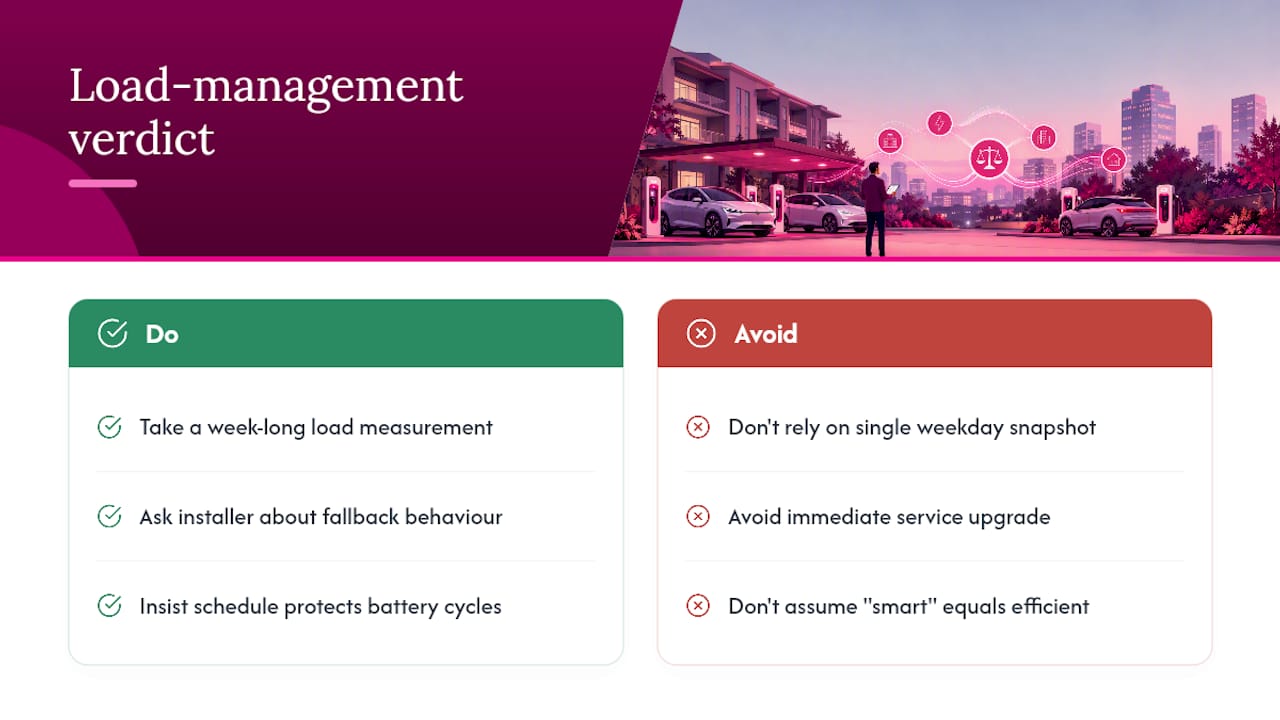
The overrated fix is jumping straight to a service upgrade because it feels like the “safe” option. It’s often the slowest, most expensive route when a well specified dynamic system would have done the job for a fraction of the cost and lead time.
What I’d prioritise first: get a proper week long load measurement, ask your installer directly about fallback behaviour on communication failure, and if you’ve got solar or a battery, insist on scheduling logic that protects battery cycles rather than assuming “smart” means efficient by default.
Get your site assessed by High Demand Electrical
High Demand Electrical is the practical alternative to guessing your way through an EV charger rollout, run a free site inspection instead of paying for hardware before anyone has measured your actual load. As a certified Level 2 contractor, our team handles everything from load calculations and phase mapping to full switchboard upgrades, so property managers and homeowners get one accountable point of contact rather than juggling a meter technician, a controller vendor and a sparkie separately.

If you’re weighing upload management against a panel upgrade, or you manage a strata site with several bays to fit out, book a free site inspection through our Level 2 electrician Sydney page. We’ll measure your baseline load, check your phase balance, and tell you honestly which approach actually fits your switchboard.
Recommended
Powering Your Needs with Expertise
If you’re looking for a reliable, experienced, and prompt electrician, look no further than High Demand Electrical. We cater to all your electrical needs, from routine maintenance to emergency repairs and complete system installations. Our skilled team is committed to providing professional service that ensures your electrical systems run smoothly. Whether it's a small task or a large project, give us a call today. Let us meet all your electrical demands with the quality and reliability you deserve.