1–4 Year LED Payback in Australia: GEMS, Rebates & Maintenance
Most LED upgrades generally pay for themselves within a few years, and domestic halogen swaps often recoup their cost relatively quickly. The exact figure depends almost entirely on how many hours the lights run and what they’re replacing, so the “typical” number matters less than running your own numbers. Australian product registration and rebates can shift that net cost significantly, and we’ll walk through exactly how below.
TL;DR:
- Domestic LED upgrades typically recoup their cost within a year due to 75% less energy use and longer lifespan compared to halogen bulbs.
- Payback periods for commercial and retail sites usually range from 1 to 4 years, depending on operating hours, electricity rates, and rebate amounts.
- High-use industrial and warehouse lighting can see payback as fast as 1 to 3 years because of longer operating hours and higher energy savings.
- Actual payback is heavily influenced by site-specific factors such as operating hours, existing lamp types, electricity tariffs, and maintenance costs often overlooked in simple calculations.
- Including demand charge reductions, maintenance savings, and rebates provides a more accurate estimate, preventing the common overstatement of lighting upgrade benefits.
Table of Contents
- Typical led payback ranges by setting
- How to calculate your LED lighting payback period
- What changes your payback period the most
- Do rebates and registration change your net cost?
- The maintenance savings most quotes leave out
- How to get an accurate payback estimate for your site
- What decision-makers consistently get wrong about payback
- Book a free site inspection for your LED upgrade
- Where to check the numbers yourself
- FAQ
- Sources
Typical led payback ranges by setting
The range you should expect depends heavily on how hard your lights work each day.
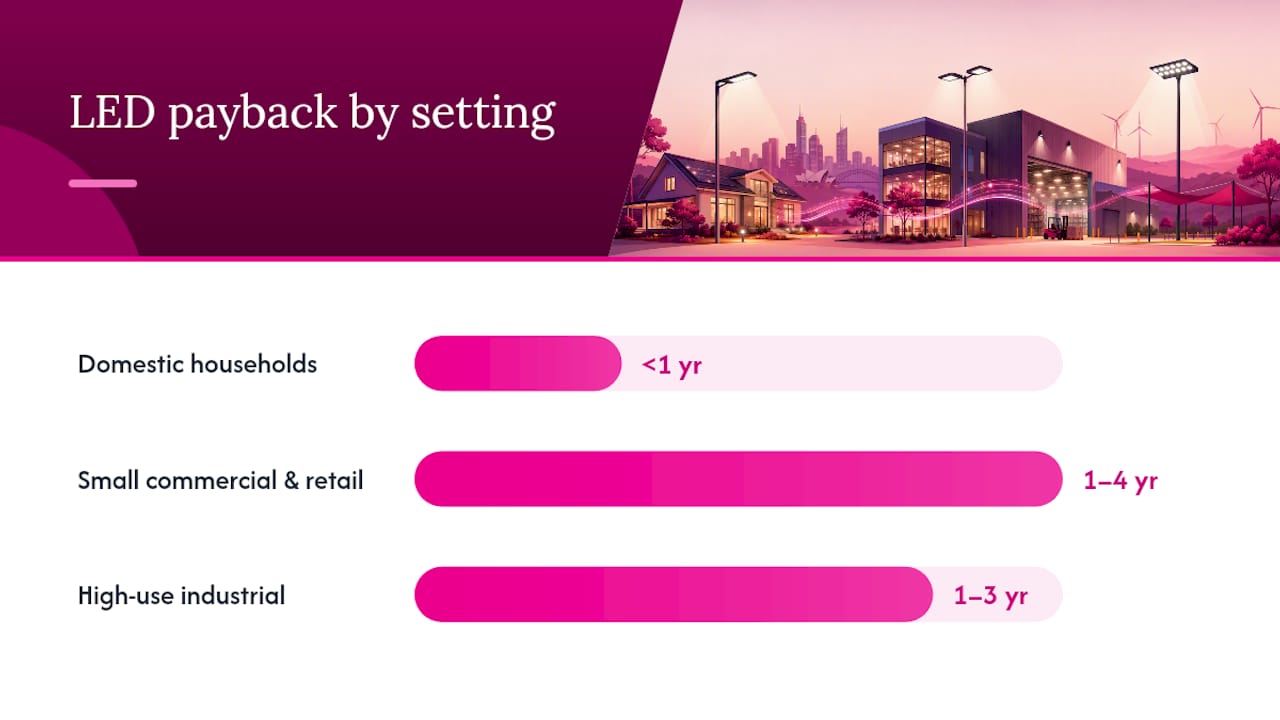
Domestic households replacing halogen or incandescent globes with LEDs often see payback in under a year. LEDs use roughly 75% less energy than halogen and last five to fifteen times longer, so even modest household lighting use recovers the cost fast.
Small commercial and retail sites usually land in the 1 to 4 year bracket, with the LED Savings Calculator for Australia confirming this as the common range once state tariffs and rebate estimates are factored in. Hours of operation and local electricity rates push individual sites toward either end.
High-use industrial and high-bay settings frequently deliver the fastest payback of all, often 1 to 3 years, because these fittings run longer hours and older high-bay lamps (metal halide, mercury vapour) waste far more energy than the halogen swaps found at home.
How to calculate your LED lighting payback period
The simple payback formula is straightforward: investment ÷ annual savings = payback period. Every serious ROI calculation starts here, though larger capital projects benefit from adding NPV or IRR to capture value over the LED system’s full lifespan.
Here’s how to build the inputs step by step:
- Calculate the wattage difference. Subtract the LED fixture’s wattage from your existing lamp’s wattage (e.g. a 250W metal halide high-bay replaced by an 80W LED equivalent saves 170W per fitting).
- Convert to annual kWh savings. Multiply the wattage saved by daily operating hours, then by 365 days, then divide by 1,000.
- Apply your electricity rate. Multiply annual kWh saved by your $/kWh rate to get annual dollar savings from energy alone.
- Add demand and maintenance savings. Demand charge reductions and avoided lamp replacement labour both add to annual savings, and skipping this step is a common calculation error that understates real returns.
- Subtract estimated rebates from the quoted price to reach your net installed cost.
- Divide net cost by total annual savings to get your payback in years, then convert to months if the result is under two years.
Worked example: A warehouse replaces 20 metal halide high-bays (250W each) with 80W LED equivalents, running 10 hours a day, 300 days a year. That’s 170W saved per fitting, 3,400W across the site, or 10,200 kWh saved annually. At $0.28/kWh, that’s roughly $2,856 a year in energy savings alone, before adding maintenance and demand savings. If the net installed cost after rebates is $8,500, payback lands at just under 3 years on energy savings alone, and noticeably faster once maintenance is included.
What changes your payback period the most
A handful of site-specific variables swing the result far more than the brand of LED you choose.
- Operating hours. A fitting running 16 hours a day pays back roughly twice as fast as an identical fitting running 8 hours, because savings accrue per hour of use, not per fitting installed.
- Existing lamp type. Metal halide, mercury vapour, and older T8 fluorescent tubes waste more energy than newer T5 fluorescents, so the wattage reduction, and the payback, varies enormously depending on what you’re replacing.
- Local electricity rates and demand charges. Higher $/kWh rates shorten payback proportionally, and demand charge reduction can account for a meaningful share of total savings depending on your tariff structure.
- Maintenance access costs. Ballast and driver replacements, plus labour and lift hire for hard-to-reach fittings, add real annual costs that LEDs largely eliminate.
- Controls. Sensors and dimming add upfront cost but can meaningfully improve savings in low-occupancy areas, though the extra spend needs its own justification.
Pro Tip: Ask any contractor quoting your job whether they’re replacing lamps only or swapping the whole fitting. Fitting replacement costs more upfront but often unlocks better light distribution and bigger wattage cuts, which changes the payback math entirely.
Do rebates and registration change your net cost?
Australia’s GEMS/MEPS framework directly affects which products are worth buying and how you should treat rebates in your calculation.
- New GEMS determinations covering LED lamps began requiring model registration and mandatory performance testing from 2025 onward, including flicker and blue light hazard testing.
- Only registered, compliant models should factor into your payback calculation. Cheap unregistered LEDs often underperform their claimed wattage or lifespan, quietly eroding the savings you calculated.
- Treat rebates as a separate estimated line, not a guaranteed discount, since scheme availability and amounts shift over time. Subtract the rebate from the quoted price to reach net installed cost, but keep the two figures visible in your paperwork.
- Check registration status and product benefits through the Energy Rating lighting resource before signing off on any quote.
The maintenance savings most quotes leave out
Many lighting proposals only count energy savings, which understates the real return sometimes, substantially.
- Lamp and ballast replacement costs disappear almost entirely with LEDs, since there’s no ballast to fail and no filament to burn out.
- Labour and lift hire for high-bay and difficult-access fittings are often the biggest hidden saving. In warehouse and ceiling-mounted settings, the labour cost of accessing a fitting can exceed the price of the lamp itself.
- Disposal costs for old fluorescent tubes and mercury-containing lamps also disappear, since LEDs don’t carry the same hazardous waste handling requirements.
LED lifespans of 5 to 15 times longer than halogen mean maintenance visits drop from several times a year to once every few years or longer for high-use sites. Annualise that saved labour and lift hire across your fitting count. In high-bay applications, this single line item can shave a meaningful chunk off your calculated payback period.
How to get an accurate payback estimate for your site
Getting a number you can actually trust means gathering the right inputs before you ask for quotes.
- Count your fittings and record existing lamp types, including wattage, age, and location (especially anything requiring a lift or scaffold to access).
- Pull your operating hours for each area. A warehouse floor and an office kitchenette rarely run the same schedule, and averaging them hides the real picture.
- Gather your last three to six months of electricity bills to establish your actual $/kWh rate and any demand charges, using a maximum demand calculator if you’re unsure how demand charges apply to your site.
- Ask contractors directly: Is the quoted product GEMS-registered? Does the payback figure include maintenance and demand savings, or energy only? Is the rebate estimate current?
- Request a site inspection if your fitting count exceeds a handful or access is complicated. A proper walkthrough catches variables a desktop quote misses entirely.
What decision-makers consistently get wrong about payback
The biggest mistake I see in lighting proposals isn’t the maths. It’s what gets left out of the maths entirely.
Most quotes calculate energy savings correctly and stop there. They ignore demand charge reduction, they ignore the labour cost of accessing high-bay fittings twice a year, and they ignore the fact that a cheap unregistered LED might not actually deliver its claimed wattage over its rated life. Add those omissions up and a quoted 4-year payback can easily be a real 2.5-year payback once you count what the desktop estimate skipped.
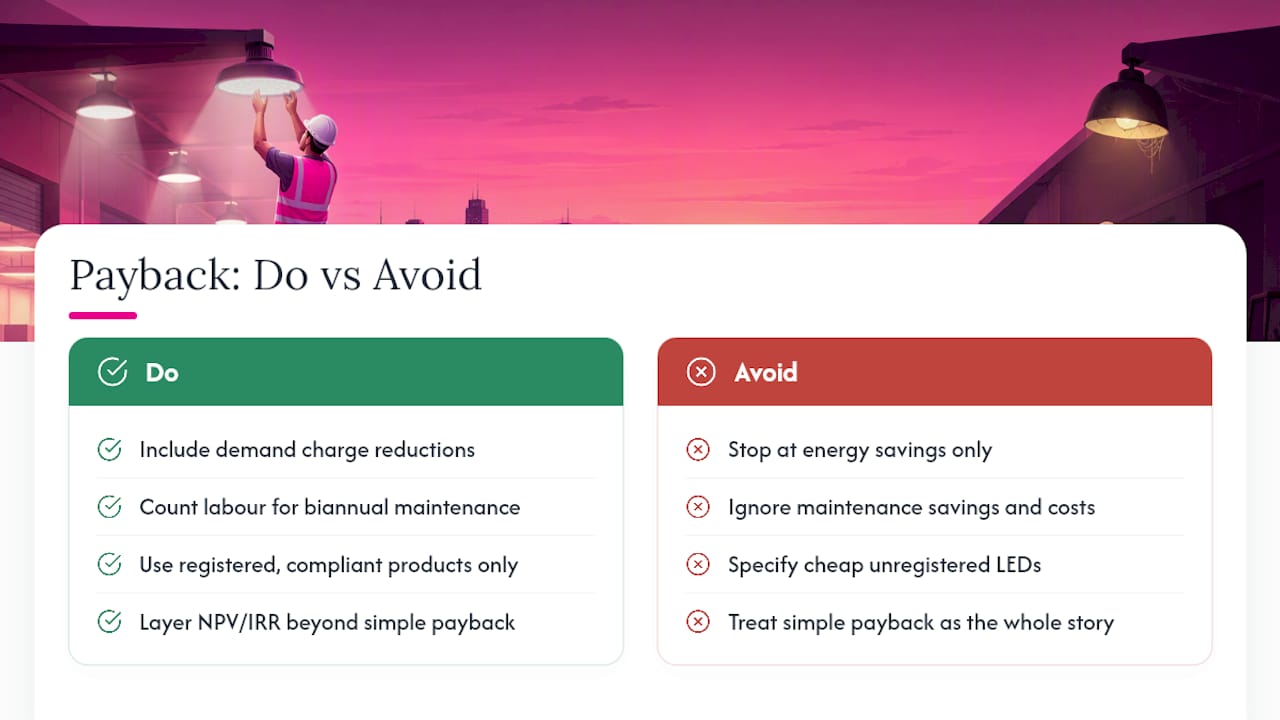
The second mistake is treating simple payback as the whole story on large projects. It’s the number every client asks for first, and it’s genuinely useful for quick comparisons, but for bigger capital spends it’s worth layering in NPV or IRR to see the value generated across the system’s full working life, not just the breakeven point.
Our approach to lighting design and installation always builds in conservative assumptions: net installed cost after estimated rebates, maintenance savings included rather than assumed away, and registered compliant product only. It’s a more honest number, even when it’s a smaller one on paper.
— Christopher
Book a free site inspection for your LED upgrade
Free site inspections for Level 2 work are offered, which means the payback estimate you get isn’t a desktop guess pulled from a spreadsheet template. It’s built from an actual walkthrough of your fittings, access constraints, and current electricity usage.
The team factors maintenance savings, demand reduction, and current rebate estimates into every quote, not just the headline energy figure most proposals lean on. Whether you’re weighing a full lighting design and installation project or want an ongoing electrical maintenance plan to protect your new fittings, we scope the job with the same conservative assumptions covered above. If you’re also weighing solar alongside your lighting upgrade to cut whole-site energy costs, our team can talk through how the two interact. Get in touch to arrange your free site inspection and a written payback estimate for your property.
Where to check the numbers yourself
- Energy: covers household energy savings, LED lifespan claims, and practical replacement guidance.
- LED lamps 2025 determination, Energy Rating: the official GEMS registration and testing requirements for LED lamp models.
- LED Savings Calculator for Australia: runs state-specific tariffs and rebate estimates for a commercial payback figure.
- ROI calculator, EleCalculator: applies the simple payback formula alongside NPV and IRR for larger projects.
- Free electrical tools and calculators: a collection of resources for running your own site numbers before requesting a quote.
Sources
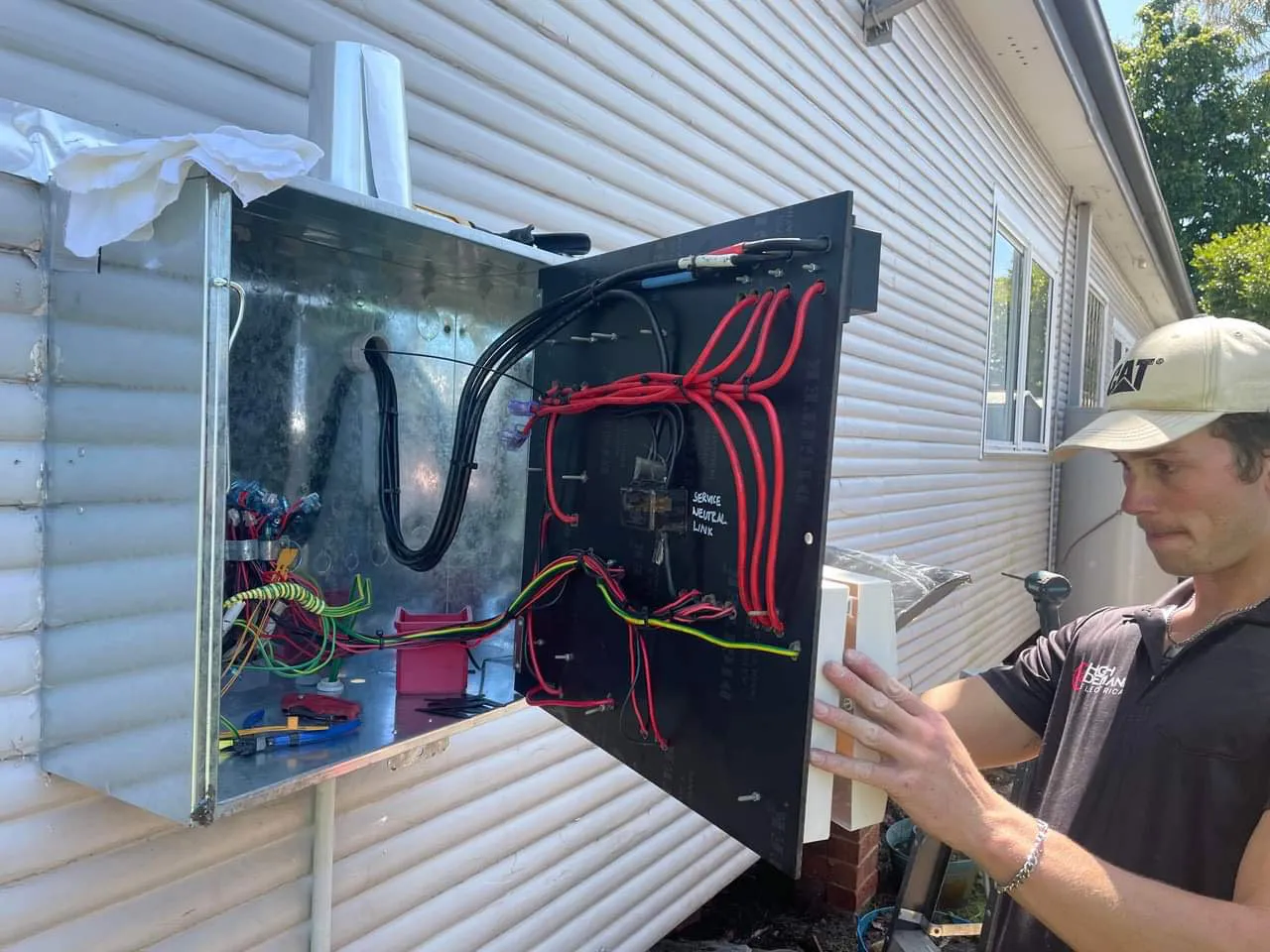
Powering Your Needs with Expertise
If you’re looking for a reliable, experienced, and prompt electrician, look no further than High Demand Electrical. We cater to all your electrical needs, from routine maintenance to emergency repairs and complete system installations. Our skilled team is committed to providing professional service that ensures your electrical systems run smoothly. Whether it's a small task or a large project, give us a call today. Let us meet all your electrical demands with the quality and reliability you deserve.