How to Clear an Electrical Defect Notice in NSW: A 2026 Sydney Homeowner's Guide
Finding an electrical defect notice taped to your property is a high-stakes compliance emergency that places your home on a 21-day countdown to total power disconnection. For many Sydney homeowners, the initial stress is quickly followed by confusion when a general electrician explains they don't have the specific accreditation to touch your consumer mains or private pole. Knowing exactly how to clear an electrical defect notice NSW requires more than a quick repair; it demands a precise sequence of technical rectifications and regulatory filings to satisfy strict network standards. With nearly 70% of NSW buildings currently harbouring defects, you're not alone in this situation, but the 2026 enforcement protocols from distributors like Ausgrid and Endeavour Energy mean you cannot afford to delay.
We recognise the urgency of keeping your lights on and your property safe. This guide provides the exact roadmap you need to rectify your electrical infrastructure, comply with the June 2025 Service and Installation Rules, and find an authorised specialist to handle the paperwork. We will detail the essential role of a Level 2 ASP, explain the mandatory Certificate of Compliance (CCEW) process, and show you how to resolve your defect before your power supply is cut.
Key Takeaways
• Understand the critical 21-day rectification deadline to prevent permanent power disconnection by Ausgrid or Endeavour Energy.
• Discover why only a certified Level 2 ASP is legally authorised to rectify infrastructure defects that standard electricians cannot touch.
• Learn the exact step-by-step process of how to clear an electrical defect notice NSW through site inspection and official certification.
• Identify high-risk infrastructure issues like leaning private power poles or UV-damaged consumer mains that frequently trigger notices.
• Ensure your property meets the latest 2026 NSW safety standards to avoid costly re-inspection fees and secure your power supply.
What is an Electrical Defect Notice in NSW?
An electrical defect notice is a formal legal warning issued by your electricity distributor, most commonly Ausgrid or Endeavour Energy in the Sydney metropolitan area. This document signifies that an authorised inspector has identified a fault or non-compliance within your property's electrical infrastructure. It is not a mere suggestion for future maintenance; it is an official directive stating that your installation currently fails to meet the electrical safety standards mandated by the NSW Service and Installation Rules.
The moment this notice is issued, a 21-day countdown begins. This grace period is the window provided to homeowners to organise repairs before the distributor takes further action. Many residents feel a sense of confusion regarding why they are responsible for equipment that sits outside their home. In New South Wales, the property owner is legally liable for all electrical assets from the "Point of Attachment" onwards. This includes the overhead wires connecting to your fascia, the consumer mains running into your house, and any private power poles situated on your land. If these components deteriorate due to UV damage, rust, or age, the burden of rectification sits with you.
Inspectors generally categorise these issues into two tiers. Safety defects are the most critical, involving hazards like exposed live parts or neutral faults that pose an immediate threat of fire or electrocution. These often result in an "imminent danger" classification. Compliance defects, while still mandatory to fix, relate to structural or regulatory issues such as insufficient cable clearance or outdated switchboard configurations that do not meet 2026 safety protocols. Learning how to clear an electrical defect notice NSW starts with identifying which category your notice falls under, as this dictates the speed at which the distributor will move toward disconnection.
Why did I receive this notice now?
Distributors are currently heightening their surveillance of aging infrastructure across Sydney. You may have received a notice following a routine street inspection where a technician spotted a leaning pole or vegetation encroachment. Frequently, the trigger is a request for a smart meter upgrade. When a technician arrives to install new metering equipment, they are required to perform a comprehensive safety check. If they find your switchboard contains asbestos or lacks proper circuit protection, they will issue a defect notice on the spot. Even nearby network repairs can lead to an inspector noticing a hazard on your property and logging it in their system.
The risk of power disconnection
The ultimate penalty for non-compliance is the total loss of power. If the 21-day deadline passes without a Level 2 ASP submitting the required paperwork, the distributor will typically disconnect your service at the street. Inspectors use a colour-coded system to signal urgency. A "yellow tag" usually grants you the standard three-week window, whereas a "red tag" indicates a high-risk scenario where the power may be cut immediately to protect the public. Once disconnected, restoring service is a complex process. You cannot simply flip a switch; you must prove the defect is cleared through official certification. Mastering how to clear an electrical defect notice NSW quickly is essential to avoiding the significant lifestyle and financial disruptions of a forced blackout.
Common Reasons for NSW Electrical Defect Notices
Inspectors from Ausgrid and Endeavour Energy are trained to spot high-risk deterioration that standard property maintenance often overlooks. One of the most prevalent issues involves consumer mains, which are the heavy-duty cables that carry electricity from the street to your switchboard. Over decades of exposure to the harsh Australian sun, the insulation on these cables becomes brittle and cracks. This reveals the copper underneath, creating a significant fire risk and an immediate defect. Understanding these technical triggers is the first step in learning how to clear an electrical defect notice NSW before the 21-day deadline expires.
Similarly, the Point of Attachment (POA) must be structurally sound. This is the specific location where the overhead service line meets your house. If the bracket is pulling away from the fascia or the insulators are cracked, the inspector will issue a notice to prevent a structural failure. Other common reasons for notices include:
Exposed Wiring
Damaged insulation on any external electrical assets.
Outdated Switchboards
A lack of modern Residual Current Devices (RCDs) or the presence of hazardous asbestos panels.
Insecure Connections
Loose or corroded terminals at the main switch or meter.
Private Power Pole Hazards
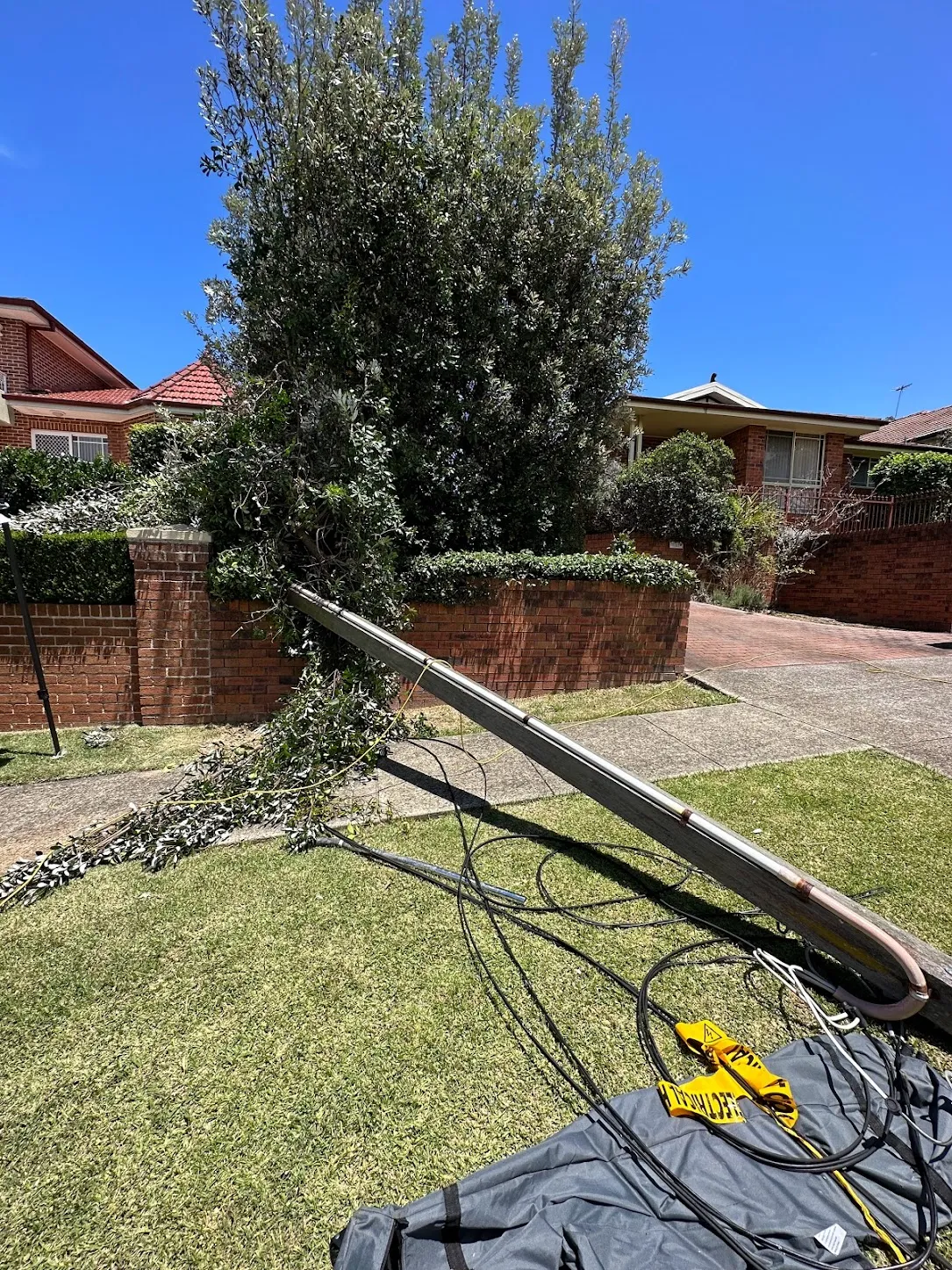
Private power poles are the primary source of defects in many Sydney suburbs. In Western Sydney, timber poles are particularly vulnerable to termite damage, which hollows out the core and compromises structural integrity. For steel poles, the danger often lurks at the ground-line. Constant exposure to moisture in the soil causes the base to rust, often hidden just below the surface. Any pole leaning more than 5 degrees from the vertical is considered a collapse risk. If you suspect your infrastructure is failing, getting a professional inspection from a Level 2 ASP can identify these issues before they become legal liabilities.
Vegetation and Line Clearance
Vegetation encroachment is a common compliance trigger. NSW regulations dictate strict minimum clearance distances between power lines and trees to prevent clashing during high winds. You should never attempt to trim branches near service lines yourself; the risk of arc flash or electrocution is extreme. In some cases, an inspector may require the installation of Tiger Tails, which are high-visibility plastic tubes, to provide temporary mechanical protection and visual warning during nearby construction work. Addressing these clearance issues is a vital part of knowing how to clear an electrical defect notice NSW efficiently.
Modern safety standards also target switchboards. If your board still uses ceramic fuses and lacks RCD protection, it is likely to fail a contemporary inspection. These safety switches are now mandatory for all circuits to prevent fatal electric shocks, making a switchboard upgrade a common requirement for clearing a defect and ensuring long-term compliance.
Licensed Electrician vs. Level 2 ASP: Who Can Clear Your Notice?
A common point of frustration for Sydney property owners is discovering that their trusted family electrician cannot legally rectify their defect notice. While a standard licensed electrician is highly skilled at installing power points or wiring a kitchen, they are restricted to working on the "load side" of your electrical system. They are legally barred from touching the "supply side" infrastructure that connects your home to the street grid. To understand how to clear an electrical defect notice NSW, you must engage a contractor with Level 2 ASP (Accredited Service Provider) credentials. These specialists have undergone rigorous training and carry the specific insurance required to work on the electricity network managed by Ausgrid and Endeavour Energy.
The ASP scheme is divided into several categories, each defining the scope of work a technician can perform. Class 1 providers typically handle large-scale network construction, while Class 3 and 4 focus on design and high-voltage metering. For the vast majority of residential defect notices, you require a Class 2 ASP. This accreditation allows the technician to work on service lines, consumer mains, and the critical point of attachment. High Demand Electrical operates as a specialized Level 2 provider in Sydney, focusing exclusively on the infrastructure and compliance issues that trigger these notices. We bridge the gap between your private property and the public network, ensuring every repair meets the strict 2026 safety protocols.
What a Level 2 ASP can do that others can't
The primary advantage of a Level 2 ASP is the authority to perform "live" work and manage the connection to the grid. When your consumer mains are damaged or your private pole is failing, the power must be safely disconnected at the street before repairs begin. A standard electrician does not have the authority to pull the network fuses or reconnect the service once the job is done. A Level 2 specialist can disconnect your home, replace the faulty infrastructure, and commission the new installation on the same day. This includes installing smart meters, upgrading consumer mains, and erecting new private power poles that comply with the latest NSW regulations.
The danger of hiring the wrong contractor
Hiring an unaccredited worker to fix a network defect is a significant legal and financial risk. Any work performed on the network side must be logged through a Notice of Service Work (NOSW). If a standard electrician attempts the repair, they cannot submit this document, meaning the defect remains "active" in the distributor's system even if the physical repair looks correct. This failure to log the work will lead to an automatic power disconnection once your 21-day window expires. Additionally, using unaccredited contractors for network-side repairs can void your building insurance, as the work is technically unauthorised. You can verify an ASP's credentials by checking the official register on the NSW Government website to ensure your project is handled by a qualified professional who knows exactly how to clear an electrical defect notice NSW correctly.

Step-by-Step: How to Clear an Electrical Defect Notice Fast
Clearing a defect is a high-stakes race against the clock, but following a structured protocol ensures you don't miss the 21-day cut-off. The first step is identifying your network distributor. In Sydney, this is typically Ausgrid or Endeavour Energy. Their logo and contact details will be clearly visible on the notice. Once you've confirmed the issuing authority, you must immediately contact a Level 2 ASP. A standard electrician cannot provide the required site inspection or the mandatory network-side quote needed to move forward. This initial assessment determines if the issue is a straightforward repair or a complex infrastructure failure. Knowing exactly how to clear an electrical defect notice NSW requires this specific coordination between the homeowner and an authorised specialist.
The execution phase involves rectifying the specific faults listed by the inspector. This often includes critical work on consumer mains or the full replacement of a private power pole that has failed its structural test. Once the physical repairs are complete, the technical paperwork begins. Your Level 2 ASP must submit a Notification of Service Work (NOSW) and a Certificate of Compliance for Electrical Work (CCEW) to the distributor. These documents are the only way to officially close the case in the network's database. Finally, the distributor may conduct a random audit to verify the work meets the June 2025 Service and Installation Rules before clearing the notice from your property file.
Understanding the NOSW and CCEW
The paperwork stage is where many DIY attempts or unaccredited repairs fail. The NOSW is a vital legal notification that tells the distributor exactly what changes were made to their network. Without it, the distributor assumes the defect still exists and will proceed with disconnection. The CCEW is your personal safety guarantee, certifying that the work complies with the latest Australian safety standards. High Demand Electrical manages this entire administrative burden for you. We lodge the digital filings directly with the supply authority to ensure your status is updated in real-time, which prevents accidental disconnections due to processing delays.
Requesting a time extension
If you are facing a complex infrastructure upgrade or parts like specific steel poles are on backorder, you can request an extension to the 21-day deadline. Valid reasons usually involve documented proof of a contracted Level 2 ASP and a scheduled date for the works. However, if you ignore the initial notice and receive a formal "Notice of Disconnection," your options narrow significantly. In this scenario, you must act within 48 hours to prevent a crew from physically cutting your service at the street. If you've received a notice and need to act now, you should book a rapid response inspection to secure your power supply and keep your lights on.
Why Choose High Demand Electrical for Defect Rectification?
High Demand Electrical operates as the authoritative rapid responder for homeowners throughout the Northern Beaches, Hills District, and the Sydney CBD. When you receive a notice, you aren't just looking for a repair; you're looking for a guarantee that your power stays on. Our team specialises in the high-stakes environment of network compliance, bringing a level of technical depth that standard electricians cannot provide. We offer fixed-price quotes for common infrastructure rectifications, such as the installation of private power poles, ensuring you have absolute financial clarity during a stressful period.
Managing the bureaucracy of supply authorities is often the most frustrating part of the process. We take full control of compliance management, liaising directly with Ausgrid and Endeavour Energy on your behalf. This ensures that every technical detail is communicated correctly and that your property is cleared in their system without delay. Learning how to clear an electrical defect notice NSW becomes a seamless experience when you have a specialist handling both the physical infrastructure and the regulatory filings.
Our Sydney-wide Level 2 ASP Services
Our capabilities extend across both residential and commercial sectors, covering complex overhead and underground power infrastructure. We maintain a fleet of specialised equipment designed for rapid pole installation and consumer main upgrades, allowing us to complete most defect rectifications in a single visit. Every project we undertake adheres strictly to Australian Standards (AS/NZS 3000), providing the professional reassurance that your home is not just compliant, but safe. We recognise the urgency of these situations and prioritise emergency defect repairs to ensure no Sydney resident is left in the dark.
Get your power cleared today
Booking an urgent inspection with our Level 2 team is the most effective way to secure your energy supply. To facilitate a rapid resolution, please ensure our technicians have clear access to your switchboards and any private poles on the property before we arrive. We understand the pressure of the 21-day deadline and work efficiently to provide the documentation needed for official clearance. Don't risk a forced disconnection by waiting until the final week. Contact High Demand Electrical to clear your defect notice now and restore your property's standing with the network distributor. Mastering how to clear an electrical defect notice NSW starts with a single call to a qualified specialist.
Secure Your Property and Maintain Compliance
The 21-day deadline issued by Ausgrid or Endeavour Energy is a strict regulatory countdown that requires immediate attention. Successfully navigating how to clear an electrical defect notice NSW depends on acting quickly to engage a specialist who understands the latest 2026 safety protocols. From rectifying leaning private poles to replacing degraded consumer mains, ensuring your infrastructure meets current standards is the only way to prevent a forced disconnection. You don't have to face the stress of a potential power cut alone.
High Demand Electrical stands ready as your authoritative rapid responder across Sydney. As a fully accredited Level 2 ASP with deep expertise in Ausgrid and Endeavour Energy regulations, we provide the technical reassurance and 24/7 emergency response needed to resolve even the most complex defects. We handle the entire process, including the mandatory NOSW and CCEW filings, so you can rest easy knowing your compliance is in expert hands. Request an Urgent Defect Inspection from Sydney's Level 2 Experts and take the first step toward a safe, compliant, and powered property today.
Frequently Asked Questions
Is the power company responsible for my private power pole?
No, the property owner is legally responsible for the maintenance and repair of any private power poles situated on their land. While Ausgrid or Endeavour Energy maintain the street-side network, your responsibility begins at the first point of connection. This includes the pole itself, the cross-arms, and the insulators that support the service lines.
How long do I have to fix an electrical defect in NSW?
You typically have a strict 21-day window from the date the notice was issued to complete all necessary rectifications. Failure to act within this timeframe usually results in the distributor disconnecting your power supply to ensure public safety. If you are researching how to clear an electrical defect notice NSW, you must prioritise this deadline to avoid a forced blackout.
Can any electrician clear a defect notice from Ausgrid?
No, a standard licensed electrician is not authorised to clear network-side defects or work on the electricity grid. Only an Accredited Service Provider (ASP) with Level 2 qualifications can legally perform the repairs and submit the mandatory paperwork to Ausgrid or Endeavour Energy. Hiring an unaccredited contractor will not clear the defect from the distributor's system.
What happens if I don't fix the defect within 21 days?
If the 21-day deadline expires without the distributor receiving a Notification of Service Work (NOSW), they will physically disconnect your property from the grid. Reconnection after a forced cut-off is a far more complex and expensive process. It requires full certification of the repairs by a Level 2 ASP before a network technician will restore your energy supply.
How much does it cost to clear an electrical defect notice in Sydney?
The cost of clearing a defect notice varies significantly depending on whether you require a simple switchboard repair or a full private power pole replacement. Because each site has unique infrastructure challenges, a Level 2 ASP must conduct a physical inspection to provide an accurate quote. Complex underground consumer mains work will naturally differ in scope from overhead line clearance.
What is an NOSW and why is it important?
An NOSW, or Notification of Service Work, is the official document that informs the electricity distributor that a Level 2 ASP has performed work on the network. It is the only legal mechanism to update your property's status in the distributor's database. Without this filing, the network authority has no record of the repair, and your defect will remain active in their system.
Can I clear a defect notice myself if I am a DIYer?
No, it is illegal and extremely dangerous for an unlicensed individual to attempt repairs on network-side assets. These components carry high-voltage currents that can be fatal if mishandled. Additionally, the distributor will only accept compliance paperwork from a certified Level 2 ASP, meaning DIY work will never legally clear the defect notice from your property file.
Why did I get a defect notice when my power is working fine?
A defect notice is issued for safety or compliance failures, not necessarily because your power has stopped. Your electricity may still flow through a rusted pole or UV-damaged consumer mains, but these conditions represent an imminent fire or electrocution risk. Learning how to clear an electrical defect notice NSW is about addressing these hazards before they cause a catastrophic failure or injury.
Powering Your Needs with Expertise
If you’re looking for a reliable, experienced, and prompt electrician, look no further than High Demand Electrical. We cater to all your electrical needs, from routine maintenance to emergency repairs and complete system installations. Our skilled team is committed to providing professional service that ensures your electrical systems run smoothly. Whether it's a small task or a large project, give us a call today. Let us meet all your electrical demands with the quality and reliability you deserve.