
How Much Power Does an EV Charger Use? A Clear Guide
What if the number on your EV charger tells you how quickly it can charge, but not how much electricity you’ll use? The question “how much power does an EV charger use” sounds straightforward, but the answer depends on what you mean by power. A charger’s kW rating describes its charging rate; kWh measures energy transferred to the battery and billed as electricity use.
It’s easy to mistake a charger’s maximum output for your home’s total consumption. In practice, the vehicle’s energy use, distance travelled, charging frequency and charging losses all affect the electricity drawn from the grid.
This guide shows you how to estimate charging use from your own driving and vehicle details, and explains how charger ratings affect charging time. It also clarifies why energy use and your home’s electrical supply capacity are separate questions, and when an electrical assessment may be relevant.
Key Takeaways
• To understand how much power does an EV charger use, separate its charging rate in kW from the energy used, measured in kWh.
• Your distance travelled, vehicle efficiency and driving conditions all influence how much electricity you’ll need to charge.
• Use your vehicle’s energy consumption and driving distance to estimate charging energy for your own routine.
• Charger power, other household electrical loads and your property’s supply capacity are separate factors to consider.
• Use your estimate as a guide, not proof that your home’s electrical installation can support a charger.
How much power does an EV charger use? Start with kW and kWh
An EV charger’s power rating is a rate, measured in kilowatts (kW). The electricity it uses accumulates over the time it charges and is measured in kilowatt-hours (kWh). So, the answer to “how much power does an EV charger use” depends on both the charging rate and how long the vehicle draws power. The charger’s rating alone won’t tell you a fixed daily or monthly electricity bill.
In short, kW tells you how quickly a charger can supply electricity; kWh tells you how much energy is used during a charging session. This distinction helps make sense of charger specifications and your electricity bill. Your bill records energy consumption in kWh, while the kW rating describes the rate at which charging can happen.
What do kW and kWh mean when charging an EV?
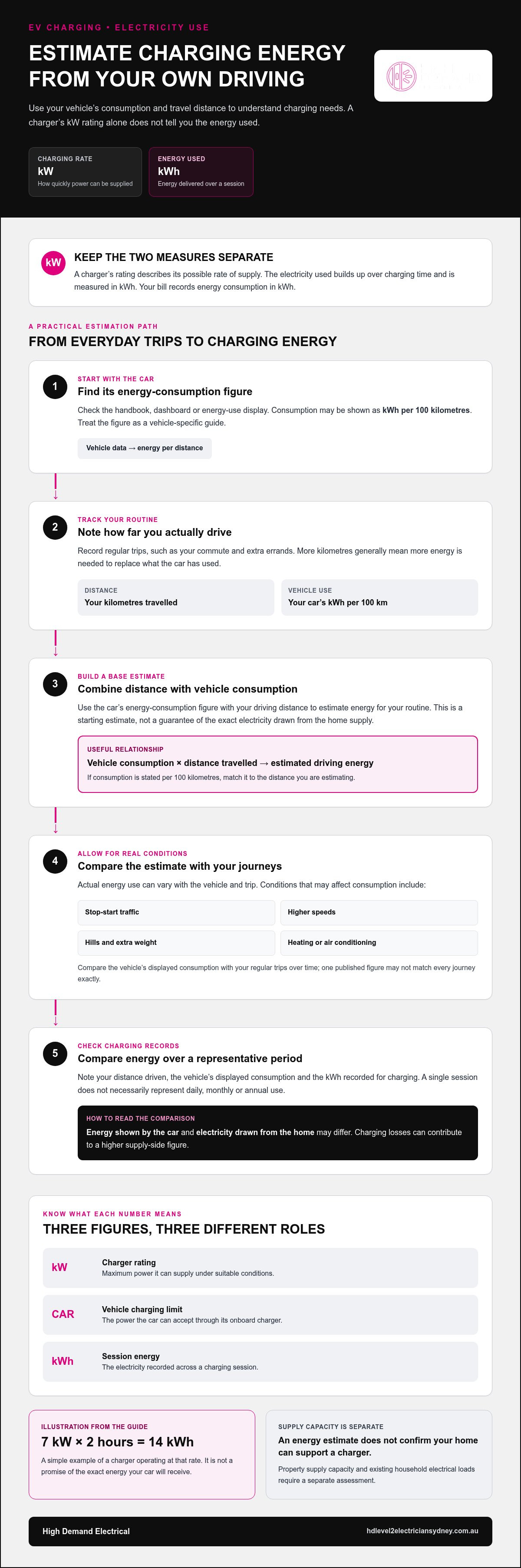
Think of kW as the rate of flow and kWh as the total amount that flows over time. A charger’s kW figure describes its available charging rate at a given moment. The kWh figure records the energy delivered across a session. For example, a 7kW charger operating at that rate for two hours would supply 14kWh. That’s a simple illustration, not a promise of the exact energy your car will receive.
Australian home charging commonly uses a dedicated wall-mounted charger, often rated at 7kW for a single-phase supply. Charger types and their power levels vary, as outlined in this overview of EV charging station types and power levels. The rating indicates a possible rate, not an amount the charger uses continuously every day.
Why charger power is not the same as electricity used
Charging duration matters. A higher power rate can deliver energy faster, but a shorter session may use less total electricity than a longer session at a lower rate. Your car also affects the outcome: its onboard charger limits how much power it can accept, and charging behaviour can change during a session. A charger’s maximum rating doesn’t mean it will draw that amount continuously.
For a useful estimate, distinguish three figures:
Charger rating
the maximum power the charger can supply under suitable conditions.
Vehicle charging limit
the power the car can accept through its onboard charger.
Session energy
the electricity recorded in kWh over the charge.
The charging rate may be below the charger’s rated maximum because of the vehicle’s limit or other charging conditions. Energy delivered to the battery may also differ from the electricity drawn from the home supply because charging involves losses. Check the charging record or energy monitor for session use rather than multiplying the charger’s rating by an entire day or month.
For Sydney households, understanding these units helps clarify energy use, but it doesn’t establish whether a property’s electrical installation can support a charger. That requires a separate assessment of the supply and existing loads. High Demand Electrical provides Level 2 electrical services in Sydney, including EV charger installation.
What changes how much electricity an EV charger uses?
Distance travelled is a major factor in your EV’s charging needs: more kilometres generally mean more energy required to replace what the car has used. But two drivers covering the same distance may still use different amounts of electricity. Vehicle efficiency, driving conditions and charging-system losses all influence the energy drawn from the home supply.
Your EV’s electricity use varies with how far you drive, how efficiently it uses energy and the conditions it faces, so there’s no single figure that suits every household. Overseas driving averages or a broad “typical EV” estimate may not reflect your Sydney routine. Your own vehicle data and travel patterns are a more useful starting point.
Driving distance and vehicle efficiency
Check your vehicle’s handbook, dashboard or energy-use display for its stated consumption figure. It may be shown as energy used per distance travelled, such as kWh per 100 kilometres. Treat this as a vehicle-specific guide, then consider your actual trips: a longer commute or extra weekly errands will generally increase the energy needed for charging.
Efficiency can also vary with driving conditions. Stop-start traffic, higher speeds, hills, carrying extra weight and frequent use of heating or air conditioning can affect the energy required to travel. The effect depends on the vehicle and journey, so don’t assume one published consumption figure will match every trip exactly. Keep a note of your regular distance and compare it with the car’s displayed consumption over time.
Charging habits, duration and charging conditions
A charging session is one event; daily, monthly and annual consumption are totals across many events. A longer session will generally record more energy than a shorter one if charging continues at a similar rate. But session length alone doesn’t tell you how much energy the car needed for driving. Battery state, the vehicle’s charging behaviour and charging-system efficiency can all affect the energy recorded at the meter.
Charging habits also determine when electricity is used. Charging after each trip can create frequent, shorter sessions, while waiting to charge may lead to fewer, longer ones. Either pattern can add up to a similar total for the same driving and vehicle, though the timing may affect your bill if your electricity plan has different rates at different times.
To understand your own use, compare records across a representative period rather than drawing conclusions from one session. Note the distance driven, the vehicle’s displayed consumption and the kWh recorded for charging. If the supply-side figure is higher than the energy shown as used by the car, charging losses may be one contributing factor. There isn’t one universal loss percentage that applies to every setup.
These observations help answer how much power does an EV charger use in your circumstances, but they don’t establish whether your home’s electrical supply can support charging. If you’re considering a home charger in Sydney, you can discuss your EV charger installation requirements with High Demand Electrical.
How to estimate EV charging electricity use from your own driving
Your own driving records and vehicle data are more useful than a broad average. Find the car’s energy consumption figure, choose a period such as a week or month, then use the distance you actually drove during that period. The result estimates energy used by the vehicle, not a guaranteed electricity meter reading or bill amount.
A simple estimate using vehicle consumption
Look for a consumption figure in your vehicle’s handbook, dashboard or energy-use display. It may be listed in kilowatt-hours per 100 kilometres (kWh/100 km). Use this formula:
Estimated vehicle energy use in kWh = consumption in kWh/100 km × distance driven in km ÷ 100.
Here, kWh means kilowatt-hours, a unit of energy; km means kilometres; and kWh/100 km means the vehicle’s stated energy use for every 100 kilometres travelled. Dividing by 100 converts the distance-based figure to the distance you drove.
For a clearly hypothetical example, suppose a vehicle’s display reports 16 kWh/100 km and you drive 250 km in a week. The calculation is 16 × 250 ÷ 100, giving an estimated 40 kWh of vehicle energy use for that week. Replace both example figures with your own vehicle’s consumption and recorded distance.
Follow these steps to apply the calculation:
• Record the vehicle’s consumption figure and its units.
• Choose a period and add up the kilometres driven during it.
• Multiply the consumption figure by those kilometres, then divide by 100 if the figure is in kWh/100 km.
• Label the answer as estimated vehicle energy use for that period.
If your car shows watt-hours per kilometre (Wh/km) instead, first convert watt-hours to kilowatt-hours by dividing by 1,000. Multiply the Wh/km figure by your distance in km, then divide by 1,000 to estimate kWh. Keep the units consistent and use the same time period for both distance and result.
Why your meter reading may differ from the estimate
The calculation uses a stated consumption figure, but real journeys may involve different speeds, traffic, terrain, loads or heating and cooling use. Your driving conditions can therefore produce a result above or below the estimate. Vehicle displays may also present figures for different periods, so check that the consumption and distance cover the same timeframe before comparing them.
Most importantly, this calculation estimates energy used by the vehicle. A home meter records electricity drawn at the premises for charging, which can differ because charging equipment and the vehicle’s charging process use energy too. Don’t add an assumed loss percentage: the amount varies by setup and conditions. Compare your estimate with charging records over the same period to build a practical picture of how much power does an EV charger use for your driving, without treating the calculation as a precise meter prediction.
Does EV charging power affect your home’s electrical supply?
Yes. A charger’s power demand can affect what your home’s electrical installation needs to support, but that’s a different question from how much energy your car uses over a day or month. An estimate of charging energy helps you understand consumption. It cannot, on its own, determine whether your property can safely accommodate a charger.
Energy use versus electrical capacity
Electrical capacity is the supply’s ability to support demand at a given time; kWh records energy used over a period. A vehicle might use a certain amount of energy over a week, while the charger draws power during the hours it operates. These figures describe different things, so a weekly or monthly kWh estimate doesn’t reveal how much capacity is available for charging alongside other household electrical loads.
The charger, the existing installation and the property’s supply all matter. Household appliances and other equipment may be operating at the same time as the charger, adding to total electrical demand. The home’s existing supply and wiring also affect what can be supported. A charger’s rated power alone doesn’t show whether the installation is suitable, and an energy estimate cannot confirm that a switchboard or supply upgrade is required.
When a Sydney home may need an electrical assessment
An electrical assessment considers the property’s existing installation and supply, the planned charger and other relevant electrical loads. This gives a more reliable basis for understanding installation requirements than driving-distance calculations alone. It’s useful when you’re planning a new charger or are unsure how the home’s existing electrical infrastructure will accommodate it.
High Demand Electrical provides EV charger installation and switchboard upgrades across Sydney. The business is a Level 2 Accredited Service Provider (ASP), authorised to carry out service line, metering and connection work for Ausgrid, Endeavour Energy and Essential Energy. Its Level 2 electrician services in Sydney connect supply considerations with the wider electrical work a property may require.
Use your vehicle’s consumption data and charging records to understand energy use, but leave the decision about electrical suitability to an assessment of the installation. If you’re planning a home EV charger in Sydney, contact High Demand Electrical on Phone 0402 559 777 or Email chris@highdemandelectrical.com.au to discuss your installation and switchboard requirements.
What to do with your EV charger power estimate in Sydney
Your estimate can help you understand how your driving translates into vehicle energy use, especially when you compare the car’s consumption information with your usual distance and charging records. Use it as a planning guide, not a verdict on your home’s electrical installation. Only an assessment of the property can establish whether its existing supply and electrical infrastructure are suitable for a planned charger.
Information to have ready for an electrical discussion
A few practical details can make a conversation about installation more useful. Note the vehicle’s stated consumption, your typical kilometres over a week or month, and any charging-session records you have. Describe your current charging arrangement, where you intend to charge, and how you expect to use the vehicle. If you’re considering changes to the switchboard, High Demand Electrical also provides switchboard upgrade services.
These details provide context, but they don’t replace an assessment. A consumption estimate describes energy use; the home’s supply and existing installation determine what needs to be considered for charger installation. An electrician can assess the relevant electrical infrastructure and planned setup rather than relying on a projected kWh figure alone.
Local qualifications and next steps
High Demand Electrical provides EV charger installation across Sydney. Engnet Pty Ltd, trading as High Demand Electrical, holds EC Licence 397193C and is a Level 2 Accredited Service Provider (ASP), authorised to carry out service line, metering and connection work for Ausgrid, Endeavour Energy and Essential Energy. The business also holds ISO 9001, ISO 45001 and ISO 14001 certifications.
Those qualifications are relevant where charger planning connects with the property’s supply, metering or electrical infrastructure. They don’t mean an energy-use estimate alone can establish installation requirements. An assessment needs to consider the home and the proposed charger together, including the existing electrical installation and other demand on the supply. If a switchboard upgrade is relevant, it can be considered as part of that wider picture.
Bring your vehicle data and typical driving distance to the discussion, along with any charging records available. That information helps explain how much power does an EV charger use in your routine, while a property assessment addresses the separate question of electrical suitability. For Sydney EV charger installation, contact High Demand Electrical on Phone 0402 559 777 or Email chris@highdemandelectrical.com.au to discuss your plans.
Plan your next step with confidence
Knowing how much power does an EV charger use can help you plan around your driving, but your next step is to connect that estimate with the realities of your home. Keep your vehicle’s consumption information and charging records handy, then consider how you want charging to fit into your routine. These details can help frame a practical conversation about an installation.
A home assessment looks beyond estimated energy use to the property’s electrical installation and planned charger. Your charging estimate is useful context, not confirmation that the existing supply is suitable. High Demand Electrical provides EV charger installation, supported by EC Licence 397193C, Level 2 Accredited Service Provider (ASP), authorised to carry out service line, metering and connection work for Ausgrid, Endeavour Energy and Essential Energy, and ISO 9001, ISO 45001 and ISO 14001 certifications.
Ready to take the next step? Discuss an EV charger installation with High Demand Electrical and move forward with a clearer understanding of what your home needs.
Frequently Asked Questions
Is an EV charger’s kW rating the amount of electricity it uses?
No. The kW rating describes the charger’s power output, not a fixed amount of electricity it uses each day. A charging session that ends once the car has enough energy for its next trips won’t necessarily run at the charger’s maximum rate for the whole session. Check the session’s recorded kWh to see its energy use, rather than multiplying the charger rating by a full day.
How do I calculate how much electricity my EV uses for charging?
To estimate how much power does an EV charger use for your routine, use your car’s consumption figure and the distance driven over the period you’re interested in. Check that the figure and distance use compatible units, such as kWh per 100 kilometres and kilometres travelled. Treat the result as an estimate of vehicle energy use, not a bill prediction. Your vehicle’s own data is more relevant than an overseas average.
Does a higher-powered EV charger always use more electricity?
No. A higher-rated charger can deliver energy faster when the vehicle and installation allow, but its rating doesn’t set the total energy needed for a journey. For the same vehicle completing the same trips, charging faster doesn’t automatically mean it needs more energy overall. The charger’s rating is more useful for understanding possible charging speed; your vehicle’s consumption and driving determine the energy it needs.
Can I estimate my EV charging use from kilometres driven?
Yes, provided you have a suitable consumption figure for your vehicle. Compare a period’s odometer distance with the car’s displayed energy-use data, and note whether the display covers the same trips. If your vehicle doesn’t show a useful figure, consult its documentation for stated consumption information. Your estimate can help with planning, but real journeys may differ from the conditions behind that figure.
Does an EV charger’s electricity use tell me whether my home supply is adequate?
No. The estimate helps describe your vehicle’s energy needs, but it can’t confirm that the home’s electrical installation is suitable for a charger. A modest monthly total doesn’t show what other electrical loads may be operating while the car charges. An assessment needs to consider the planned charger alongside the property’s existing installation and supply, rather than using a kWh estimate as approval to proceed.
Why might my electricity records differ from an EV charging estimate?
Your estimate and electricity records may describe different things. A whole-premises meter can include household electricity use beyond the car, while a vehicle display may report energy used for driving rather than electricity drawn during charging. Compare records covering the same dates and check that the units match. If you have charging-session records, use them to identify charging periods; treat the calculation as a guide, not a replacement for meter data.
Powering Your Needs with Expertise
If you’re looking for a reliable, experienced, and prompt electrician, look no further than High Demand Electrical. We cater to all your electrical needs, from routine maintenance to emergency repairs and complete system installations. Our skilled team is committed to providing professional service that ensures your electrical systems run smoothly. Whether it's a small task or a large project, give us a call today. Let us meet all your electrical demands with the quality and reliability you deserve.

