
How Long Does a Private Power Pole Last? A Sydney Guide
What if your private power pole’s age tells you less than its condition? If you’re asking how long does a private power pole last, there’s no dependable expiry date that applies to every pole. Its material, installation, soil, weather exposure and maintenance all affect how it holds up over time.
It’s understandable to look for a number, especially if you’re unsure whether an older pole needs replacing or a change you’ve noticed could be a safety concern. Age alone can’t confirm whether a pole is sound. Leaning, timber decay, rust at the base, cracks, termite damage or sagging overhead lines are reasons to seek a professional assessment. Don’t inspect or repair the pole yourself.
This guide explains why lifespans vary, what deterioration can look like and how Sydney conditions can affect a pole. It also covers property owners’ responsibilities, the role of the electricity distributor and how a Level 2 Accredited Service Provider assessment can help you decide what to do next.
Key Takeaways
• There’s no reliable fixed answer to how long does a private power pole last. A qualified assessment considers the pole’s condition and the conditions around it.
• Sydney weather exposure, ground conditions, termites, rot and corrosion can affect a pole. The site matters as well as the material.
• Changes such as leaning, visible damage or deteriorated components warrant professional attention. Keep clear and don’t attempt a close inspection or repair.
• If you’re concerned, note what you can see from a safe distance, keep any network notice handy and arrange a qualified assessment of the pole and connected infrastructure.
• High Demand Electrical provides private power pole installation, replacement and maintenance across Sydney. Call 0402 559 777, email chris@highdemandelectrical.com.au or get in touch.
How long does a private power pole last? Why there is no single expiry date
There’s no fixed service life that reliably predicts when every private power pole must be replaced. The answer to how long does a private power pole last depends on its material, condition and exposure, as well as how it was installed and maintained. Age provides useful context, but it can’t confirm whether a particular pole remains serviceable.
Some published estimates give broad lifespan ranges, including 30-50 years, but that range isn’t a universal rule. It can’t account for differences in materials, ground conditions, weather exposure or maintenance between properties. A pole may need attention before reaching an estimated lifespan, while age alone doesn’t prove it has failed. A qualified assessment helps establish its current condition.
What does a private power pole supply?
A private power pole is property side electrical infrastructure that can support overhead lines supplying a home or another building. Those lines may connect the pole with the property’s electrical supply. Poles and their conductors are part of a broader utility system. The Utility pole overview explains their general uses and materials.
A private pole and the electricity network’s assets aren’t necessarily the same thing. Where responsibility changes depends on the property and network arrangement, so don’t assume it is always at the boundary fence or the nearest pole. If you’re unsure which infrastructure is involved, a Level 2 assessment can help identify the relevant equipment. In Sydney, High Demand Electrical provides Level 2 electrician services in Sydney.
Why can two poles of similar age have different service lives?
Two poles installed around the same time can face very different conditions. Material matters, but it isn’t the only factor. Moisture, prolonged contact with damp ground, soil conditions, weather exposure and maintenance history can all influence how a pole changes over time. A pole in a sheltered, well drained position may experience different stresses from one exposed to harsher weather or persistently wet ground.
The area where the pole meets the ground deserves attention during a professional assessment because conditions there can affect the structure. However, appearance alone can’t establish the condition of parts that aren’t readily visible. Don’t dig around the base or probe the pole. These actions won’t provide a reliable diagnosis.
Age alone cannot establish whether a pole is safe or serviceable. It’s useful background information for an assessment, not a pass or fail test. If the pole’s age is unknown, or you’re concerned about a change in its condition, avoid touching or closely inspecting it. A qualified professional can consider its visible state, site exposure and role in the electrical supply before advising on next steps.
What affects a private power pole’s condition in Sydney?
A pole’s condition reflects the environment around it as well as its material and maintenance history. Sydney properties can face very different exposures. A coastal site may have salt laden air, while a property near bushland may have more exposure to termites or vegetation related hazards. These conditions can affect what a professional looks for, but no single local factor determines how long a pole will last.
How do weather, pests and ground conditions affect a pole?
Moisture and weathering can contribute to deterioration over time. In timber, rot or termite activity may be a concern. On metal poles, corrosion can develop, particularly where conditions favour rust. The soil and ground around the base also matter, as persistent dampness or changes in the surrounding ground may be relevant to an assessment.
The base is an important area for a professional visual assessment because it meets the ground and may be exposed to moisture or decay. However, surface appearance alone can’t confirm the strength of the pole beneath it. Don’t dig around the base, scrape material away or probe the pole to look for damage. These actions can disturb electrical infrastructure and won’t provide a reliable diagnosis.
Can trees and overhead lines change the safety picture?
Yes. Vegetation close to private overhead powerlines can create a separate safety concern, even if the pole itself shows no obvious deterioration. A branch near a line may require attention, but that doesn’t automatically mean the pole is structurally damaged. Keep away from both the vegetation and the lines. Don’t attempt to cut branches or move anything near electrical equipment.
Tell the assessing professional what you’ve noticed and where, including whether branches are close to the lines or the pole. This helps distinguish a vegetation concern from visible signs of pole deterioration, while leaving the technical assessment to a qualified person. For broader context about property side responsibilities and private poles, see this Sydney private power pole guide.
From a safe distance, note changes such as visible rust, damaged timber, nearby vegetation or a change in the pole’s position. These observations are useful information, not proof of failure. Don’t touch, climb, lean equipment against or closely inspect the pole. If a line appears damaged, is unusually low or has come into contact with vegetation, stay well clear and arrange qualified advice promptly.
High Demand Electrical carries out private power pole work in Sydney, including installation, replacement and maintenance. If you’re concerned about the pole, its base or nearby overhead lines, arrange a professional assessment rather than trying to investigate or repair electrical infrastructure yourself.
Which signs matter more than a private power pole’s age?
Visible changes can be a reason to arrange a professional assessment, but they can’t confirm on their own that a pole has failed. Look from a safe distance and note what you can see. Don’t approach electrical infrastructure to get a closer look.
What should you observe from a safe distance?
Without touching or approaching the pole, note whether it appears to lean or whether you can see cracking, splits, decay, corrosion or other damage. Also observe whether an overhead line looks damaged or unusually low, and whether vegetation is close to the lines. These are observations to pass on, not diagnoses.
A recently installed pole isn’t automatically free from concerns. Impact damage, changes around the site or problems with connected components may still warrant attention. Age can provide context, but it shouldn’t be used to dismiss a visible change or assume a pole is safe.
Keep clear of the pole, its base, overhead lines and nearby vegetation. Don’t climb, touch, dig around the base, move branches or attempt a repair. Electrical hazards may not be obvious from their appearance, and getting close can put you at risk. If a line is down, damaged or in contact with vegetation, stay well away and contact the relevant electricity distributor for guidance. Treat an immediate danger as urgent.
Does a defect notice mean the pole must be replaced?
A notice from a network operator identifies a concern that requires attention. It doesn’t, by itself, establish that replacement is the only solution. The work needed depends on the issue and an assessment of the pole and related equipment. Read the notice carefully, note any instructions or response timeframe it gives, and follow up with the network operator that issued it.
Keep the notice available when arranging qualified help. It can clarify what has been identified and support a focused assessment. Depending on the findings, the appropriate work may involve addressing a defect rather than replacing the pole. A qualified professional should make that decision, not age or appearance alone. High Demand Electrical provides defect notice rectification.
Concerned about a visible change but haven’t received a notice? You don’t need to wait for one before seeking advice. A qualified Level 2 Accredited Service Provider can assess the pole and connected electrical infrastructure. This gives you a more useful answer to how long does a private power pole last at your property: whether its current condition calls for further work.
If you’ve noticed a possible hazard or received a network notice, arrange a professional assessment. Share what you observed from a safe distance and provide any notice details. Don’t try to verify the problem yourself.
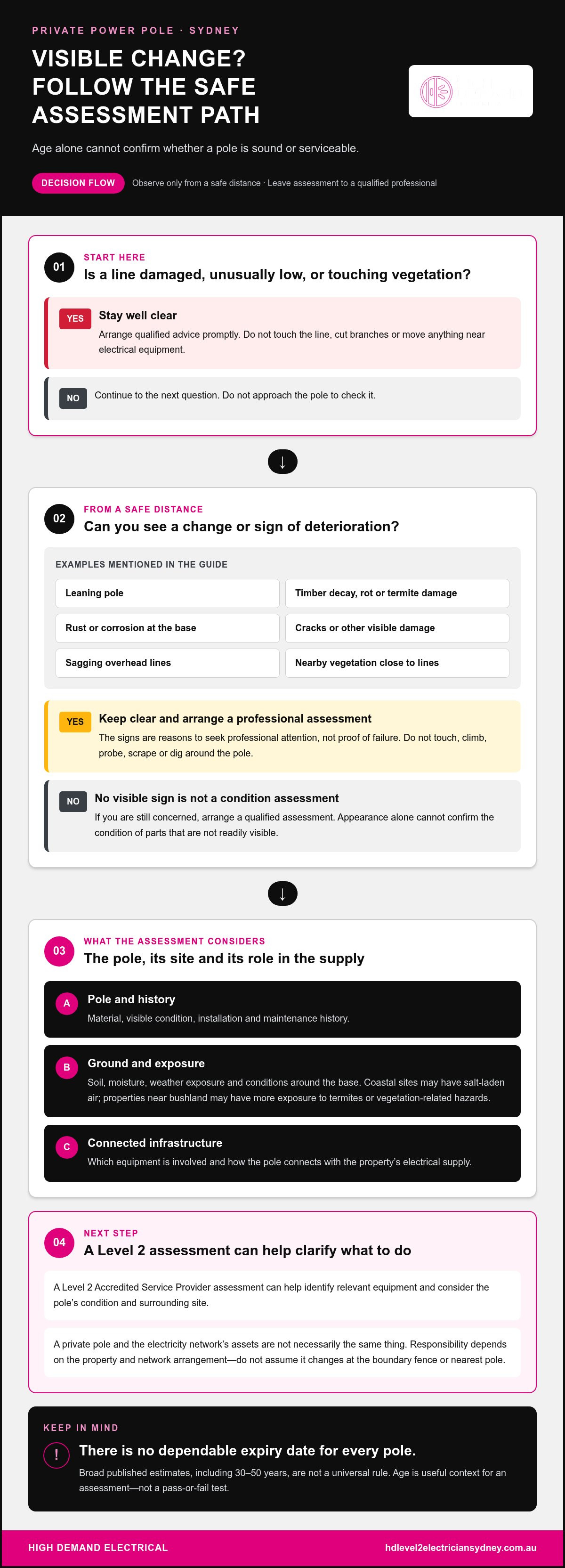
How to assess a private power pole and plan the right next step
A clear process helps you move from concern to an informed decision without putting yourself near electrical hazards. Keep clear, note what you can observe safely, gather any network notice, then arrange a qualified assessment. Don’t climb the pole, touch its components or try to test whether it is stable.
Stay clear of hazards.
Keep people away from a pole, overhead lines or vegetation that may be in contact with electrical equipment. If a line is down or visibly damaged, don’t approach it.
Record what you can see from a safe distance.
Note the location and visible changes, such as a lean, cracking, corrosion or damage. Don’t go closer to take a photograph.
Gather relevant information.
Keep any defect notice or correspondence from the electricity network operator, and note what you know about the pole’s role and connected lines.
Arrange a qualified assessment.
A specialist can consider the pole, its visible condition and the electrical infrastructure connected to it, then explain the appropriate next step.
What happens during a professional assessment?
An assessment is a site review of the pole and relevant electrical infrastructure. The assessor considers its visible condition alongside its function and the site context. The findings help determine whether maintenance, replacement or another response is appropriate. The next step depends on the specific condition and any requirements that apply to the work, rather than age alone.
There isn’t one outcome for every concern. A pole may need attention to a particular issue, or the assessment may indicate that replacement is warranted. The assessor can explain the reasoning and work involved. High Demand Electrical carries out private power pole installation, including replacement work, as part of its electrical infrastructure services.
Who can carry out relevant Sydney power-pole work?
Private pole work involving service lines or a connection to the electricity network calls for appropriate Level 2 expertise. High Demand Electrical is a Level 2 Accredited Service Provider (ASP), authorised for service line, metering and connection work for Ausgrid, Endeavour Energy and Essential Energy. The relevant network operator depends on the property’s location, so Sydney properties aren’t all served by the same distributor.
Using an accredited specialist connects the condition assessment with the service line and connection work that may be needed. High Demand Electrical provides Level 2 electrician services in Sydney, including private power pole work. If you’ve noticed a concern or have a network notice, arrange a qualified private pole assessment to understand the appropriate next step.
When to arrange private power pole work in Sydney
Arrange professional advice if you notice visible damage or deterioration, receive a network notice or can’t establish whether the pole is in sound condition. You don’t need to diagnose the issue yourself. Keep clear of the pole and overhead lines, note what you can see from a safe distance, and share any notice or relevant details with a qualified electrical professional.
A concern doesn’t automatically mean the pole needs replacing. The appropriate work depends on an assessment of its condition, its role in the property’s electrical supply and any requirements that apply. A qualified assessment can help clarify whether maintenance, replacement or another response is appropriate, without relying on an estimated lifespan alone.
How does High Demand Electrical support Sydney property owners?
High Demand Electrical provides private power pole installation, replacement and maintenance across Sydney, including the Inner West, Sydney’s West, South West and the Sutherland Shire. High Demand Electrical is a Level 2 Accredited Service Provider (ASP), authorised for service line, metering and connection work for Ausgrid, Endeavour Energy and Essential Energy. The relevant electricity network operator depends on the property’s location, so the network serving one part of Sydney may differ from another.
Pole work is specialist electrical infrastructure work, not a DIY repair. High Demand Electrical holds Electrical Contractor Licence EC Licence 397193C and triple ISO certification: ISO 9001, ISO 45001 and ISO 14001. If an assessment indicates that installation or replacement is needed, High Demand Electrical’s private power pole installation service is a relevant next step. The recommendation depends on the individual site and findings.
If your concern is an older pole with no obvious damage, uncertainty is still a reasonable reason to seek advice. Share its location, what you’ve noticed from a safe distance and whether you have received a network notice. These details can help frame the discussion, but they don’t replace a professional assessment. Avoid touching the pole, lines or connected equipment while waiting for advice.
What contact details should readers use?
For a specific concern about a private power pole, contact High Demand Electrical by phone on 0402 559 777 or by email at chris@highdemandelectrical.com.au. If you have a network notice, keep it available so you can refer to its instructions and any stated timeframe. If you observe an immediate electrical hazard, stay well clear and contact the relevant network operator for urgent guidance.
You don’t need to decide in advance whether the pole must be replaced. Discuss what you’ve observed and arrange the appropriate next step with a qualified professional. Contact High Demand Electrical about a private power pole.
Make your next step a confident one
There’s no calendar date that can settle the question of how long does a private power pole last at your property. If you’re concerned, seek clear, qualified advice rather than trying to judge the pole yourself. A professional can help you understand its condition and what action, if any, is appropriate.
High Demand Electrical holds Electrical Contractor Licence EC Licence 397193C and triple ISO certification: ISO 9001, ISO 45001 and ISO 14001. It is a Level 2 Accredited Service Provider (ASP), authorised for service line, metering and connection work for Ausgrid, Endeavour Energy and Essential Energy.
Share the specific concern you’ve noticed or the details of a network notice. Contact High Demand Electrical about a private power pole to discuss the next step. Getting informed advice can help you move forward with confidence.
Frequently Asked Questions
How long does a private power pole last?
There’s no dependable expiry age that applies to every private power pole. Some published estimates suggest a broad range of 30-50 years, but it shouldn’t be treated as a universal rule or a guarantee of serviceability. Material, site exposure and current condition vary between properties. A qualified assessment considers the individual pole and its surroundings, since age alone can’t show whether it remains suitable for service.
Is the homeowner responsible for a private power pole?
Responsibility depends on whether the pole and connected infrastructure are privately owned or network owned, and where the relevant boundary sits. Ausgrid’s guidance covers owner responsibilities for private assets in its network area, but Sydney properties don’t all have identical arrangements. Check the relevant electricity network operator’s guidance for your address, particularly if you’re unsure which parts of the supply equipment are yours to maintain.
Can a private power pole be inspected if it was installed recently?
Yes. Recent installation doesn’t mean you should ignore visible damage, a network notice or another safety concern. For example, if a vehicle has struck the pole or you notice a damaged connection, keep clear and arrange an appropriate professional assessment. Don’t climb, touch or test the pole yourself. There’s no need to assume a fault, but it’s sensible to act on a specific concern rather than wait based on the pole’s age.
What happens if Ausgrid sends a defect notice about a private pole?
Read the notice carefully and follow the process it describes for addressing the identified issue. The notice doesn’t automatically mean the pole must be replaced. The appropriate work depends on the defect and the property’s network arrangements. Contact Ausgrid if you need clarification about its notice, and arrange qualified electrical assistance where required. Service line or connection work may need an appropriately accredited provider.
Can trees near a private power pole affect its safety?
Yes. Vegetation near overhead electrical infrastructure can pose a safety concern even if the pole itself appears sound. Ausgrid’s guidance highlights vegetation and community safety, but branches near lines aren’t, by themselves, proof of pole deterioration. Don’t trim branches or handle vegetation close to live lines. Keep clear and follow the relevant network operator’s safety directions about reporting or managing the hazard.
Can I repair or replace a private power pole myself?
No. Don’t climb, touch or attempt repairs to a pole or overhead line. Electrical infrastructure can present serious hazards, and the appropriate work depends on the pole’s condition and the property’s network arrangements. Keep clear of the equipment and arrange an assessment by a suitably accredited service provider for relevant electrical infrastructure work. If you see an immediate hazard, stay well away and contact the relevant network operator.
Powering Your Needs with Expertise
If you’re looking for a reliable, experienced, and prompt electrician, look no further than High Demand Electrical. We cater to all your electrical needs, from routine maintenance to emergency repairs and complete system installations. Our skilled team is committed to providing professional service that ensures your electrical systems run smoothly. Whether it's a small task or a large project, give us a call today. Let us meet all your electrical demands with the quality and reliability you deserve.

