
Separate Meter for a NSW Granny Flat: Get the NMI Before Billing
A granny flat can have a separate meter in NSW, but only when the meter measures supply to that dwelling alone, is installed to industry standards and has its own NMI. With that NMI in place, a tenant can generally be billed. Without it, the landlord usually carries the cost. We offer free site inspections for Level 2 work to confirm where you stand.
TL;DR:
- Wait to bill tenants until the NMI is assigned and the meter is on market; otherwise, landlords generally pay electricity charges.
- A submeter tied to the house meter does not qualify as separate metering, so verify the supply before adding charges to a tenancy agreement.
- Installation usually requires a site inspection, Level 2 electrical work, distributor approval, then retailer setup; approval often creates the longest delay, so start early.
- If a parent connection supplies the flat, check whether it can receive its own NMI; embedded networks can restrict retailer choice and complicate billing.
Table of Contents
- What does separately metered mean for a granny flat?
- When can a tenant be charged for electricity?
- How do you arrange a separate meter for a granny flat?
- What affects the cost and timing of separate metering?
- Are embedded networks a problem for granny flat metering?
- Why a documented Level 2 handover protects you
- Get your granny flat metering sorted with us
- FAQ
- Sources
What does separately metered mean for a granny flat?
NSW guidance sets three tests. The meter must measure supply only to that specific property, it must be installed to industry standards, and it must be assigned its own National Meter Identifier (NMI). The NMI identifies the metering point. Check the relevant electricity paperwork for the NMI assigned to the property.
A submeter fed from the main house meter is different. Check whether the property meets NSW’s requirements for separate metering before passing electricity charges to a tenant.
To assess an existing setup, check these points:
- A dedicated meter is present for the granny flat, not a shared one.
- The meter label or a recent bill shows an NMI for that dwelling.
- The meter box is accessible and in good condition.
- A compliance tag or certificate from the installing electrician is on file.
When can a tenant be charged for electricity?
The Residential Tenancies Act 2010 (NSW) makes separate metering the dividing line for utility liability. Where a property is separately metered, the tenant is generally responsible for electricity charges. Where it is not, the landlord usually must pay electricity and non-bottled gas charges.
That has direct consequences for how you run the tenancy. Billing a tenant before the NMI exists exposes you to a dispute you are likely to lose. A sensible landlord approach looks like this:
- Record the metering arrangement in the tenancy agreement.
- Keep the compliance certificate, NMI details and meter paperwork together.
- Hold off on any tenant billing until the NMI is assigned and the meter is on-market.
- Keep copies of distributor paperwork for the life of the tenancy.
Pro Tip: Ask for an itemised, compliance-based quote and a handover pack that includes the NMI and any distributor paperwork, so every document a tenant or tribunal might ask for is already in one folder.
How do you arrange a separate meter for a granny flat?
The sequence matters, because each party depends on the one before it.
- Book a site inspection. We assess the switchboard, earthing and whether new consumer mains or a private pole are needed. Our new electrical connections page covers granny flat connection work, and our meter relocation service applies when the existing meter must move.
- Level 2 electrical work. We install the meter or submeter where required, upgrade the switchboard or consumer mains, lodge forms with the distribution network service provider (DNSP) and arrange testing and compliance certificates.
- DNSP approval. The distributor may need to review the proposed connection and carry out works. Ask the distributor or electrician about the approval process, timing and any fees.
- Retailer account. Once the metering arrangement is confirmed, check with the retailer and distributor how the tenant can arrange an account and when billing can begin.
At completion, make sure you hold:
- The electrical compliance certificate
- The NMI for the granny flat
- Meter details, including its location and identifier
- Distributor paperwork confirming the connection
If the granny flat will carry heavy loads such as underfloor heating, mention it at inspection. Electric screed heating is one example that affects switchboard capacity.
What affects the cost and timing of separate metering?
Price depends on the work your site needs, not on the meter itself. The main drivers are:
- Switchboard upgrades to carry a second supply
- New consumer mains or a private power pole
- Trenching and conduit between the main house and the granny flat
- Distance to the distributor’s network assets
- Meter relocation complexity
- Distributor fees, which are separate from electrician charges
Embedded-network work is typically more complex and can raise cost and limit retailer choice, which the next section explains.
Timing follows the same order as the steps above: inspection and quote, approvals and scheduling, installation and commissioning, then NMI assignment and retailer switch. Distributor approval is often the longest lead time, so start early if a tenant is waiting.
Pro Tip: Ask your electrician to separate Level 2 charges from distributor charges in the quote, so you can see which costs are negotiable and which are fixed.
Are embedded networks a problem for granny flat metering?
An embedded network supplies several premises through one parent connection. According to the Embedded Network Action Plan, operators can bulk-purchase energy and avoid on-market offers, which can reduce retailer competition for the customers inside it. That limits a tenant’s choice and complicates billing.
To check how the property is supplied, ask:
- Is the dwelling supplied through a parent connection?
- Is the supply passed through a parent meter owned by someone else?
- Who bills for the energy used?
If an embedded network is present, get technical confirmation, check whether an on-market NMI can be assigned, and work out what that means for tenant billing. Embedded networks can occur in multi-dwelling developments and retrofit projects.
Why a documented Level 2 handover protects you
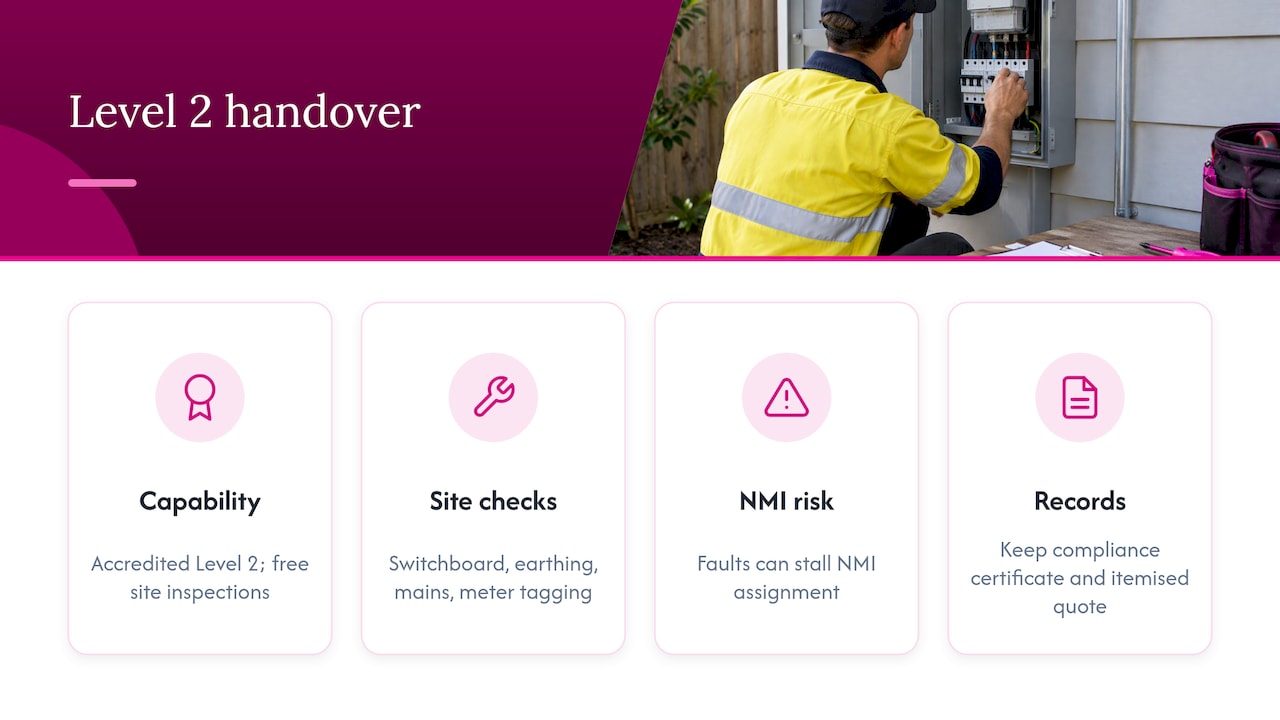
We hold accredited Level 2 capability, run free site inspections for Level 2 work and handle meter relocation and DNSP liaison as part of the job. On site, we check switchboard condition, earthing, consumer mains routing and meter tagging, because a fault in any of them can stall NMI assignment or create a safety problem for your future tenant.
The paperwork is not an afterthought. A landlord who holds the compliance certificate and an itemised quote has a clear record if a billing question ever arises, so ask for both every time.
— Christopher
Get your granny flat metering sorted with us
We handle the full path from inspection to handover. For a granny flat, that includes:
- Level 2 metering services and new electrical connections
- Meter relocation and switchboard upgrades
- DNSP and NMI paperwork
Our free site inspection for Level 2 work lets us assess your site, and we can talk you through the distributor steps as they apply to it. Book a free site inspection with our Level 2 team.

FAQ
Can a tenant be billed for a granny flat’s electricity?
Yes, when the granny flat is separately metered with its own NMI. If it is not, the landlord generally pays, as the Residential Tenancies Act 2010 (NSW) ties liability to separate metering.
What is the difference between a submeter and a separate meter?
A submeter sits inside the property and has no NMI of its own. A separate meter must meet NSW’s requirements, including having its own NMI. The tenant’s responsibility for electricity charges generally depends on whether the property is separately metered.
Who do I contact to get a separate meter installed?
Start with a Level 2 electrician, who inspects the site, does the electrical work and lodges forms with the distributor. Ask the distributor how the NMI is assigned, then check with the retailer about setting up an account.
Do granny flat arrangements affect capital gains tax?
They can. The ATO says granny flat arrangements that are not commercial in nature can be exempt from capital gains tax, while commercial rental arrangements follow normal CGT and income tax rules.
Sources
Recommended
Powering Your Needs with Expertise
If you’re looking for a reliable, experienced, and prompt electrician, look no further than High Demand Electrical. We cater to all your electrical needs, from routine maintenance to emergency repairs and complete system installations. Our skilled team is committed to providing professional service that ensures your electrical systems run smoothly. Whether it's a small task or a large project, give us a call today. Let us meet all your electrical demands with the quality and reliability you deserve.

