Emergency Power Pole Repair Sydney: 24/7 Level 2 ASP Specialist Solutions
Did you know that a leaning or sparking private power pole could legally allow the network to disconnect your entire Sydney property without warning? It's a stressful realisation, especially when you're faced with immediate fire hazards or a strict 21-day defect notice from Ausgrid or Endeavour Energy. If you're currently dealing with a fallen line or a failing timber pole, securing an emergency power pole repair sydney service is the only way to protect your home and maintain your connection to the grid.
We understand that the confusion between private and public responsibility often leads to costly delays and safety risks. This guide clarifies exactly how to restore your power fast while ensuring full compliance with the NSW Electricity Supply Act 1995. You'll learn why a Level 2 ASP specialist is mandatory for these high-stakes repairs, what to expect regarding pole replacement timelines, and how to resolve network defects before they result in a total power disconnection.
Key Takeaways
• Understand your legal obligations as a Sydney property owner regarding the maintenance and safety of private power poles within your boundary.
• Learn how to identify critical warning signs, such as ground-line rot or structural leaning, that indicate a need for immediate emergency power pole repair sydney.
• Navigate the strict 21-day rectification window following an Ausgrid or Endeavour Energy defect notice to prevent a total loss of power.
• Evaluate the structural and financial benefits of upgrading to fire-resistant galvanised steel poles compared to traditional timber repairs.
• Discover why only an accredited Level 2 ASP is authorised to perform high-risk electrical work on overhead and underground service lines.
Emergency Power Pole Issues: Private Liability and Sydney Safety
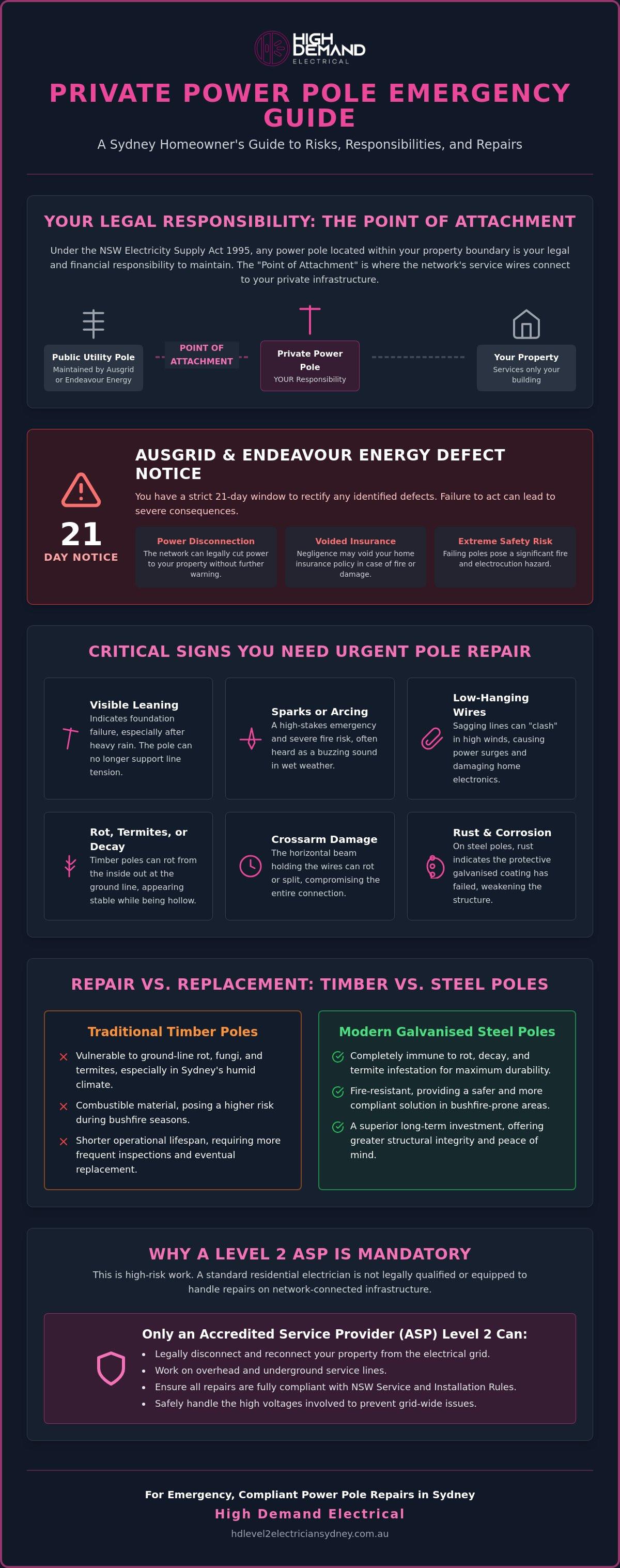
A private power pole is the essential piece of infrastructure that supports the overhead electrical lines connecting your Sydney property to the street mains. While a standard Utility Pole on the street is maintained by network providers like Ausgrid or Endeavour Energy, any pole located within your property boundary is generally your legal responsibility. In Sydney, homeowners often don't realise they own this asset until a storm or structural failure necessitates an emergency power pole repair sydney specialist. Under the NSW Electricity Supply Act 1995, the legal "Duty of Care" for this equipment rests solely with the property owner.
This responsibility means you must ensure the pole is structurally sound and free from encroaching vegetation. If a pole begins to lean dangerously or the crossarms show signs of rot, you can't simply call a standard residential electrician. Standard electricians aren't authorised to work on network-connected infrastructure because they lack the specific Level 2 ASP (Accredited Service Provider) qualification. Only an ASP Level 2 can legally disconnect and reconnect your service from the grid to perform safe, compliant repairs.
Private vs. Public Poles: Where Does Your Responsibility Start?
The line of financial liability is determined by the "Point of Attachment." This is the precise spot where the network's service wires meet your private electrical infrastructure. If the pole is located on your land and only services your building, it's a private pole. A common misconception among Sydney residents is that storm damage to a pole on a nature strip is always the network's problem. However, if that pole exists specifically to facilitate your connection, the network provider will likely issue a defect notice requiring you to organise an emergency power pole repair sydney at your own expense.
The Legal Risks of Delayed Emergency Repairs
Ignoring signs of instability creates significant legal and financial exposure. NSW Service and Installation Rules dictate strict safety standards for private poles to prevent grid interference and fire hazards. If your pole is identified as a bushfire risk during a network inspection, you'll receive a defect notice with a mandatory rectification deadline. Failure to act doesn't just risk a power cut; it can void your home insurance. Most policies require you to maintain your property to a safe standard. If a neglected pole sparks a fire, your insurer may argue you breached your duty of care, leaving you liable for the full cost of damages. Engaging a specialist ensures your property remains compliant and your insurance coverage stays intact.
Critical Signs You Need Urgent Power Pole Repair
Identifying a failing private power pole before it collapses is the most effective way to prevent property damage and sudden grid disconnection. While some issues are obvious, others remain hidden beneath the soil line or high up in the crossarms. If you notice any of the following physical red flags, organising an emergency power pole repair sydney specialist should be your immediate priority to ensure the safety of your household and the surrounding community.
Visible leaning is often the first indicator of structural instability. This usually occurs after heavy Sydney rain when soil movement allows the pole's foundation to shift. Any angle that deviates significantly from vertical suggests that the pole is no longer capable of supporting the tension of the overhead service lines. Similarly, arcing or sparking wires are high-stakes emergencies. During humid or wet weather, compromised insulation can cause electricity to jump between wires or to the pole itself, creating a severe fire risk. If you hear a persistent buzzing sound or see flashes, the infrastructure is actively failing.
Low-hanging service lines present a different kind of danger. When wires sag too low, they are prone to "clashing" during high winds, which leads to power surges and potential damage to your home’s sensitive electronics. If your lines appear lower than usual, or if you spot rust and corrosion on a galvanised steel pole, the structural integrity of your connection is at risk. For a professional assessment of these hazards, you should consult an accredited Level 2 ASP to determine if a repair or a full replacement is necessary.
Timber Pole Failures: Rot, Termites, and Decay
Sydney's high humidity and soil moisture levels make timber poles particularly susceptible to ground-line rot. This decay often starts from the inside out, meaning a pole can look sturdy on the surface while being completely hollowed by fungi or termites. Professionals often use a "tap test" with a specialised hammer to listen for hollowing, but homeowners should look for "fruiting bodies" or mushrooms growing at the base. These fungi signal advanced wood decay that has already compromised the pole's strength.
Steel Pole Vulnerabilities: Rust and Structural Integrity
While galvanised steel is durable, it isn't invincible, especially in coastal Sydney areas like the Northern Beaches or Eastern Suburbs. Salt air accelerates corrosion, leading to "pitting" where the metal surface becomes pockmarked and thin. The most critical area to inspect is the base, where the steel meets the concrete or soil. If the rust has eaten through the protective galvanised layer, the structural base may be compromised beyond simple repair, necessitating an emergency power pole repair sydney to prevent a total collapse during the next storm.
The Repair vs. Replacement Decision: Timber vs. Steel
Once a fault is identified, the critical question is whether to patch the existing infrastructure or invest in a full upgrade. This decision isn't purely financial; it's a matter of grid compliance and long-term property safety. An emergency power pole repair sydney specialist will assess the pole's structural health by examining the "effective remaining circumference" at the ground line and the condition of the top-side hardware. If the pole's core is compromised by rot or termites, a simple repair may only be a temporary band-aid that fails to meet Ausgrid or Endeavour Energy safety standards.
We use a specific set of criteria to determine if a pole is "serviceable" or "limited life." If the structural integrity is mostly intact, targeted repairs can extend the asset's utility. However, if the pole has lost significant strength, a full replacement is often the most cost-effective path over a ten-year horizon. During this assessment period, we often install Tiger Tails. These high-visibility yellow and black pipes provide a temporary insulation barrier for overhead lines, protecting workers and residents while permanent repair plans are finalised.
When is Repair a Viable Option?
Repair is often suitable when the damage is localised to the hardware rather than the pole itself. Common scenarios where we can avoid a full replacement include:
Crossarm Replacement
If the timber or steel crossarm is split or sagging but the pole is solid, we can replace just the arm and insulators.
Consumer Mains Re-tensioning
Over time, overhead wires can sag due to heat or wind. We can re-tension these lines to restore safe clearances from roofs and trees.
Pole Staking
For timber poles with minor ground-line decay, installing a galvanised steel reinforcement (a "stake") can provide another 10 to 15 years of life without the cost of a full extraction.
Choosing the Right Material for Your Sydney Property
If replacement is unavoidable, you must choose between traditional timber and modern galvanised steel. Timber poles remain a cost-effective choice for many, offering a typical lifespan of 20 to 25 years. They're resilient in various soil types but require regular inspections for termite activity and fungal rot, which thrive in Sydney's humid climate.
In contrast, galvanised steel poles are increasingly the standard for emergency power pole repair sydney projects. While the initial investment is higher, steel poles offer a lifespan of 40 to 70 years. They're completely fire-resistant, making them the superior choice for bushfire-prone areas. Steel is also lighter and easier to install in sites with limited access. For coastal properties, we ensure the steel is treated to resist salt-spray corrosion, providing a maintenance-free solution that outlasts timber by decades.
Navigating Ausgrid and Endeavour Energy Defect Notices
Receiving an official defect notice from Ausgrid or Endeavour Energy is a serious matter that requires immediate attention. These notices are issued when a network inspector identifies a hazard on your property that could compromise the safety of the electricity grid. Common triggers include structural instability in your private pole, insufficient vegetation clearance, or degraded consumer mains. If you've been served a notice, you usually have a strict 21-day window to rectify the issue. Ignoring this deadline doesn't just result in fines; it leads to a "forced disconnection," where the network operator physically cuts your power to protect the public. In these high-stakes scenarios, arranging an emergency power pole repair sydney specialist is the only way to ensure your property remains connected.
The role of an Accredited Service Provider (ASP) Level 2 is critical in this process. Unlike standard electricians, a Level 2 specialist has the authority to submit a Notice of Service Work (NOSW) to the network provider. This document serves as official proof that the defect has been rectified to NSW electrical safety standards. Once we complete the necessary repairs, we lodge the compliance paperwork, which "clears" the notice in the network's database. Without this specific certification, the network won't recognise the repair as valid, and your disconnection risk remains. If you need to resolve a compliance issue quickly, you should contact our Level 2 ASP team to fast-track your repairs.
The Defect Notice Lifecycle: From Inspection to Clearance
The lifecycle begins with a routine inspection. Network operators use both ground teams and aerial drones to spot non-compliant infrastructure. If a fault is found, they issue a formal letter detailing the required corrective actions. You must then engage an ASP Level 2 to perform the work and provide a Certificate of Compliance for Electrical Work (CCEW). If the 21-day deadline is approaching and the work isn't finished, the network may grant a short extension, but only if an accredited professional has already been engaged and a clear plan is in place. The paperwork trail is just as important as the physical repair to avoid power loss.
Dealing with 'Urgent' Defects and Power Outages
Some notices are marked as "Life Threatening" or "Urgent." This usually involves arcing wires, sparking crossarms, or a pole that is actively falling. In these cases, the network may disconnect the power immediately for safety. Coordinating a safe "Disconnect/Reconnect" requires precise timing between the ASP and the network operator to minimise downtime. If you're facing a sudden outage due to a defect, our Emergency Electrician Sydney service manages the entire power failure protocol, from site isolation and emergency power pole repair sydney to final grid reconnection. We ensure your site is made safe before the network's manual re-energisation occurs.
Why High Demand Electrical is Sydney's Trusted ASP Level 2
High Demand Electrical operates as an authoritative rapid responder for all critical grid-connection issues. As an accredited Level 2 ASP, we possess the specialised certification required to work on both overhead and underground service lines. This qualification is mandatory for any emergency power pole repair sydney project involving live network connections. We don't just fix a leaning pole; we manage the entire technical and regulatory lifecycle of your electrical infrastructure. Our team is available 24/7 across the Sydney region to address storm damage, fallen lines, or structural failures that threaten your property's safety.
Our comprehensive service model ensures you aren't left managing multiple contractors. We handle Private Power Pole Installation, Consumer Mains Installation, and Switchboard Upgrades within a single, coordinated workflow. This holistic approach is vital because a pole failure often reveals underlying issues with consumer mains or non-compliant switchboards. By choosing a specialist who understands the interplay between these components, you ensure a safer, more resilient connection to the Ausgrid or Endeavour Energy networks. Our transparent process provides you with technical reassurance during high-stakes repairs.
Our Approach to Emergency Pole Repairs
Safety is the non-negotiable foundation of our methodology. Upon arrival at a high-risk site, we immediately secure the area to prevent accidental contact with live components. We often deploy Tiger Tail Installation to provide high-visibility insulation for overhead wires while repairs are underway. Our technicians are experts in complex infrastructure, often upgrading consumer mains alongside pole replacements to ensure your system handles modern electrical loads. We only use NSW-compliant materials, offering both traditional timber and high-durability galvanised steel to suit your specific site requirements and soil conditions.
Securing Your Sydney Property Today
While we thrive in crisis situations, we advocate for a proactive approach to electrical safety. Routine inspections of your private poles can identify ground-line rot or termite activity before they escalate into a costly emergency. Our deep familiarity with local Sydney conditions and network provider regulations allows us to clear defect notices faster than generalist providers. We provide transparent, detailed assessments that help you understand the long-term value of your infrastructure choices. Don't wait for a total power disconnection or a fire hazard to compromise your home. Contact High Demand Electrical for Emergency Power Pole Repair to secure your property with Sydney's Level 2 ASP specialists.
Restore Safety and Compliance to Your Sydney Property
Your private power pole is the backbone of your property's electrical connection, making its maintenance a critical legal and safety priority. We've explored how identifying early warning signs like ground-line rot or structural leaning can prevent the sudden loss of power or the risk of fire. Whether you're navigating a strict 21-day defect notice from Ausgrid or managing storm damage, the resolution depends on the expertise of an accredited specialist.
Securing a professional emergency power pole repair sydney ensures your infrastructure meets current NSW safety standards while protecting your insurance validity. By choosing to repair or upgrade to durable galvanised steel, you invest in decades of reliable service and grid compliance. As a fully accredited Level 2 ASP with 24/7 emergency response capabilities across Sydney, we are authorised by both Ausgrid and Endeavour Energy to handle your high-risk electrical needs with absolute precision.
Don't let a leaning pole or a defect notice compromise your property's safety. Request an Emergency ASP Level 2 Inspection Now to restore your power and peace of mind today. We're ready to help you navigate these complex regulations and get your connection back on track.
Frequently Asked Questions
Who is responsible for a power pole on my property in Sydney?
Property owners are legally responsible for the maintenance and safety of private power poles and all electrical equipment on their property beyond the network connection point. This includes the pole itself, the crossarms, and the consumer mains that connect to your switchboard. If the pole is located within your boundary and exists specifically to facilitate your supply, it's your asset to maintain under NSW safety regulations.
How much does it cost to replace a private power pole in Sydney?
The total investment depends on several variables, such as the pole material, site accessibility, and the height required for safe line clearance. Factors like whether you choose galvanised steel over timber or if the foundation requires specialised drilling through rock will influence the final cost. We provide tailored assessments to ensure your new installation meets all current network standards without unnecessary overheads.
Can any electrician fix a private power pole?
No, standard electricians aren't authorised to perform work on private power poles that are connected to the electricity distribution network. Only a Level 2 Accredited Service Provider (ASP) has the specific certification required to disconnect and reconnect your service from the grid. Engaging an unaccredited contractor for this work is illegal and can lead to immediate disconnection by the network operator.
What should I do if my power pole is leaning after a storm?
If you notice a leaning pole after a storm, you must treat the area as life-threatening and keep a safe distance from all wires. Contact an emergency power pole repair sydney specialist immediately to assess the structural stability of the foundation. Soil movement after heavy rain is a common cause of failure, and a leaning pole can quickly lead to clashing wires or a total collapse.
How long does an emergency power pole repair take?
Most emergency repairs are completed within a single day, though the exact timeframe depends on the severity of the damage. A simple crossarm replacement or line re-tensioning may take only a few hours. However, a full pole replacement involves coordinating with the network for isolation, excavation, and re-connecting your consumer mains, which typically requires a full day of onsite work.
What is a Level 2 ASP and why do I need one for pole work?
A Level 2 ASP is an electrician specially accredited by network operators like Ausgrid and Endeavour Energy to work on the distribution network. You need one because pole work involves high-risk tasks like handling live overhead service lines and underground consumer mains. They're the only professionals authorised to lodge the official compliance paperwork required to clear network defect notices.
Will my insurance cover the cost of a private power pole replacement?
Insurance coverage often depends on the cause of the damage and your specific policy terms. Many insurers cover pole replacements caused by sudden events like storms, falling trees, or vehicle impacts. However, they may deny claims if the failure is attributed to long-term neglect, such as untreated termite damage or ground-line rot that should've been identified during routine maintenance.
How do I clear an Ausgrid or Endeavour Energy defect notice fast?
To clear a notice quickly, you must engage a Level 2 ASP to rectify the identified safety hazards before the 21-day deadline. Once the emergency power pole repair sydney is complete, your ASP will lodge a Notice of Service Work (NOSW) and a Certificate of Compliance (CCEW) with the network. This digital lodgement is the official mechanism that informs the network provider that your property is now safe and compliant.
Powering Your Needs with Expertise
If you’re looking for a reliable, experienced, and prompt electrician, look no further than High Demand Electrical. We cater to all your electrical needs, from routine maintenance to emergency repairs and complete system installations. Our skilled team is committed to providing professional service that ensures your electrical systems run smoothly. Whether it's a small task or a large project, give us a call today. Let us meet all your electrical demands with the quality and reliability you deserve.