AS/NZS 3000: A Sydney Homeowner’s Guide to the Wiring Rules
Could electrical work follow the Wiring Rules and still need to meet separate requirements before it connects to Sydney’s electricity network? Homeowners can easily confuse the national installation standard with NSW’s service rules, even though each has a distinct role.
If you’re planning electrical work, it helps to understand which requirements may apply and what information to share before work begins. This guide explains what as/nzs 3000 covers, how it sits alongside NSW requirements, and what to clarify about the project with your electrician.
We’ll look at AS/NZS 3000:2018, known as the Wiring Rules, and the Service and Installation Rules of NSW (SIRNSW), including their connection to network work. You’ll also see how details such as consumer mains, switchboard upgrades or a defect notice shape a project discussion. This context can help you ask clear questions and understand the work being planned at your Sydney property.
Key Takeaways
• Understand what AS/NZS 3000 means for electrical work and why its current requirements need to be considered for your project.
• See how the Wiring Rules differ from NSW’s Service and Installation Rules, and where network operators fit.
• Prepare for a project by describing the work, gathering relevant documents and noting property details or observed concerns.
• Learn how consumer mains work, switchboard upgrades and defect notice rectification relate to electrical projects.
• Find out how High Demand Electrical serves Sydney, including the Inner West, Sydney’s West, South West and the Sutherland Shire, with Level 1 and Level 2 ASP accreditations.
What is AS/NZS 3000, and why do the Wiring Rules matter?
AS/NZS 3000 is the Wiring Rules. Homeowners may hear the term when planning electrical work, discussing an inspection or trying to understand requirements for a property. The standard gives a shared reference point, but its name alone doesn’t explain what a specific job requires or confirm whether an installation meets the applicable requirements.
That distinction matters when you’re deciding what to do next. A general guide can explain the terminology and help you prepare questions, but it can’t replace the current standard or an assessment of the installation. Requirements depend on the work and property. Treat an overview as background information, not as approval to carry out work or proof of compliance.
What does the name AS/NZS 3000 tell readers?
AS/NZS 3000 is the standard’s code, while “Wiring Rules” is its plain-language name. The code helps identify the document being discussed, but it doesn’t tell you which technical requirement applies to your project. For context about the organisation behind Australian standards, see Standards Australia, the developer of AS/NZS 3000.
The edition identified in this guide is AS/NZS 3000:2018, with amendments issued since publication. The edition label helps identify the standard, but it isn’t a substitute for consulting the current document. Requirements can be technical and depend on the job, so don’t use a summary to decide how wiring or equipment must be installed.
When might a property owner encounter the Wiring Rules?
You may hear about the Wiring Rules while planning electrical work, discussing a proposed change or reviewing an inspection finding. For example, a conversation about consumer mains or a switchboard upgrade may involve questions about which requirements apply to that work. It doesn’t follow that every project has the same requirements or outcome.
If an inspection identifies a concern, keep a record of what was reported and share any relevant documents with your electrician. Don’t open equipment, handle wiring or attempt a repair to investigate it yourself. High Demand Electrical carries out electrical safety inspections in Sydney to help assess concerns at a property. An inspection can inform the discussion, but this general explanation can’t determine whether an individual installation complies. Learn more about a Sydney electrical safety inspection.
Before work starts, set out the proposed work and share the property details, inspection notes or defect information you have. Ask for a clear explanation of how those details affect the work being planned. The standard provides a common reference; the current requirements and the condition of the installation need to be considered before reaching a compliance conclusion.
What does AS/NZS 3000 cover, and what needs checking?
A reference to the Wiring Rules identifies a standard, but it doesn’t tell you exactly what it means for a particular job. The document is technical, so an overview can help you follow a project discussion, but it can’t replace checking the current source and assessing the work. Avoid relying on an old note, a general summary or a clause quoted without context as proof that an installation meets the applicable requirements.
Check standard-specific requirements against the current source. This matters before making decisions about proposed work or drawing conclusions from an inspection. The current document, the type of work and the property circumstances all matter. The guidance here helps you frame the discussion; it isn’t clause-by-clause technical advice or a compliance assessment.
How to read a standard reference without guessing its requirements
A reference to AS/NZS 3000 points to a standard, but a code alone doesn’t set out every obligation for every project. Don’t infer a particular device, clearance, test or installation method from a general description. If a specific technical example matters to your project, have its application explained against the current standard and relevant guidance. As a property owner, treat a brief reference as a prompt to ask how the requirement applies to the work being considered.
It’s useful to distinguish between what a standard says, how a qualified professional applies it to the proposed work, and whether the completed installation has been assessed. Those are different questions. An article can explain why a standard reference matters, but it shouldn’t claim that a particular setup complies without an appropriate assessment.
Why project details matter when applying a standard
The useful questions depend on the work and the property. A discussion about consumer mains may need different project details from one about a switchboard upgrade. These examples identify types of work, not confirmed requirements under AS/NZS 3000. The applicable technical requirements need to be checked for the actual job.
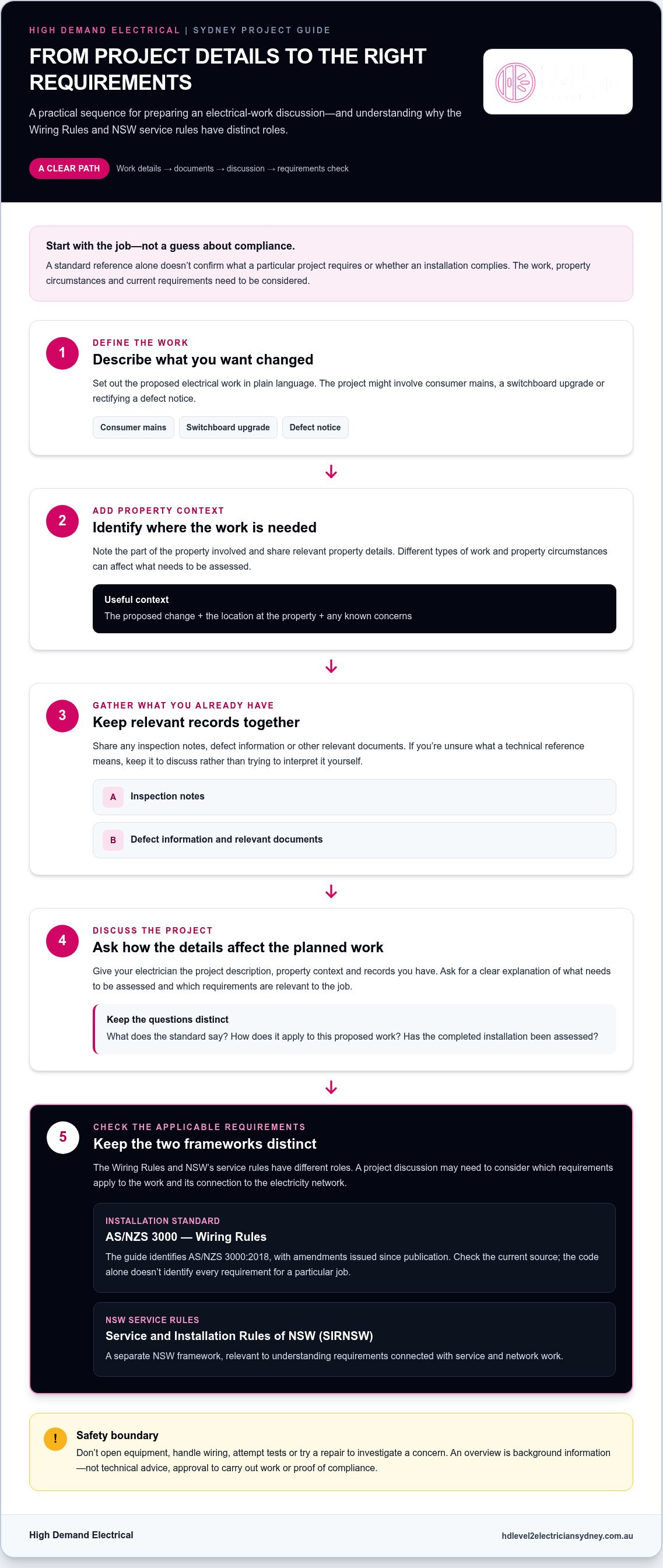
Before discussing proposed work, organise the information you already have. Describe what you want changed, identify the part of the property involved, and share relevant inspection notes or defect information. If you’re unsure what a document means, keep it to share with your electrician rather than trying to interpret technical references yourself. Don’t remove covers, handle wiring or attempt tests to gather more information.
Clear project information helps your electrician explain what needs to be assessed and which requirements are relevant. For consumer mains or switchboard work, you can discuss your electrical project with High Demand Electrical. The aim is to understand the work in context, not to draw a conclusion from a general summary.
AS/NZS 3000 and NSW rules: how the named frameworks differ
Electrical work in Sydney can involve more than one framework. AS/NZS 3000 is the Wiring Rules. The Service and Installation Rules of NSW (SIRNSW) set out NSW-specific service and installation requirements, while Ausgrid, Endeavour Energy and Essential Energy are network operators relevant to connections across the state. These terms are related, but they don’t mean the same thing.
The table below is a starting point for understanding the names, not a substitute for checking current documents. The requirements relevant to a project depend on the work and property. High Demand Electrical can assess the project and explain which frameworks are relevant, rather than treating one reference as the answer to every question.
| Framework or organisation | Plain-language role |
|---|---|
| AS/NZS 3000 | The electrical standard commonly known as the Wiring Rules. |
| Service and Installation Rules of NSW (SIRNSW) | NSW service and installation rules relevant to connection with electricity distribution networks. |
| Ausgrid | An electricity distribution network operator in NSW. |
| Endeavour Energy | An electricity distribution network operator in NSW. |
| Essential Energy | An electricity distribution network operator in NSW. |
AS/NZS 3000 and the Service and Installation Rules of NSW
AS/NZS 3000 and SIRNSW are separate frameworks. The Wiring Rules provide a national reference for electrical installation work; SIRNSW covers service and installation requirements in NSW, including requirements associated with connections to distribution networks. They aren’t interchangeable documents. Check the current requirements and their application to the project before reaching a technical or compliance conclusion.
This distinction is useful when proposed work involves both the electrical installation at a property and its connection to a network. It doesn’t mean that every job involves the same documents or triggers the same requirement. A reference to one framework alone may not describe everything relevant to a particular project.
Where Ausgrid, Endeavour Energy and Essential Energy fit
These network operators manage distribution networks in NSW. The network operator relevant to a property depends on its location. High Demand Electrical’s documented accreditation is: Level 2 Accredited Service Provider (ASP) - authorised for service line, metering and connection work for Ausgrid, Endeavour Energy and Essential Energy. This describes the business’s network-work scope; it doesn’t, by itself, establish whether a particular installation complies with a standard.
For work involving service lines, metering or connections, High Demand Electrical’s Level 2 electrical services relate directly to this network context. The applicable rules still need to be considered for the project. A clear explanation should distinguish network requirements from installation standards rather than combining them into a blanket claim.
Electrical work: practical questions for Sydney property
A clear starting point makes a standards-related discussion more useful. Before speaking with an electrician, think about what you want done, what you’ve noticed and what information you can share. You don’t need to interpret AS/NZS 3000 or diagnose an electrical issue yourself. Describe the situation accurately and leave technical assessment and electrical work to a qualified professional.
Information to organise before discussing electrical work
Keep your preparation simple. Gather details that help explain the property and proposed work without trying to decide which technical rule applies. A short written summary is useful if you have several changes or concerns to discuss.
Define the work.
Describe the planned change in plain language, such as work involving the consumer mains or a switchboard upgrade.
Identify the property.
Record the address and, if relevant, which part of the property the work or concern relates to.
Gather relevant information.
Keep any inspection document, defect notice, previous work records or photographs you already have, if available.
Describe what you observed.
Say what you noticed and when, without opening equipment, touching wiring or attempting a test or repair.
These are practical preparation steps, not a regulatory checklist. If you have an inspection report or defect notice, share its wording rather than trying to interpret technical references on your own. That gives your electrician useful context to assess the issue and explain which information or work is relevant.
When the project involves consumer mains or a switchboard
High Demand Electrical undertakes consumer mains work and switchboard upgrades. These are distinct project types, so the right discussion depends on the proposed change and the property. For information about supply infrastructure at a property, the consumer mains installation page explains the relevant service. A general description still can’t determine the requirements for an individual installation.
If a concern comes from an inspection, High Demand Electrical can carry out an electrical safety inspection to assess the property and identify issues for discussion. If you’re planning switchboard work, describe the intended change and share any relevant documents. Don’t assume a particular upgrade is required, or that a proposed setup meets a standard, before the work has been assessed.
Once the project details are clear, High Demand Electrical can explain the proposed work and the requirements that need to be checked against current sources. For guidance on electrical work at your Sydney property, get in touch and outline the project. Share what you know; leave technical conclusions and hands-on investigation to a qualified professional.
How High Demand Electrical handles standards-related work in Sydney
Standards references become more useful when connected to the work at your property. High Demand Electrical helps Sydney property owners with consumer mains work, switchboard upgrades and defect notice rectification. The first step is to understand the work involved and the property details, then explain the relevant project considerations clearly. A general discussion of AS/NZS 3000 doesn’t, by itself, establish that a specific installation complies.
High Demand Electrical serves Sydney-wide, including the Inner West, Sydney’s West, South West and the Sutherland Shire. To start a discussion, describe the proposed work or share information from an inspection or defect notice. That gives the conversation a practical focus. The applicable technical requirements and any compliance assessment need to be considered in the context of the actual work.
Documented accreditation, licence and certifications
High Demand Electrical’s network-work credentials include Level 2 Accredited Service Provider (ASP) - authorised for service line, metering and connection work for Ausgrid, Endeavour Energy and Essential Energy. Its documented Level 1 accreditation is Level 1 Accredited Service Provider (ASP) - newly accredited with IAC for network construction and new connection work, in addition to Level 2 service/metering work.
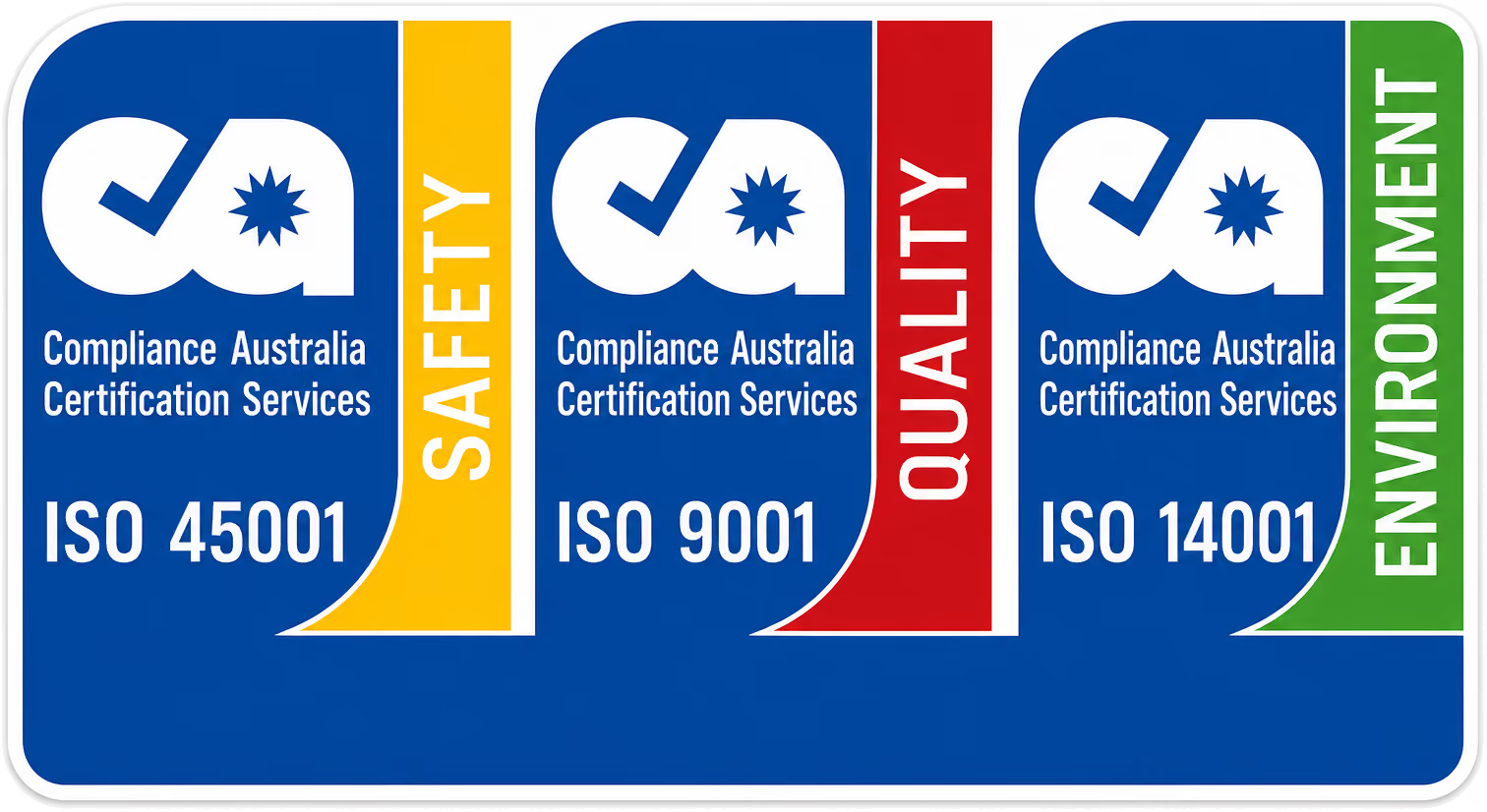
The business holds EC Licence 397193C and has triple ISO certification: ISO 9001 (Quality Management), ISO 45001 (Health and Safety) and ISO 14001 (Environmental Management). These credentials describe the business’s licence, accreditations and management systems. They don’t declare that every installation or proposed job meets AS/NZS 3000 or another applicable requirement. Project-specific requirements still need to be assessed and verified.
Discuss your Sydney electrical project
If you’ve received a defect notice, are planning consumer mains work or need to discuss a switchboard upgrade, share the project details and any relevant documents with High Demand Electrical. Explain what you’ve observed without attempting electrical work yourself. The team can discuss the work in plain English and explain the relevant next steps, while considering the requirements for the specific project.
For enquiries, call 0402 559 777 or email chris@highdemandelectrical.com.au. Contact High Demand Electrical to discuss your Sydney electrical project and the work you’re planning.
Contact High Demand Electrical about your project
Take the next step with confidence
Before electrical work begins, turn what you’ve learned about as/nzs 3000 into a practical next step: describe what you want changed, gather relevant paperwork and note what you’ve observed. Leave technical checks and conclusions about the installation to a qualified electrician. A clear project discussion helps you understand the work being considered and which requirements need to be verified for your property.
High Demand Electrical’s credentials include EC Licence 397193C, ABN 87 051 836 527, Level 2 Accredited Service Provider (ASP) - authorised for service line, metering and connection work for Ausgrid, Endeavour Energy and Essential Energy, and ISO 9001, ISO 45001 and ISO 14001 certification. These qualifications provide context for discussing electrical work, but don’t guarantee a particular compliance outcome.
Ready to discuss your plans or an electrical concern? Contact High Demand Electrical about your Sydney electrical project. Call 0402 559 777 or email chris@highdemandelectrical.com.au to get the conversation started.
Frequently Asked Questions
What is AS/NZS 3000?
AS/NZS 3000 is the standard known as the Wiring Rules. The name identifies the document, but it isn’t enough to determine what applies to a particular electrical job. Check the current authoritative standard for its scope and requirements. A general explanation can help you understand a reference, but it can’t assess your property or confirm whether specific work complies.
What does “Wiring Rules” mean in the supplied standards list?
“Wiring Rules” is the plain-language label used alongside the AS/NZS 3000 code. It helps you recognise which standard a document or discussion refers to, but it doesn’t explain every technical requirement. Check the authoritative source if you need to understand its scope, a clause or the current edition. A label or summary alone isn’t an assessment of your home’s electrical installation.
Is AS/NZS 3000 the only framework named for NSW electrical work?
No. Other named frameworks and organisations include the Service and Installation Rules of NSW (SIRNSW), Ausgrid, Endeavour Energy and Essential Energy. Their names alone don’t explain the detailed scope of each framework or how requirements apply to a particular job. Consider the current authoritative material and the specific work when planning a project.
Which network operators are named in High Demand Electrical’s Level 2 accreditation?
The named network operators are Ausgrid, Endeavour Energy and Essential Energy. The documented wording is: “Level 2 Accredited Service Provider (ASP) - authorised for service line, metering and connection work for Ausgrid, Endeavour Energy and Essential Energy”. This states the accreditation’s documented scope. It doesn’t confirm that a particular project complies with applicable requirements.
What qualifications does High Demand Electrical list?
High Demand Electrical holds EC Licence 397193C and has ABN 87 051 836 527. Its triple ISO certification comprises ISO 9001 (Quality Management), ISO 45001 (Health and Safety) and ISO 14001 (Environmental Management). These identifiers describe documented business credentials; they don’t determine which technical requirements apply to a specific installation or confirm the outcome of electrical work at a property.
How can Sydney property owners discuss work involving AS/NZS 3000?
Contact High Demand Electrical to discuss consumer mains work, a switchboard upgrade or defect notice rectification. Share a plain-language description of the proposed work and any relevant notice or inspection documents. The requirements for AS/NZS 3000 need to be considered against current authoritative sources and the property details. Call 0402 559 777 or email chris@highdemandelectrical.com.au to start the conversation.
Powering Your Needs with Expertise
If you’re looking for a reliable, experienced, and prompt electrician, look no further than High Demand Electrical. We cater to all your electrical needs, from routine maintenance to emergency repairs and complete system installations. Our skilled team is committed to providing professional service that ensures your electrical systems run smoothly. Whether it's a small task or a large project, give us a call today. Let us meet all your electrical demands with the quality and reliability you deserve.