7kW vs 22kW EV Charger: Which Do You Actually Need?
Every EV charger spec sheet leads with kW, so it's natural to assume more is better. But charger speed is only useful if your property's electricity supply — and your daily driving — can actually make use of it. A 22kW charger sitting on a single-phase home doesn't run at 22kW; it's capped at whatever your supply allows, and the "upgrade" you paid for goes unused.
Below, we break down what 7kW and 22kW chargers actually deliver overnight, why single-phase 7kW is the right call for roughly 9 in 10 homes, and the specific situations where stepping up to a three-phase 22kW setup genuinely pays off.
7kW vs 22kW: What's Actually Different
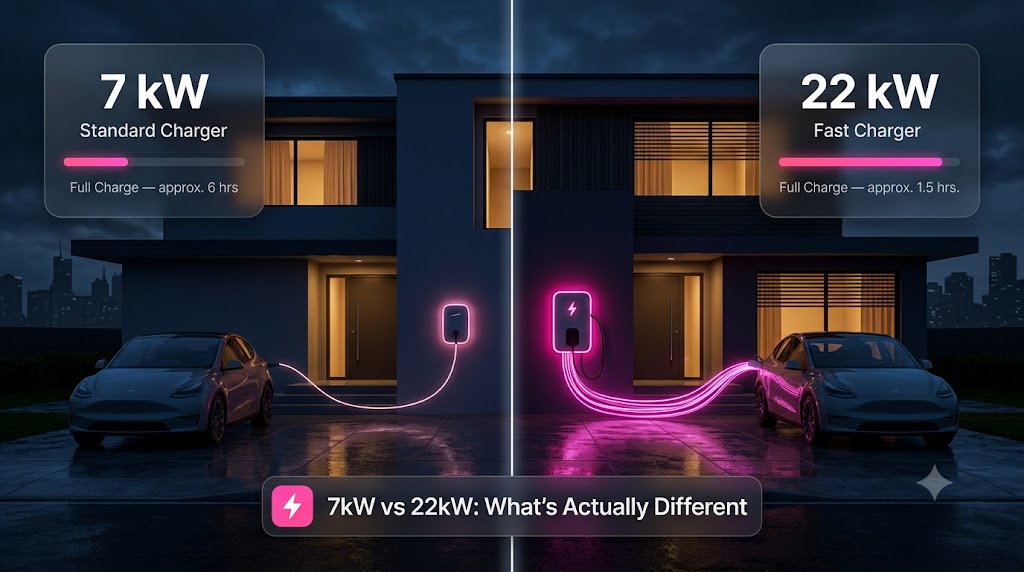
The kW rating of a home EV charger comes down to two things: how many "phases" of electricity your property has, and how much current the circuit is rated to carry.
- 7kW (single-phase, ~32A): The standard home charger output on a typical single-phase electricity supply — what most Sydney houses and apartments already have at the switchboard.
- 22kW (three-phase, ~32A per phase): Requires a three-phase supply, where three separate active conductors deliver power simultaneously rather than one. Common in newer builds, larger homes, and most commercial and strata buildings, but far from universal in older residential Sydney.
A charger can only output what your property's supply — and the vehicle's onboard charger — will actually accept. Most mainstream EVs sold in Australia cap their AC charging rate well below 22kW anyway (many single-motor models top out around 7–11kW), which is one reason the 22kW figure looks more impressive on paper than it often is in practice.
How Much Range Do You Actually Get Overnight?
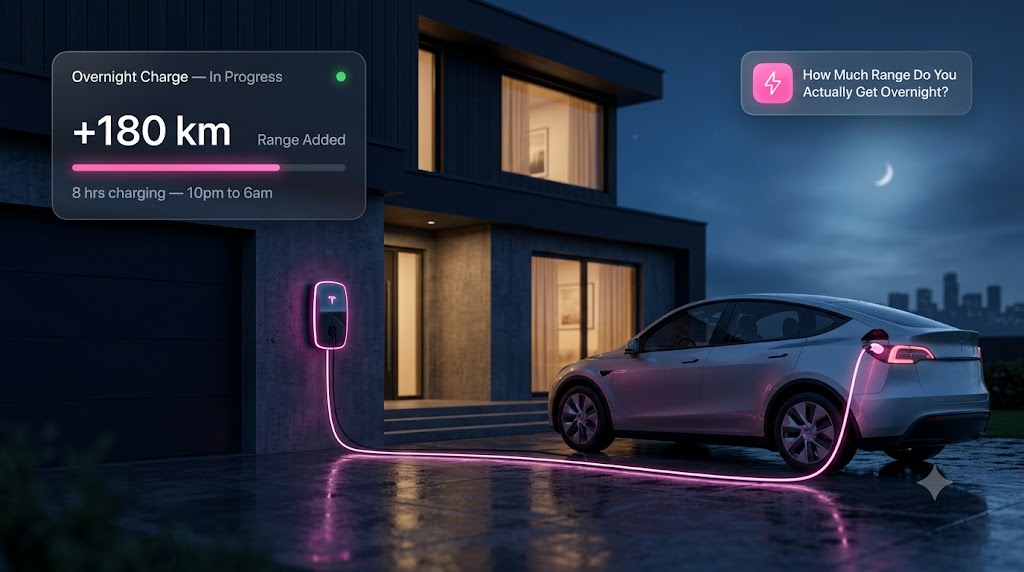
This is the number that matters more than the kW rating itself: how much driving range does the charger actually add while you sleep?
*Actual range added on 22kW depends entirely on your vehicle's onboard AC charger — most passenger EVs can't draw the full 22kW, so real-world results are often closer to the 7–11kW single-phase figures above.
For context, the average Sydney driver covers well under 100 km a day. A 7kW charger replaces that overnight, several times over, without touching three-phase infrastructure at all.
Why 7kW Suits ~90% of Sydney Homes
o

If you're weighing up residential EV charger installation, a 7kW single-phase charger is the right starting point unless one of the specific triggers below applies to you:
- You drive under 100–150 km on a typical day. A 7kW charger comfortably tops this up overnight, every night, on off-peak power.
- Your property is currently single-phase. Most established Sydney houses and units fall into this category, and 7kW needs no phase upgrade — it's usually a same-day install.
- Your car's onboard charger is rated below 11kW AC (check your vehicle's specs). If this is the case, paying for a 22kW charger delivers no extra speed at all — the car becomes the bottleneck, not the charger.
- You charge every night, or close to it. With daily top-ups, you rarely need a fast recharge — you just need enough time, and overnight almost always provides it.
For the large majority of homeowners, this is where the decision ends: a 7kW charger, professionally installed, on your existing single-phase supply.
See our residential EV charger installation service →
When 22kW (Three-Phase) Actually Makes Sense
%20Actually%20Makes%20Sense.jpg)
Stepping up to a three-phase 22kW setup is the right call in a smaller number of specific situations — and if any of these sound like you, it's worth getting a proper assessment rather than defaulting to 7kW:
- Dual-EV households. Two EVs sharing one overnight charging window puts real pressure on a single 7kW circuit. Three-phase gives you the headroom to charge both vehicles without one waiting on the other.
- Very high daily distances. Tradies, reps, and anyone regularly covering 200 km+ a day may need a faster top-up than an overnight 7kW charge can reliably deliver.
- You already have three-phase at the switchboard. If the supply is already there, stepping up to a 22kW charger costs less than starting from single-phase.
- Fleet, strata, or commercial car parks. Multiple vehicles charging on a schedule is where three-phase infrastructure earns its cost.
- You're planning ahead for a second EV or a large-battery upgrade. It's often more cost-effective to install three-phase infrastructure once rather than twice.
If you're three-phase-ready or fit one of these profiles, our 3-phase EV charger installation service covers the full scope — supply assessment, any required network application, and a fully compliant 22kW install for home, strata, or commercial sites.
For apartment buildings and strata car parks specifically, multi-vehicle three-phase setups also need to account for shared supply and billing — see our apartment & strata EV charger installation page for how we handle that.
If You're Single-Phase Now, What Does Upgrading Cost You?

Moving from single-phase to three-phase isn't just a different charger — it's a different supply, and that changes the scope of the job:
- Supply assessment and network application. Ausgrid and Endeavour Energy both require sign-off before a three-phase upgrade proceeds, which our Level 2 accredited electricians handle on your behalf.
- Switchboard capacity. Older switchboards are frequently not rated for a three-phase load — see our switchboard upgrades service for what that typically involves.
- Consumer mains and metering. A phase upgrade can also mean new consumer mains and a metering change — our power supply upgrades team scopes this as part of the same job.
None of this is required if you're staying on 7kW single-phase — which is exactly why it remains the lower-cost, lower-hassle option for most homes. If you want the full picture on a specific upgrade, our single-phase to three-phase upgrade page covers the process end to end.
Not sure which category your home falls into? Our EV charger load calculator gives you a fast, free indication based on your vehicle and daily driving before you book an assessment.
Related Services

Powering Your Needs with Expertise
If you’re looking for a reliable, experienced, and prompt electrician, look no further than High Demand Electrical. We cater to all your electrical needs, from routine maintenance to emergency repairs and complete system installations. Our skilled team is committed to providing professional service that ensures your electrical systems run smoothly. Whether it's a small task or a large project, give us a call today. Let us meet all your electrical demands with the quality and reliability you deserve.