3 Phase Power Upgrade Cost Sydney: The 2026 Homeowner’s Guide
Did you know that your Sydney home’s electrical capacity could be the only thing standing between you and a fully charged EV in under three hours? With Ausgrid and Endeavour Energy increasing network tariffs by up to 11.9% in 2026, homeowners are under pressure to ensure their property’s infrastructure is performing at its peak. If you're tired of circuit breakers tripping every time the air conditioning kicks in, you've likely started researching the 3 phase power upgrade cost Sydney specialists are quoting this year. It’s a strategic investment, especially for those installing high-capacity solar or rapid chargers who need to eliminate electrical bottlenecks for good.
We recognise that the technical requirements for Level 2 ASP work and the updated April 2026 NSW Service and Installation Rules can be confusing. This guide provides a transparent breakdown of the technical benchmarks and the long-term ROI of upgrading your connection. You’ll learn how to future-proof your home against rising energy demands and navigate the latest compliance standards for a seamless, professional installation that secures your property's value and safety.
Key Takeaways
• Understand why upgrading to 3-phase power is the essential foundation for rapid EV charging and full-home electrification in modern Sydney households.
• Discover the critical variables influencing the 3 phase power upgrade cost Sydney residents encounter, including consumer mains length and mandatory network provider fees.
• Identify the specific compliance requirements for Ausgrid and Endeavour Energy networks to ensure your infrastructure meets the April 2026 NSW Service and Installation Rules.
• Learn how a Level 2 ASP manages the transition from street to switchboard, providing a high-capacity supply that eliminates circuit breaker tripping and supports 22kW charging.
• Evaluate the long-term return on investment, including increased property value and the ability to export solar energy more efficiently to the grid.
Understanding 3 Phase Power vs. Single Phase in Sydney
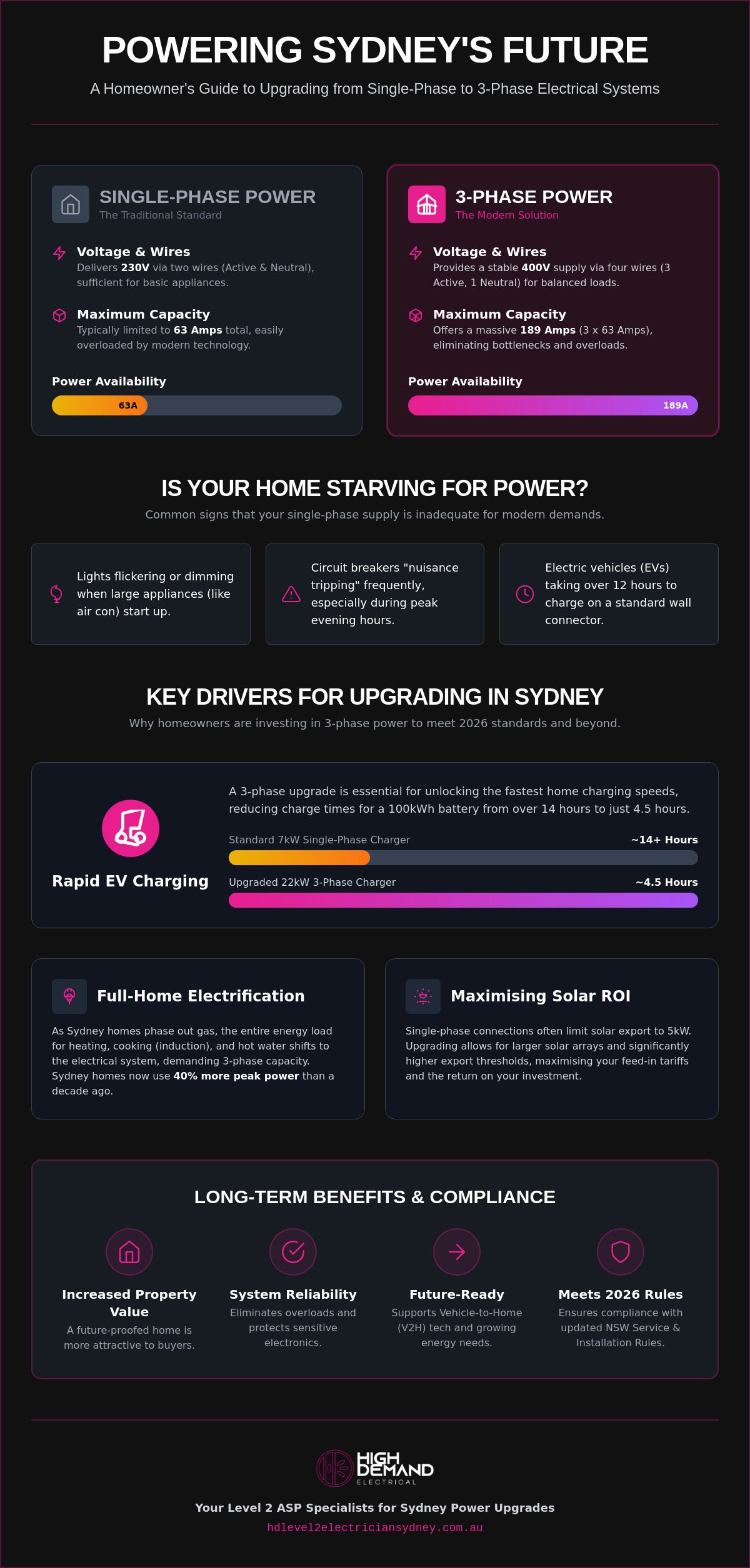
Most older residential properties in suburbs from Parramatta to the Northern Beaches operate on a single-phase supply. This traditional 230V connection uses two wires: an active and a neutral. While this was sufficient for the basic lighting and modest appliances of the late 20th century, the energy profile of a modern Sydney household has transformed. Current data indicates that the average local home now consumes approximately 40% more peak power than it did just ten years ago. This surge is driven by high-draw technology like ducted climate control systems and induction cooking that older grids weren't designed to handle.
three-phase electric power is the industrial-strength energy standard that is rapidly becoming the benchmark for modern residential infrastructure in Sydney. Instead of a single active wire, a three-phase system delivers three separate 230V lines to your switchboard. This configuration provides a consistent 400V supply, allowing for much higher total wattage without overloading the system. You can usually identify a three-phase setup by looking at your point of attachment where the street cables meet your roof; you'll see three distinct service fuses instead of one.
The Technical Difference: Amps and Kilowatts
The most significant advantage lies in the raw capacity. A standard single-phase connection is typically limited to 63 Amps. In contrast, a 3-phase upgrade provides 63 Amps across three separate paths, effectively offering a massive 189 Amps of total capacity. This extra headroom allows a Level 2 ASP to balance your home’s electrical load across three phases. It stops one heavy appliance from causing voltage drops that lead to "dirty power" or surges. When you calculate the 3 phase power upgrade cost Sydney experts provide, you're paying for this fundamental technical stability and the elimination of power quality issues.
This stability is particularly crucial for precision electronics and high-performance equipment. For those interested in the cutting edge of technological innovation, you can discover MindRove and their neural interface solutions designed for advanced research and development.
Signs Your Sydney Home is Starving for Power
Your home will often tell you when its current supply is inadequate. You might notice lights flickering or dimming momentarily when the ducted air conditioning compressor or the pool pump kicks in. Another red flag is "nuisance tripping" at the main switchboard, especially during the evening peak when the oven, dryer, and television are all running simultaneously. For owners of modern electric vehicles, the most obvious sign is frustratingly slow charging speeds. If your Tesla or BYD takes over 12 hours to reach a full charge on a standard wall connector, your single-phase supply is the bottleneck. Factoring these daily inconveniences into the 3 phase power upgrade cost Sydney homeowners evaluate helps clarify the immediate necessity of the project.
Why Sydney Homeowners are Upgrading in 2026
Sydney's residential energy landscape is undergoing a radical shift. As natural gas connections are phased out across many suburbs in favour of full-home electrification, the demand on traditional single-phase switchboards has reached a breaking point. Homeowners are no longer just powering lights and basic appliances; they are managing sophisticated energy ecosystems. This transition is a primary driver for those investigating the 3 phase power upgrade cost Sydney specialists are currently quoting. By moving away from gas heating and cooking, you're shifting that entire energy load onto your electrical system, which requires the heavy-duty capacity that only 3-phase power can provide.
High-capacity solar systems are another critical factor. If you intend to install a solar array larger than 5kW, a single-phase connection often imposes strict limits on how much energy you can export back to the grid. Upgrading to 3-phase allows for significantly higher export thresholds, which maximises your feed-in tariffs and overall system ROI. We are also seeing the rapid adoption of Vehicle-to-Home (V2H) technology. This allows your electric vehicle to act as a backup battery for your house during peak periods or blackouts. Such bi-directional energy flow demands robust infrastructure to handle the high-current transfer safely and efficiently.
EV Charging: The 11kW and 22kW Advantage
Charging a modern 100kWh battery on a standard 7kW single-phase charger is a slow process, often requiring over 14 hours for a full cycle. Upgrading to a 22kW three-phase system slashes this time to approximately 4.5 hours. This massive efficiency gain is why a Tesla charger installation Sydney project frequently acts as the catalyst for a phase upgrade. For households with two or more electric vehicles, 3-phase power is the only viable way to charge both cars simultaneously at high speeds without risking a total system shutdown.
Modern Climate Control and Induction Cooking
Sydney’s extreme summer heatwaves have made 20kW+ ducted air conditioning systems a standard requirement for many large family homes. These units, combined with high-performance 90cm induction cooktops that draw massive amounts of current instantaneously, can easily exceed the 63-Amp limit of an old single-phase supply. Investing in a 3-phase system reduces the thermal stress on your consumer mains and switchboard components. This proactive approach is a key consideration when evaluating the total 3 phase power upgrade cost Sydney property owners face, as it prevents the costly emergency repairs associated with overloaded circuits. If you're planning a major renovation, speaking with a Level 2 ASP specialist ensures your home's backbone is ready for the future.
Breaking Down the 3 Phase Power Upgrade Cost in Sydney
Calculating the 3 phase power upgrade cost Sydney homeowners should expect involves more than just a single figure. A professional quote is built on three distinct pillars: mandatory network provider fees, Level 2 ASP specialised labour, and the hardware required for a 400V environment. With the Australian Energy Regulator approving network price increases of 9.7% for Ausgrid and 11.9% for Endeavour Energy effective July 2026, the external component of your investment has shifted. These network fees cover the administration and site inspection protocols required to authorise your new connection to the Sydney grid.
The distance of your "Consumer Mains" is often the largest variable in any infrastructure project. This refers to the heavy-duty cabling running from the street connection point to your main switchboard. Whether your supply is overhead or underground, the length of this run dictates the volume of copper or aluminium required. In many cases, Sydney homeowners only discover the need for an upgrade after receiving a "Defect Notice" from their energy distributor. These notices are issued when existing service lines are deemed unsafe or overloaded. Addressing these issues through a planned upgrade is often more cost-effective than responding to an emergency disconnection.
Variable Factors: What Drives the Price Up?
Installation complexity varies significantly between Sydney regions. Underground connections in established areas like the Inner West often require trenching through sandstone or concrete, which adds substantial time to the project compared to a standard overhead service. Your existing switchboard condition also plays a vital role. If your current panel is outdated, a comprehensive switchboard upgrade is mandatory to house the new 3-phase meters and circuit breakers. Older Sydney properties frequently feature mounting panels containing asbestos. Safely removing and disposing of these materials according to NSW health regulations requires specific protocols that influence the final project scope.
Essential Materials and Hardware
A move to 3-phase power requires a complete overhaul of your entry point hardware. This includes the installation of 4-core consumer mains cable, which provides the three active phases and the neutral link. Under the April 2026 NSW Service and Installation Rules, all new 3-phase connections must also include a compliant smart meter. These devices are essential for managing modern solar exports and tracking the high-current draw of EV chargers. Finally, your Level 2 ASP will install dedicated 3-phase circuit breakers and high-capacity enclosures designed to handle the increased thermal load of a 400V supply, ensuring your home's backbone remains stable during peak demand periods.
The Level 2 ASP Process: Ausgrid and Endeavour Requirements
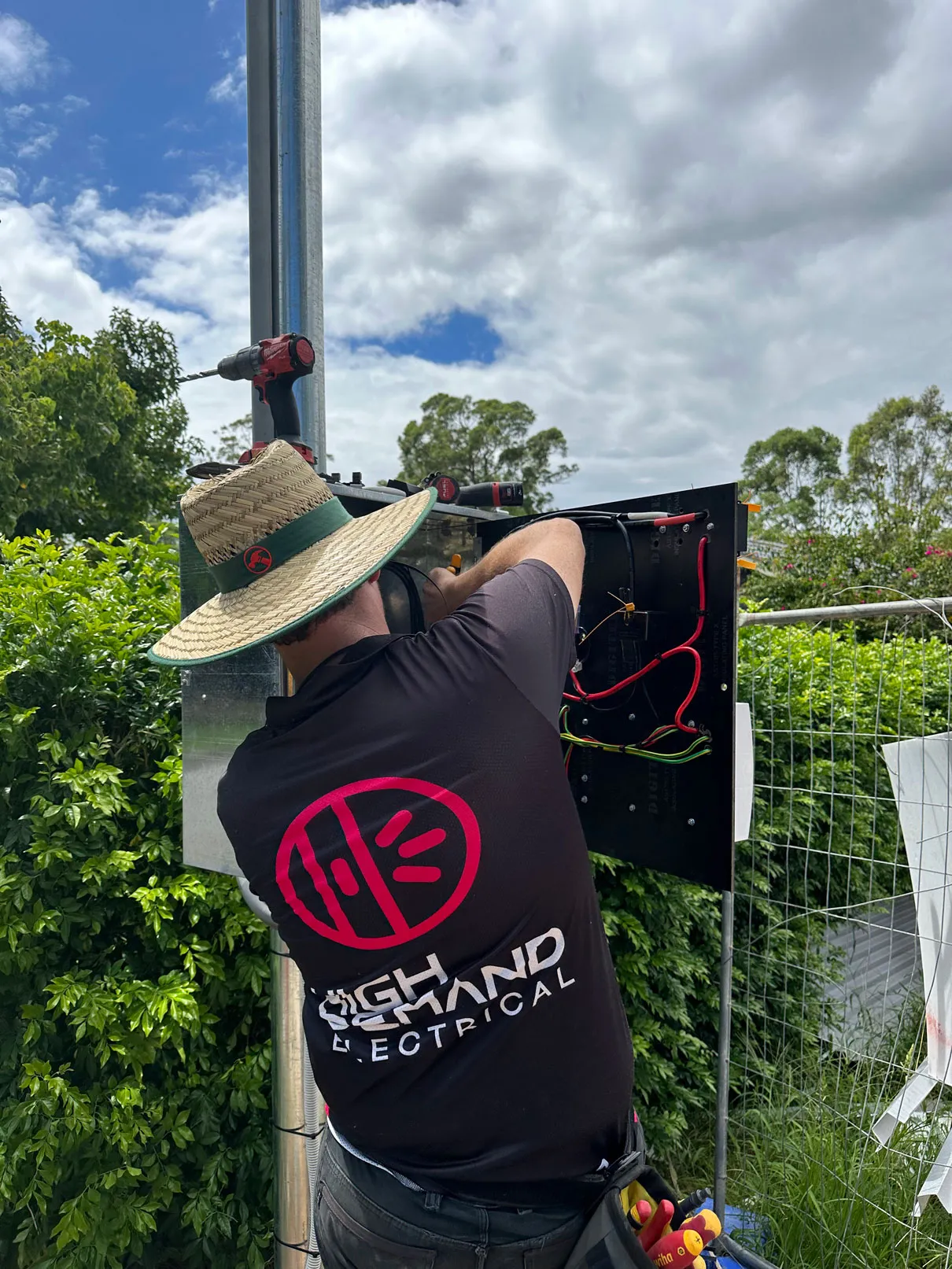
The transition to a multi-phase supply is a highly regulated procedure that demands precise coordination between the homeowner, the electrical specialist, and the network distributor. Unlike standard residential wiring, a 3-phase upgrade involves direct interaction with the Sydney power grid infrastructure. This is why only an accredited Level 2 ASP is authorised to perform the connection and disconnection at the point of attachment. The process begins with a comprehensive site assessment where we calculate your property's maximum demand. This calculation ensures the new infrastructure can handle your anticipated load, such as fast EV charging and ducted air conditioning, without compromising the local network's stability.
Once the load is verified, we submit an "Application for Connection" to either Ausgrid or Endeavour Energy. This administrative step is critical for securing the necessary approvals before any physical work commences. Following approval, the installation phase involves running new 4-core consumer mains and upgrading your switchboard with 3-phase meters and protective components. The final stage is the most critical for legality and safety. We perform rigorous testing and commissioning before submitting the Notice of Service Work (NOSW) to the distributor. This formalises the upgrade and ensures your 3 phase power upgrade cost Sydney investment is fully compliant with state regulations.
Ausgrid vs. Endeavour Energy: Knowing Your Network
Your location in Sydney determines which network rules and fee structures apply to your property. Ausgrid typically services the CBD, North Shore, and Eastern Suburbs, while Endeavour Energy manages the West, South-West, and Greater Western regions. In 2026, both providers have updated their connection protocols. A "Basic Connection" usually applies to standard residential street-to-house upgrades. However, a "Complex Connection" may be triggered if the local transformer requires augmentation to support your new load. Understanding these distinctions is vital; network-specific fees are a non-negotiable part of the 3 phase power upgrade cost Sydney residents must budget for when planning their project.
Compliance and Safety Certification
Safety is the non-negotiable core of every infrastructure project we undertake. From July 1, 2026, all Certificates of Compliance for Electrical Work (CCEW) must be submitted through the BCNSW eCert portal; paper and PDF forms are no longer accepted by the regulator. This digital trail provides a permanent record of the work's safety and strict adherence to the April 2026 NSW Service and Installation Rules. If your property is located near overhead street lines, we also manage "Tiger Tail" installations to provide essential visual warnings and insulation during the work. For a seamless transition that meets every regulatory benchmark, book a site inspection with our Level 2 ASP team.
Is a 3 Phase Upgrade Right for Your Sydney Property?
Deciding whether to commit to the 3 phase power upgrade cost Sydney specialists provide requires a balanced look at your household's future trajectory. If you're moving toward a gas-free home with a 10kW solar array and multiple electric vehicles, the return on investment is undeniable. You'll gain superior energy efficiency, significantly faster charging, and increased appliance reliability. However, an upgrade isn't always the mandatory path for every property. For smaller households with minimal peak demand, a sophisticated load management system on a single-phase supply might suffice. But for most, the risk of lost solar export revenue far outweighs the initial infrastructure investment. Single-phase systems are often capped at 5kW exports, meaning you could be wasting significant renewable energy that a 3-phase system would otherwise monetise.
The Long-Term Value Proposition
Beyond immediate utility, this upgrade acts as a significant asset for property resale. In a competitive Sydney market, "EV-ready" infrastructure is becoming a primary selling point for modern buyers, similar to high-end kitchen renovations. You'll also see reduced wear on expensive equipment like ducted AC compressors and large motors. These components run cooler and more efficiently on a balanced 400V supply, which lowers long-term maintenance costs. This provides critical peace of mind during the peak of a Sydney summer when the local grid is under maximum stress and older, single-phase systems are prone to brownouts or failure.
Next Steps: Getting an Accurate Quote
To get a precise estimate, start by preparing your most recent electricity bill. Your Level 2 electrician Sydney specialist will use this data to build a custom load profile for your home. Be aware that existing site issues, such as a leaning private power pole or a degraded point of attachment, can complicate the project scope. Always scrutinise "cheap" quotes that seem too good to be true. These often omit mandatory network inspection fees or skip the essential digital CCEW compliance steps required by the July 2026 regulations. A professional ASP provides a transparent, fixed-price breakdown that secures your home's safety and legal standing for the next decade.
Secure Your Property’s Electrical Future
Upgrading to 3-phase power is no longer a luxury reserved for industrial sites; it's the essential backbone for modern Sydney living. By 2026, the rapid shift toward full-home electrification and high-speed EV charging has made the traditional single-phase connection a significant bottleneck for growing families. We've explored how calculating the 3 phase power upgrade cost Sydney residents face involves more than just simple cabling. It requires a precise understanding of Ausgrid and Endeavour Energy protocols, mandatory digital CCEW compliance, and the strategic load balancing that only a qualified specialist can deliver.
As accredited Level 2 ASP specialists serving all Sydney metro areas, we provide the technical expertise needed to manage this complex transition safely. We offer fixed-price infrastructure quotes that eliminate the risk of hidden fees, ensuring your project remains on budget and fully compliant with the latest NSW safety standards. Your home deserves a power supply that can handle the high-stakes energy demands of tomorrow without compromise. Get a Professional 3-Phase Upgrade Quote from Sydney’s Level 2 Experts today and secure the reliability your property needs for the years ahead.
Frequently Asked Questions
How much does a 3 phase power upgrade cost in Sydney in 2026?
The total 3 phase power upgrade cost Sydney homeowners pay is determined by several site-specific variables. These include the distance of your consumer mains from the street, the age of your current switchboard, and mandatory network provider application fees. While prices vary between projects, we provide fixed-price quotes after a site inspection to ensure you have a clear understanding of the investment required for your specific property layout.
Do I need a Level 2 electrician for a 3 phase upgrade?
Yes, you must engage an accredited Level 2 ASP for any 3-phase power upgrade. Standard electricians are not authorised to work on the network side of your meter or handle the connection to the street mains. A Level 2 specialist manages the high-risk task of connecting your new 400V supply to the Ausgrid or Endeavour Energy grid while ensuring all work meets the April 2026 NSW Service and Installation Rules.
How long does the 3 phase upgrade process take from start to finish?
The physical installation typically takes one full day to complete. However, the end-to-end process usually spans several weeks because it involves administrative steps like the "Application for Connection" and network provider approvals. We manage the entire timeline from the initial load calculation to the final submission of the NOSW, ensuring your property remains powered and compliant throughout the transition.
Can I keep my existing single-phase solar inverter after an upgrade?
You can technically keep your existing single-phase solar inverter, but it will only supply power to one of your three new phases. This often leads to an imbalance where you're importing power on two phases while exporting on the third. For maximum efficiency and higher export limits, most Sydney homeowners choose to upgrade to a 3-phase solar inverter as part of their infrastructure overhaul.
Is 3 phase power necessary for a Tesla Wall Connector?
A 3-phase connection is not strictly required for a Tesla Wall Connector, but it is necessary if you want to access maximum charging speeds. On a single-phase supply, you're limited to 7kW, whereas a 3-phase upgrade allows for 22kW charging. This slashes your charging time significantly, making it the preferred choice for those with large-battery EVs or households running multiple electric vehicles.
Will upgrading to 3 phase power increase my quarterly electricity bill?
Your actual electricity usage rates don't increase just because you have more phases, but your fixed daily supply charge might change. Most retailers apply a slightly higher daily connection fee for 3-phase properties to account for the increased network capacity. However, the improved efficiency of large appliances like ducted air conditioning can often lead to lower overall consumption during peak periods.
What is the difference between Ausgrid and Endeavour Energy fees for upgrades?
Ausgrid and Endeavour Energy operate as separate entities with distinct regulatory fee structures. For the 2026-27 period, the Australian Energy Regulator approved an average network price increase of 9.7% for Ausgrid and 11.9% for Endeavour Energy. These network-specific charges are a non-negotiable component of the 3 phase power upgrade cost Sydney residents must factor into their project budget, depending on which distributor services their suburb.
Do I need to upgrade my consumer mains if I upgrade to 3 phase?
Yes, upgrading your consumer mains is a mandatory part of the 3-phase transition. Your old single-phase setup uses a 2-core cable, which is physically incapable of carrying a 3-phase supply. We replace this with a modern 4-core consumer mains cable, consisting of three active phases and a neutral, to safely deliver the 400V supply from the street to your upgraded switchboard.
Powering Your Needs with Expertise
If you’re looking for a reliable, experienced, and prompt electrician, look no further than High Demand Electrical. We cater to all your electrical needs, from routine maintenance to emergency repairs and complete system installations. Our skilled team is committed to providing professional service that ensures your electrical systems run smoothly. Whether it's a small task or a large project, give us a call today. Let us meet all your electrical demands with the quality and reliability you deserve.