Timber vs Steel Private Power Pole: The Homeowner’s Guide to Sydney Infrastructure
Choosing the lowest quote for a new power pole might actually be the most expensive mistake you make this year. When you receive an urgent defect notice from Ausgrid or Endeavour Energy, the pressure to find a quick fix is intense. However, selecting between a timber vs steel private power pole requires more than just looking at the initial price tag. In Sydney's unique environment, where termites and coastal corrosion are constant threats, the wrong material can lead to another costly replacement in just a few years.
We understand that protecting your property and ensuring the safety of your family is your primary concern. This guide provides a detailed comparison of durability, long-term costs, and the latest compliance requirements under the April 2026 Service and Installation Rules of New South Wales. You will learn how to select a pole that offers a 40 year lifespan while maintaining full adherence to AS/NZS 3000:2018 standards. We will examine the specific benefits of galvanised steel and treated hardwood to ensure your infrastructure remains defect-free for decades.
Key Takeaways
• Understand why galvanised steel is the superior choice for termite-prone Sydney suburbs, offering a significantly longer lifespan than traditional hardwood.
• Evaluate the total lifecycle costs of a timber vs steel private power pole to ensure your infrastructure investment survives 40+ years without recurring defect notices.
• Ensure full compliance with the April 2026 NSW Service and Installation Rules to protect your property from emergency disconnection by Ausgrid or Endeavour Energy.
• Identify the mandatory role of a Level 2 ASP in safely managing the disconnection and reconnection of your overhead consumer mains during a pole replacement.
Private Power Poles in Sydney: Why Material Choice Matters
A private power pole is a critical piece of electrical infrastructure that belongs entirely to you. Unlike the poles lining the street, which are managed by network providers, any pole located within your property boundary is your legal responsibility. It acts as the primary support for your overhead consumer mains, ensuring electricity travels safely from the street network to your home switchboard. When deciding between a timber vs steel private power pole, you aren't just choosing a material; you're selecting the foundation of your home's electrical safety.
While Utility Poles serve a universal purpose, Sydney's specific environmental conditions make material choice vital. You must consider factors like soil acidity, termite activity, and bushfire risk before committing to an installation. Whether you opt for the traditional resilience of treated hardwood or the modern durability of galvanised steel, the decision impacts your property's compliance for the next four decades. Choosing the wrong material for your specific site can lead to premature failure and expensive emergency repairs.
Your Legal Responsibilities as a Property Owner
The boundary between the energy provider's network and your private system is usually the point of attachment on your pole. Ausgrid and Endeavour Energy regularly inspect these assets to mitigate risks. If they identify rot, excessive leaning, or rusted footings, they will issue a formal defect notice. Ignoring this isn't an option. Failure to rectify the issue within the specified timeframe can lead to a complete disconnection of your power supply to protect the wider grid. You are responsible for all costs associated with the maintenance, repair, and eventual replacement of the pole.
The Anatomy of a Private Power Pole Installation
An installation involves more than just a post in the ground. It includes the point of attachment, the consumer mains cables, and specialised footings designed to withstand Sydney's weather extremes. Steel poles often require concrete footings for stability, whereas timber poles rely on deep earth burial. Because this work involves connecting directly to the live street network, NSW law mandates that only a Level 2 Accredited Service Provider (ASP) can perform the installation or replacement. A standard electrician lacks the certification to legally handle the connection between your private pole and the street network.
The Traditional Choice: Treated Hardwood Timber Poles
Choosing treated hardwood is often a matter of tradition and local character. For many Sydney properties, particularly in established suburbs or rural-residential zones, the natural look of timber is preferred over industrial steel. These poles are typically sourced from dense Australian hardwoods and treated to resist the harshest elements. While the upfront cost for a timber pole often starts around $1,800, many property owners view this as a necessary investment to maintain the visual character of their land. However, the timber vs steel private power pole comparison isn't just about looks. It's about how the material interacts with the ground over several decades.
Understanding your private power pole responsibilities is the first step in avoiding unexpected electrical failures. While timber has been the standard for over a century, the maintenance requirements are far more intensive than modern alternatives. You aren't just buying a pole; you're committing to a long-term inspection regime to ensure the structure remains safe and upright. If your current pole is showing signs of age or wear, you might need to book a professional inspection with an accredited specialist to determine if a replacement is required.
The Risk of Ground-Line Rot and Termites
The ground-line is the most vulnerable point for any timber asset. In Sydney, high humidity and varying soil moisture levels create the perfect environment for fungal decay. This rot often begins internally, making it difficult for an untrained eye to spot until the pole begins to lean. Termites are another significant threat. Despite chemical barriers, aggressive local species can still find their way into the core of the pole if the treatment has leached out over time. A leaning pole is a significant safety hazard that triggers immediate defect notices from network providers like Ausgrid.
Lifespan and Maintenance Requirements
A well-maintained timber pole generally lasts between 15 and 30 years, though some can reach 40 years in ideal conditions. Hardwood poles undergo a high-pressure impregnation process where Chromated Copper Arsenate (CCA) is forced into the wood fibres to provide a protective barrier against biological attack. Regular inspections are mandatory. NSW safety standards require homeowners to monitor their poles for signs of splitting, rot, or insect infestation. In heavy clay soils common across Greater Sydney, moisture retention can accelerate decay, often shortening the expected lifespan compared to poles installed in well-drained sandy areas.
The Modern Standard: Galvanised Steel Power Poles
Galvanised steel has rapidly become the preferred choice for Sydney homeowners looking to future-proof their property. While timber was once the default, the evolution of Australian Standards for power poles has highlighted the superior structural reliability of steel in high-risk environments. This material eliminates the two biggest threats to Sydney infrastructure: subterranean termites and fungal decay. By removing the organic element from your electrical setup, you effectively eliminate the risk of the ground-line rot that plagues traditional hardwood installations. Steel stays standing.
In fire-prone areas across Greater Sydney, such as the leafy corridors of the North Shore or the fringes of the Blue Mountains, steel is often the only logical material. Unlike timber, which can ignite during a bushfire and leave a property without power when it is needed most, galvanised steel remains structurally sound under extreme heat. Its slender profile also offers a significant aesthetic advantage. Modern residential designs often favour the clean, industrial lines of a steel pole over the bulky, weathered appearance of a wooden one. When weighing a timber vs steel private power pole, the long-term peace of mind provided by a non-combustible, pest-proof asset is hard to overlook.
Understanding the Galvanisation Process
The durability of these poles comes from a metallurgical bond created during the hot-dip galvanisation process. Steel is submerged in molten zinc, creating a multi-layered coating that acts as a sacrificial anode. This means the zinc will corrode before the underlying steel is ever touched by oxidation. These poles are also significantly lighter than their timber counterparts. This reduced weight allows for more precise handling during the installation phase, ensuring a Level 2 ASP can position the pole with absolute accuracy even on sites with limited access or challenging terrain.
Coastal Considerations for Steel Poles
While steel is impervious to termites, salt air in suburbs like Bondi, Manly, or Cronulla presents a different challenge. Constant exposure to sea spray can eventually lead to surface oxidation if the pole is not monitored. However, unlike the internal rot found in timber, steel corrosion is visible and manageable. Most coastal installations utilise heavy-duty galvanisation to extend the time between maintenance cycles. Identifying surface rust early allows for simple treatment with cold-galvanising sprays, preventing structural degradation. Compared to the complex task of treating internal timber decay, maintaining a steel pole in a high-salt environment is a straightforward, visual process that any homeowner can manage.
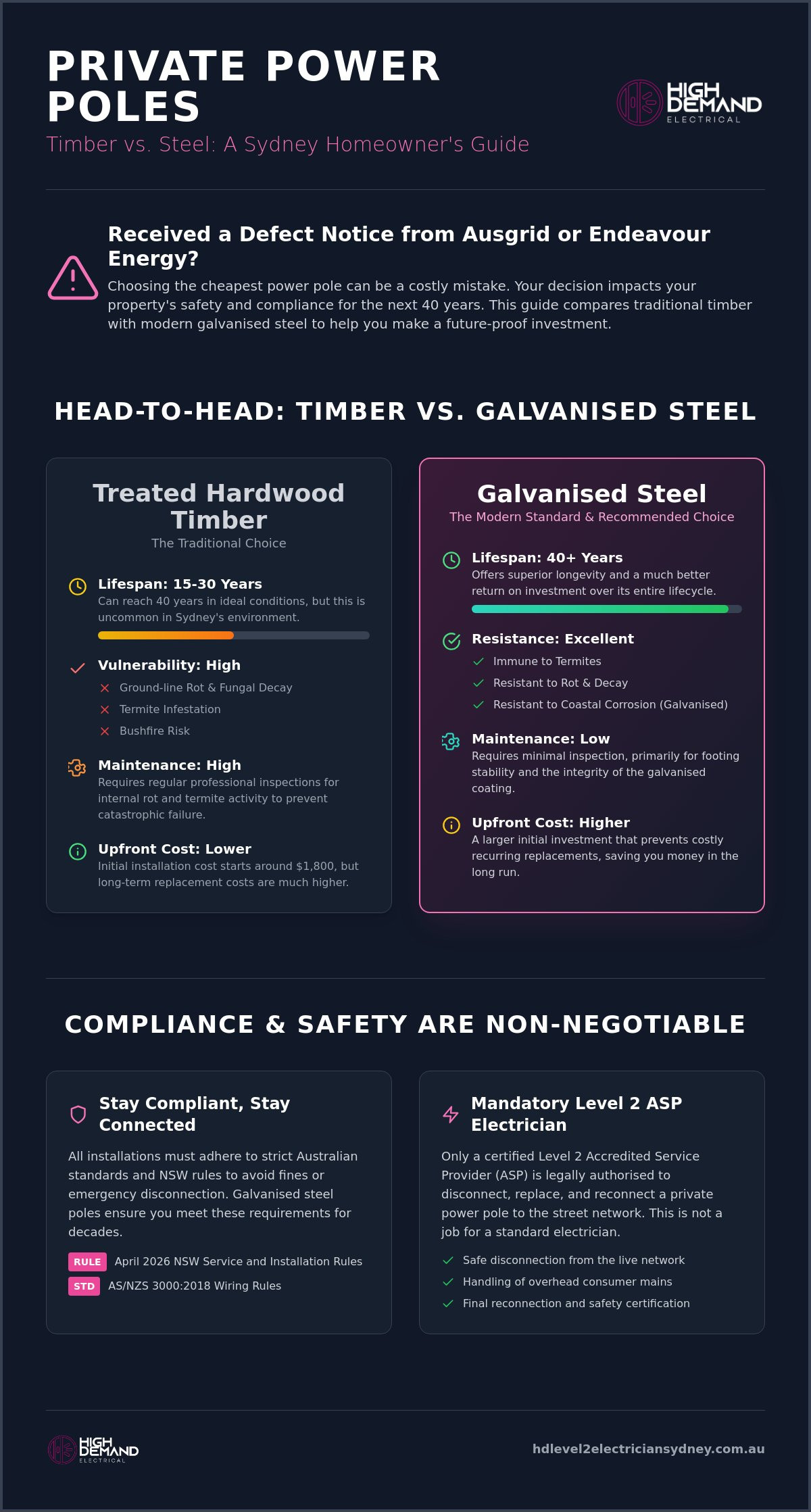
Head-to-Head Comparison: Timber vs Steel Power Poles
Deciding on the right infrastructure for your property requires a balance between immediate budget constraints and long-term asset management. While many homeowners assume timber is the more economical entry point, current market data suggests otherwise. A galvanised steel pole typically starts at approximately $1,100, whereas a treated hardwood alternative often begins closer to $1,800. When evaluating a timber vs steel private power pole, you must look beyond these purchase prices and consider the structural demands of your specific site. Steel offers a superior strength-to-weight ratio, making it the more reliable choice for supporting heavy overhead consumer mains without the risk of warping or bowing over time.
Environmental factors also play a significant role in this comparison. Hardwood is a natural, renewable resource, but the heavy chemical treatments required to prevent decay can complicate its eventual disposal. Steel is 100% recyclable and leaves a smaller footprint when it finally reaches the end of its service life. From a property value perspective, a modern steel installation is a major asset during a pre-sale building inspection. It signals to potential buyers that the electrical infrastructure is modern, low-maintenance, and unlikely to trigger a defect notice in the near future.
The Cost Equation: Initial vs. Lifecycle
The total cost of ownership over 40 years tells the real story. While timber poles have a lower initial price for some configurations, they often lead to expensive defect rectifications due to ground-line rot or termite damage. Choosing steel significantly reduces the frequency of professional inspections and emergency repairs. Your specific Level 2 ASP electrical services quote will vary based on site access and the complexity of the connection, but the long-term savings on maintenance usually make steel the more fiscally responsible choice for Sydney residents.
Safety and Compliance Comparison
Compliance with the April 2026 NSW Service and Installation Rules is non-negotiable. Steel poles provide an inherent safety advantage in bushfire-prone zones because they do not contribute fuel to a fire and maintain structural integrity under extreme heat. They are also much easier for homeowners to monitor; surface oxidation on steel is visible and treatable, whereas timber rot often hides deep within the core of the pole. Both materials must meet strict Ausgrid and Endeavour Energy technical standards, but steel is the contemporary benchmark for reliability. If you are ready to upgrade your property's safety, you should request a site-specific installation plan from a qualified Level 2 specialist.
Installation and Rectification: The Role of a Level 2 ASP
Most homeowners don't realise that a standard electrician is legally prohibited from installing or replacing a private power pole. Because this work involves direct interaction with the live street network, NSW law requires a Level 2 Accredited Service Provider (ASP). We possess the specific certifications needed to manage high-risk overhead connections that a general sparky simply cannot touch. Whether you have finalised your choice in the timber vs steel private power pole debate or need a professional recommendation based on your site's topography, the installation must be handled by a qualified specialist to ensure network integrity.
The process is a precision operation that begins with a coordinated power disconnection. Once the site is safe, we remove the old, compromised asset and prepare the footings for the new installation. After the pole is secured, we reconnect the overhead service lines and perform rigorous safety testing. High Demand Electrical specialises in private power pole replacement, ensuring that every component, from the point of attachment to the earthing system, meets the stringent April 2026 Service and Installation Rules of New South Wales.
Resolving Ausgrid and Endeavour Energy Defects
Receiving a safety hazard report from Ausgrid or Endeavour Energy is a high-stakes situation that requires immediate action. These notices often carry strict deadlines, and failing to comply can result in a total power disconnection for your property. We act as your rapid responder, assessing the defect and fast-tracking the replacement process to keep your lights on. Following the completion of any installation, we submit a mandatory Notice of Service Work (NOSW) to the network provider to formally certify that your property now adheres to all current electrical safety standards.
Beyond the Pole: Tiger Tails and Consumer Mains
A pole replacement is the ideal time to evaluate your entire overhead service. We often install Tiger Tails, which are high-visibility markers placed on powerlines to provide a visual warning for other trades or delivery drivers working near live wires. It's also the most cost-effective moment to upgrade your consumer mains. If your existing cables are undersized or showing signs of UV degradation, replacing them while the pole is being swapped prevents future electrical faults. Taking a holistic approach to your infrastructure doesn't just lower your risk of future defects; it ensures your home's electrical system is robust enough to handle modern energy demands for decades to come.
Secure Your Property's Electrical Future
Your private power infrastructure is the gateway to your home's energy supply. Selecting between a timber vs steel private power pole is a decision that dictates your maintenance schedule and safety profile for the next 40 years. While hardwood offers a traditional aesthetic, galvanised steel provides the structural resilience and fire resistance required in modern Sydney landscapes. Ensuring your property remains compliant with the latest NSW Service and Installation Rules protects you from sudden network disconnections and costly emergency rectifications.
High Demand Electrical is ready to assist with all your pole installation and defect notice needs. As accredited Level 2 ASP specialists, we provide a comprehensive Sydney-wide service and offer a fast response for Ausgrid and Endeavour Energy defect notices. Our team ensures your new asset is connected safely and certified correctly the first time. Get a professional quote for your Sydney power pole installation today and gain the peace of mind that comes with expert infrastructure management. We look forward to helping you secure your home's electrical future.
Frequently Asked Questions
How long does a timber power pole last in Sydney compared to steel?
Treated hardwood timber poles in Sydney typically have an expected lifespan of 15 to 30 years, though some may last up to 40 years with ideal soil conditions and regular maintenance. Galvanised steel poles are often rated for 10 to 20 years by manufacturers, but many industry professionals find they remain structurally sound for over 40 years. The main difference lies in the failure mode; timber rots internally at the ground-line, while steel failure is usually visible as surface oxidation that can be treated before it becomes structural.
Do I need a Level 2 electrician to replace my private power pole?
Yes, you must engage a licensed Level 2 Accredited Service Provider (ASP) for any pole replacement. A standard electrician lacks the legal authorisation to disconnect your property from the Ausgrid or Endeavour Energy network or to reconnect the overhead service once the work is complete. Attempting to use an unaccredited person is a breach of the NSW Electricity (Consumer Safety) Act 2004, which carries penalties of up to $22,000 for unlicensed electrical work.
Which power pole is better for termite-prone areas in Sydney?
Galvanised steel is the superior choice for any Sydney property with high termite activity. Because steel is an inorganic material, it is entirely immune to pest infestations that can hollow out the core of a wooden pole. While treated timber uses chemicals to repel insects, these protective barriers can leach into the soil over several decades. This leaves the timber vulnerable to aggressive local termite species, whereas a steel pole remains structurally impervious to biological attack.
What is the average cost difference between timber and steel poles?
In the current timber vs steel private power pole market, galvanised steel poles are often more affordable upfront, with material costs starting at approximately $1,100. Hardwood timber poles generally start at a higher price point of around $1,800. Total installation costs for a new private pole in Sydney typically range from $3,000 to $6,000 or more, depending on site access and the complexity of the consumer mains connection. Steel often provides better long-term value due to lower maintenance requirements.
What happens if I ignore a defect notice for my power pole?
Ignoring a defect notice will result in the mandatory disconnection of your property's power supply. Ausgrid and Endeavour Energy issue these notices when they identify safety hazards, such as a leaning pole or ground-line rot, that could cause a bushfire or network failure. If a Level 2 ASP does not rectify the issue by the deadline stated on the notice, the network provider is legally obligated to cut your power to protect the public and the grid.
Can I paint my steel power pole to match my house?
You can paint a galvanised steel pole, provided you use a specific painting system designed for treated metal. It's vital to apply a specialised primer for galvanised steel before using an exterior-grade topcoat to ensure proper adhesion. This prevents the paint from peeling and ensures you don't inadvertently trap moisture against the metal surface. Many Sydney homeowners use this method to help the slender profile of a steel pole blend into their garden or home's colour scheme.
How often should I have my private power pole inspected?
NSW safety standards generally recommend a professional inspection of your private power pole every five years. However, if your property is situated in a bushfire-prone area, your network provider may require more frequent or even annual inspections. Homeowners should also perform their own basic visual checks every six months, looking for signs of new leaning, deep cracks in timber, or significant rust at the base of a steel pole to catch issues before a defect notice is issued.
Are steel power poles safer than timber during a bushfire?
Steel power poles are significantly safer in bushfire-prone zones because they are non-combustible and do not contribute fuel to a fire. While a timber pole can ignite and collapse, potentially bringing live wires down into dry scrub, a steel pole maintains its structural integrity under extreme heat. This is a critical safety feature for properties on the urban-bushland fringe, as it reduces the risk of fallen lines starting secondary fires or blocking emergency access routes during an evacuation.
Powering Your Needs with Expertise
If you’re looking for a reliable, experienced, and prompt electrician, look no further than High Demand Electrical. We cater to all your electrical needs, from routine maintenance to emergency repairs and complete system installations. Our skilled team is committed to providing professional service that ensures your electrical systems run smoothly. Whether it's a small task or a large project, give us a call today. Let us meet all your electrical demands with the quality and reliability you deserve.